
Los Angeles has become one of the most active cities in North America for podcast production. The density of independent creators, media companies, production agencies, and corporate communications teams has pushed demand for dedicated recording spaces well beyond what most people anticipated even five years ago. That demand, however, has also brought a wave of options that vary considerably in quality, reliability, and suitability for professional work.
Renting a studio for a one-time episode is low-stakes. Renting for a recurring series, a client deliverable, or a long-form production schedule is a different situation entirely. In those cases, the studio you choose becomes part of your production infrastructure. If it underperforms — whether because of acoustic problems, unreliable equipment, or poor booking systems — it creates downstream problems for your schedule, your budget, and your output quality.
The seven points below are not about finding the cheapest option or the most visually appealing room. They are about identifying whether a given studio will actually hold up under working conditions.
1. Acoustic Treatment and Room Design
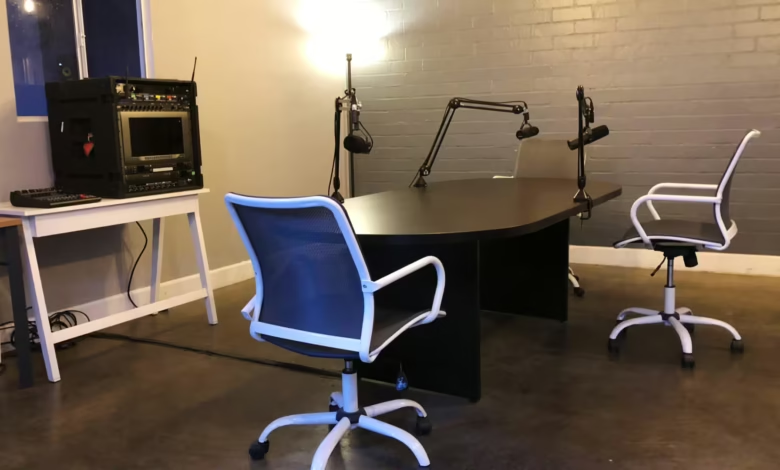
A podcast studio for rent in Los Angeles should demonstrate deliberate acoustic design, not just a room that looks like a studio. This distinction matters more than most renters initially realize. A space can have foam panels on the walls and still produce recordings full of low-frequency resonance, flutter echo, or room coloration that no amount of post-production can fully remove.
What to Listen for During a Site Visit
Before committing to a booking, ask for a short walkthrough and pay attention to how the room sounds when someone speaks at a normal volume from the recording position. Rooms with poor bass trapping often produce a boomy or muddy quality in vocal recordings. Rooms without adequate diffusion can sound unnaturally dead, which creates its own set of editing challenges. Neither extreme serves spoken-word recording well.
The goal is a controlled environment — one where the recording reflects the speaker’s voice as cleanly as possible, without the room adding unwanted character. Studios that were purpose-built for audio production typically achieve this through a combination of wall construction, ceiling treatment, and floor isolation. Studios that were converted from general office space or photography setups often do not, regardless of surface-level cosmetic treatment.
2. Equipment Quality and Maintenance Consistency
The microphones, preamps, and interface hardware available in a rental studio have a direct and measurable impact on the final recording. High-end equipment that is poorly maintained, however, can perform worse than mid-range gear that is regularly serviced and correctly calibrated. When evaluating a studio, the question is not just what equipment they have — it is how well that equipment is kept.
Signs of a Well-Maintained Technical Setup
Cables that show wear at the connectors, phantom power switches that require multiple attempts, and monitors that hum at low volume are all indicators that the technical infrastructure is not being actively managed. These are not minor inconveniences — they are the kinds of problems that surface mid-session and cause real disruption. A studio that treats its equipment as a long-term investment rather than a static inventory will typically have consistent channel levels, clean gain staging, and headphone systems that work reliably across multiple outputs.
It is reasonable to ask a studio coordinator how often their equipment is tested or replaced, and what their protocol is when something fails during a booked session. The clarity of that answer tells you a great deal about how the studio is actually operated day to day.
3. Soundproofing Against External Noise
Los Angeles presents a specific challenge that studios in quieter markets do not face at the same intensity: ambient urban noise. Street traffic, air traffic approaching LAX and Burbank, construction, and neighboring businesses are all potential intrusions into a recording environment. A studio that looks well-treated on the inside can still be compromised by a poor building envelope that allows external noise to penetrate during takes.
How to Assess Isolation Before You Book
The most reliable method is to visit the studio during the same time of day you plan to record. Sit in the recording position, ask the staff to leave the room quiet, and listen for one to two minutes. Traffic rumble, HVAC bleed from neighboring units, and low-frequency intrusions from the building structure will become apparent fairly quickly. If the studio is located on a ground floor near a street, or in a building with shared HVAC systems and thin interior walls, those conditions will not improve between your visit and your session.
Studios that have invested in mass-loaded barriers, decoupled wall construction, and floating floor systems offer substantially better isolation than those relying on surface treatment alone. The difference between a studio with genuine isolation and one without it is not subtle — it shows up clearly in every recorded take.
4. Booking Reliability and Session Flexibility
Production schedules are rarely perfectly predictable. Guests run late, technical checks take longer than expected, and conversations that were supposed to run forty minutes sometimes run ninety. A studio’s booking and session management policies directly affect how much pressure you operate under during a recording day.
Understanding What Happens When Sessions Run Over
Some studios maintain tight back-to-back booking schedules that leave no margin for overrun. Others build buffer time between sessions and offer reasonable extension options when a booking needs more time than originally reserved. Before committing, ask specifically what happens if your session runs over by fifteen or thirty minutes — whether there is a hard stop, an overage rate, or a more flexible arrangement depending on what follows your slot.
Also ask about cancellation and rescheduling policies. A studio that offers no rescheduling flexibility or charges full fees for last-minute cancellations caused by circumstances outside your control creates financial exposure that compounds over a multi-episode commitment. According to the U.S. Bureau of Labor Statistics, freelance and independent media production continues to grow as a category of work, which means more individual producers are navigating these arrangements without institutional support behind them. Flexible booking terms matter more in that context, not less.
5. Technical Support Available During Sessions
Not every person renting a podcast studio has a dedicated audio engineer on their team. Even experienced producers encounter unfamiliar equipment configurations, signal routing issues, or software compatibility problems that require someone with facility-level knowledge to resolve quickly. The availability of on-site or on-call technical support during booked sessions is a practical consideration that is often underweighted in the evaluation process.
The Difference Between Self-Operated and Staffed Studios
Self-operated studios — where you are handed a key code and expected to manage everything independently — can work well if you have a high degree of technical familiarity with the specific setup. For everyone else, they introduce real risk. A signal that isn’t routing correctly to the recording software, a headphone mix that isn’t balanced for a remote guest, or an interface that requires driver configuration can all become significant time sinks without someone qualified to troubleshoot on site.
Staffed studios, or those with a coordinator available during business hours to assist, absorb that risk. When evaluating options, ask directly whether a staff member will be present during your session, or at least reachable by phone with authority to solve equipment-level problems.
6. Guest and Remote Recording Infrastructure
Many podcast formats involve guests who are not in the same room as the host. The infrastructure a studio provides for remote guest recording — whether through dedicated platforms, video interface setups, or isolated recording tracks — varies considerably and affects both the experience of remote participants and the quality of what you capture.
Evaluating the Remote Guest Experience
A studio that supports high-quality remote recording will typically have a stable, dedicated internet connection separate from any general building network, a clear process for getting remote guests into a recording session before the host is ready to begin, and the ability to record each participant on an isolated track rather than a mixed output. Mixed outputs significantly limit what you can do in post-production if one participant’s audio needs correction.
Ask studios how they handle remote guests specifically — not in general terms, but step by step. The specificity of their answer reflects how often they actually handle this scenario and how well the workflow has been refined through real use.
7. Location and Practical Access Conditions
In Los Angeles, travel time is a production variable. A studio that is technically well-equipped but located in an area with unpredictable parking, limited street access, or significant commute complexity creates logistical friction that accumulates across a production schedule. This matters most when you are managing guests who are unfamiliar with the area, or when you are running multiple sessions in a single day.
What to Evaluate Beyond the Address
Dedicated off-street parking or validated parking arrangements, proximity to public transit for guests who prefer it, and clear load-in access for equipment are all worth confirming before you finalize a booking. Some studios also offer private waiting areas or green room spaces for guests who arrive before the prior session has wrapped, which reduces awkward overlap between bookings and creates a more professional environment for everyone involved.
The neighborhood itself also matters from a sound perspective. A podcast studio for rent in a dense commercial or mixed-use area requires stronger isolation than one in a quieter district, because the acoustic pressure on the building envelope is simply higher. Location and soundproofing are related considerations, and it is worth thinking about them together.
Closing Thoughts
Selecting a podcast studio for rent in Los Angeles is not a decision that should rest primarily on price or aesthetic appeal. The factors that determine whether a studio will actually support professional-quality work are largely operational: how the room was built, how the equipment is maintained, how bookings are managed, and how the facility handles the situations that deviate from a perfectly smooth session.
Producers who work in podcast studios regularly develop a clear sense of which facilities are run with discipline and which ones are managed more casually. The difference shows up in recordings, in schedules, and in the cumulative experience of working in a given space over time. Taking the time to evaluate these seven areas before signing any agreement is the most practical way to avoid discovering those differences after the fact.
A recording environment is not just a room — it is part of your production process. It should be selected with the same care you bring to any other part of that process.