How to Size and Spec a Temperature Controlled Enclosure for Harsh US Industrial Environments

Industrial environments in the United States vary enormously, from desert heat in the Southwest to freezing warehouse floors in the Upper Midwest, from coastal humidity along the Gulf Coast to the dry, particulate-heavy air of mining operations in Nevada and Wyoming. For the electrical and electronic systems that support production in these environments, ambient conditions are not background noise — they are an active threat to uptime, component life, and operational consistency.
When control systems, sensors, drives, or programmable logic controllers are exposed to temperature extremes outside their rated operating range, the consequences are rarely sudden and dramatic. More often, they are gradual: increased fault rates, shortened component life, calibration drift, and eventually, unplanned downtime that costs far more than the enclosure specification that might have prevented it. Getting the sizing and specification of thermal management right from the start is one of the more consequential decisions in any industrial installation.
What a Temperature Controlled Enclosure Actually Does in a Production Context
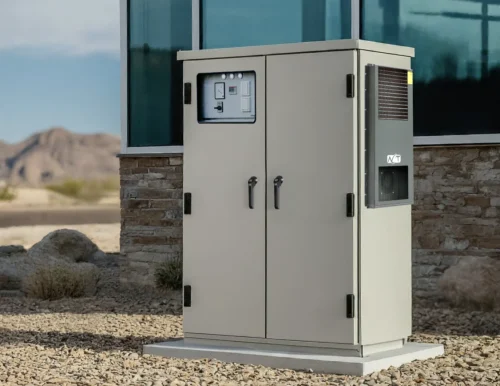
A temperature controlled enclosure is a sealed or semi-sealed housing designed to maintain the internal environment within a defined thermal range, regardless of what is happening outside. Unlike a standard electrical cabinet, which provides physical protection and basic IP-rated sealing, a thermally managed enclosure actively regulates the air inside it — either by introducing cooled air, circulating conditioned air, or adding controlled heat to prevent cold-related failures.
The core function is not to match outdoor temperature or to provide comfort in any conventional sense. It is to give sensitive electronics a stable, predictable operating environment, and to do so reliably across years of operation without regular human intervention. In production settings where a failed drive or controller can halt an entire line, that stability has a direct monetary value.
The Difference Between Passive and Active Thermal Management
Passive approaches — foam insulation, thermal breaks, shielding from direct sun — can moderate temperature swings in mild environments, but they do not control temperature. They only slow the rate at which an enclosure’s interior tracks outdoor conditions. In environments where temperature extremes are sustained rather than brief, passive approaches are typically insufficient on their own.
Active thermal management uses a device — an air conditioner, heat exchanger, thermoelectric cooler, or heater — to add or remove heat energy from the enclosure interior. This creates a controlled internal environment that can hold within a narrower range even when external conditions are at their worst. The decision to use active control is not always driven by average conditions; it is usually driven by extremes, particularly the worst-case summer high or the lowest overnight winter temperature the equipment may face.
Defining the Real Thermal Load Before Selecting Hardware
The most common mistake in enclosure specification is selecting cooling or heating capacity based on ambient temperature alone. Ambient temperature matters, but it is only part of the equation. The heat generated by the equipment inside the enclosure — drives, power supplies, transformers, processors — adds directly to the thermal load the cooling system must handle. Ignore internal heat generation, and the selected unit will be undersized before it ever runs.
Internal heat dissipation figures are typically available from component manufacturers and should be collected and summed before any thermal device is selected. The total internal load, combined with the worst-case differential between the internal target temperature and the maximum expected external temperature, defines the actual thermal burden the system must manage.
Accounting for Duty Cycle and Load Variation
Industrial equipment does not always run at maximum output. Variable frequency drives, for example, may generate significantly less heat at partial load than at full capacity. If thermal management is sized only for peak conditions without considering typical operating duty cycles, the system may be overspecified, adding unnecessary cost. However, the more dangerous error is sizing for average load and discovering that peak conditions — sustained production runs in high-ambient summer conditions — push the system past its limits.
A conservative approach is to size for the worst realistic sustained condition, not the theoretical maximum, and not the average. That means identifying the hottest expected ambient for the installation region, the highest expected internal dissipation under sustained load, and building in enough margin that the thermal system does not operate at its limits continuously. Continuous operation near maximum capacity shortens the life of the thermal device itself.
Solar Gain and Installation Orientation
Enclosures installed outdoors or in spaces with direct sun exposure face an additional heat load that has nothing to do with the equipment inside. A metal enclosure in direct afternoon sun can absorb significant radiant heat, adding to the burden on any cooling device. This effect is often underestimated, particularly in Southern and Southwestern US regions where solar intensity is high and summer conditions are sustained for months.
Where possible, enclosures in high-solar environments benefit from shading structures, light-colored or reflective finishes, or orientation that minimizes direct sun exposure during peak afternoon hours. These measures reduce thermal load before it reaches the cooling system, and they extend the operating life of the thermal management hardware.
Matching Enclosure Type to the Specific Environmental Hazard
US industrial environments present a range of hazards beyond temperature, and the enclosure must address all of them simultaneously. Dust, moisture, corrosive vapors, and washdown conditions each require specific enclosure construction and sealing ratings. Thermal management adds another layer of requirement, because the devices used to cool or heat an enclosure must also maintain the enclosure’s protection rating.
The NEMA enclosure rating system provides a standardized way to understand what a given enclosure construction protects against. A NEMA 12 enclosure, for example, is suitable for dust and dripping water in indoor industrial settings, while a NEMA 4X adds corrosion resistance and is appropriate for washdown or coastal environments. Any cooling or heating device integrated into the enclosure must preserve the original protection rating — a poorly sealed air conditioner penetration can undermine the entire enclosure’s protection level.
Choosing Between Enclosure Air Conditioners, Heat Exchangers, and Thermoelectric Devices
Each category of thermal management device has a different working principle, capacity range, and suitability profile. Enclosure air conditioners work similarly to residential units — they use refrigerant cycles to move heat from inside to outside — and they are capable of managing large temperature differentials and high internal loads. They are well suited to environments where the external temperature may exceed the internal target by a wide margin.
Heat exchangers, by contrast, transfer heat between internal and external air without mixing the two airstreams, which makes them appropriate for environments with dust, oil mist, or other contaminants. They do not add cooling below ambient, so they are only effective when the external temperature is lower than the internal target. In hot climates or during summer months, they may be insufficient as the sole thermal management method.
Thermoelectric or Peltier coolers are compact, have no moving parts, and can cool below ambient, making them suitable for smaller enclosures or remote locations where maintenance access is limited. Their capacity is more modest, so they are best reserved for enclosures with lower heat loads and less severe ambient conditions.
Cold Climate Considerations and the Case for Heating
Cold-weather operation is a frequently overlooked part of enclosure thermal management in US installations. Electronic components, particularly certain capacitor types, can fail or behave unpredictably when operated at temperatures below their rated minimums. Liquid-cooled systems, instrumentation with fluid elements, and LCD displays are also vulnerable to cold.
In northern states, elevated industrial facilities, or refrigerated warehouse environments, an enclosure that protects only against heat will still expose equipment to damaging cold during winter shutdowns or overnight periods. The appropriate solution is either a dedicated enclosure heater controlled by a thermostat, or a combined thermal management unit capable of both heating and cooling. The thermostat setpoint should be selected to maintain internal temperature above the lowest rated operating point of the most cold-sensitive component in the enclosure.
Condensation as a Year-Round Risk
Condensation forms when warm, humid air contacts a cooler surface. In industrial enclosures, this can occur during temperature transitions — when production starts in the morning after a cool night, or when an enclosure is cooled below the dew point of the internal air. Condensation on circuit boards, connectors, and terminals leads to corrosion and electrical leakage faults that are often difficult to trace.
Enclosures in humid climates or with significant temperature cycling benefit from sealed construction that limits air exchange with the outside environment, combined with thermostatically controlled heaters that keep internal temperatures above the dew point during idle periods. This is a simple, low-cost addition that eliminates a significant failure mode.
Maintenance Access and Long-Term Reliability Planning
A thermal management system is only as reliable as its maintenance program. Air conditioners have filters that accumulate dust, reducing airflow and cooling capacity over time. Heat exchangers have surfaces that can become coated with oil or particulate. Heaters have elements that eventually reach the end of their service life. None of these failures are sudden, but all of them can lead to thermal management loss that damages the equipment inside the enclosure.
At the specification stage, it is worth considering how maintenance will actually be performed: how accessible the unit is, whether filters can be changed without opening the enclosure, and how failure of the thermal device will be detected. Installations that include temperature monitoring with remote alerting are more likely to catch thermal management failures before they cause component damage.
- Specify thermal management units with replaceable, accessible filters where dust levels are a concern.
- Include a temperature sensor inside the enclosure connected to an alarm or SCADA system where possible.
- Establish a scheduled maintenance interval for filter inspection and cleaning appropriate to the specific environment.
- Select thermal devices rated for continuous duty rather than intermittent or residential use, as industrial environments demand longer run cycles.
- Document the thermal design assumptions — internal load, target temperature, ambient extremes — so future modifications can be evaluated against the original specification.
Closing Thoughts
Specifying a temperature controlled enclosure for a US industrial environment is an exercise in understanding the specific conditions of the installation site, the thermal demands of the equipment inside, and the realistic operational extremes the system will face over its service life. Generic selections based on catalog ratings or rule-of-thumb estimates frequently result in undersized systems that struggle in summer peaks, or oversized systems that cycle too frequently and wear prematurely.
The investment in a properly specified thermal management solution is recovered quickly through improved equipment reliability, reduced fault rates, and longer service intervals. More importantly, it reduces the unpredictable downtime events that carry costs well beyond the price of the enclosure itself. In industrial operations where consistency and uptime are operational requirements rather than aspirations, thermal management is not an accessory — it is a fundamental part of the system design.