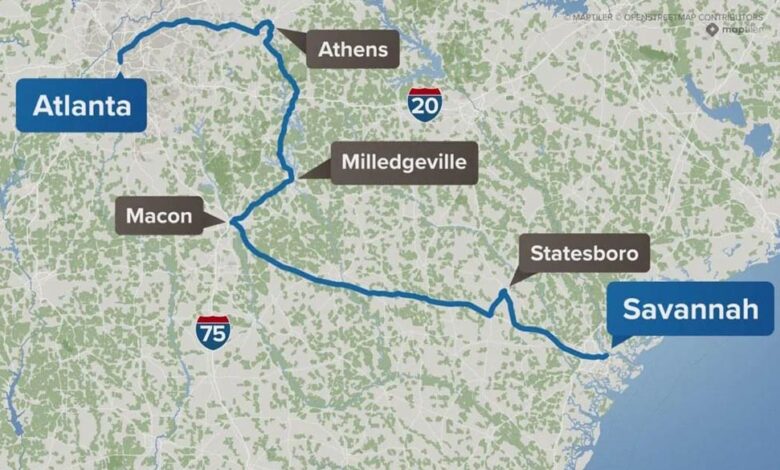

Trading Savannah’s quiet, moss-draped streets for Atlanta’s fast-paced energy demands a fresh approach to homebuying. In a region this spread out, your workplace dictates where you look. A buyer working in Midtown will find different homes and price points than someone working near Hartsfield-Jackson Airport, even on the same budget.
The move also requires you to adjust your financial expectations. Atlanta recorded a median sale price of $425,000 in September 2026, compared to $329,450 in Savannah in March 2026. That puts Atlanta’s reported median at $95,550 above Savannah’s, although the figures come from different months.
Still, broad averages cannot tell you which home is right for you. Finding the right fit comes down to comparing similar properties and testing actual weekday commutes.
How Much More Does a Home Cost in Atlanta?
Start with a home in Savannah that suits the household. Note the property type, bedroom count, approximate size, condition, and the features the household uses. Then compare Atlanta listings with similar features.
The results may call for a new budget or different expectations. But a citywide price gap does not prove a buyer must accept an older house, less space or a longer drive.
Upfront cash requirements are another consideration. With a hypothetical 10% down payment, a $425,000 purchase calls for $42,500 up front, before closing costs. The same 10% on $329,450 is $32,945. That $9,555 difference helps with planning, but neither figure is a required down payment, and the two medians do not represent comparable homes.
Monthly costs need their own review. A townhouse with an HOA fee and a detached house without one can produce very different bills. Insurance, taxes, and future repairs also matter.
Once you set your budget and basic property requirements, it becomes easier to judge homes for sale in Atlanta. Price alone should not decide the shortlist.
Why Your Atlanta Commute Matters More Than Distance
The Census Bureau puts the average one-way commute time at 20.7 minutes for Savannah workers and 26.5 minutes for Atlanta workers in its 2020–2024 estimates.
Those city averages cannot predict the trip from one house to one office. Atlanta drivers may cross major interchanges, use local streets, or travel away from downtown. A short distance is not always a short drive.
For a practical test, pick the actual workplace and drive down the route during the hours the household expects to travel. Check both directions. A morning trip that works well may take longer on the return after school pickup or an evening appointment.
Even a modest difference deserves attention. If one home adds 15 minutes each way, five workdays mean two and a half additional hours in the car. Actual trips will vary.
A household with two commuters faces another wrinkle. One address may shorten one person’s trip and lengthen the other’s. Comparing both routes before touring saves time later.
Can MARTA Make Your Atlanta Commute Easier?
Rail access can offer options a driving-only search might miss.
According to MARTA, weekday train services generally run from 4:45 a.m. to 1 a.m. That schedule can help if you work near a station, but the full trip matters more than train hours alone.
Take a Midtown job as an example. A buyer might compare a listing within walking distance of the workplace with another near a rail station. Check the walk to the station, transfers, and the final walk to work.
Late shifts may need an extra check because some rail lines operate on shorter routes after 9 p.m. Station parking and service changes can also affect the trip.
Houzeo’s map search can help you find listings near your workplace or a convenient station. Then use MARTA’s trip planner to check the journey itself. A home near a railway line can be a smart option. However, it shouldn’t make the shortlist until you’ve checked the full trip.
How Competitive Is Atlanta’s Housing Market?
The two markets also report different selling times. In October 2026, Atlanta homes stayed on the market for 75 days, while in March 2026, Savannah homes stayed for 99 days.
Those figures come from different months. They cannot prove that an equivalent Atlanta home will sell faster than one in Savannah.
Averages also hide individual listings. One property may draw offers soon after it appears on the market. Another may sit for weeks because of its condition, pricing, or location. Ask how long the listing has been active and whether earlier offers or contracts fell through.
That is why buyers should finish their financing work before they find a promising house. An updated preapproval, a realistic monthly limit, and a clear picture of the desired property type make it easier to respond without guessing.
Recent sales of similar nearby homes matter more to an offer than a citywide average. So do inspection findings and the seller’s terms. A listing’s age cannot guarantee a discount.
What Will Moving From Savannah to Atlanta Actually Cost?
Savannah-to-Atlanta buyers may need cash for more than just a down payment.
A home purchase can overlap with the final month of rent or another mortgage payment. Buyers may also pay for a moving truck, storage, utility deposits, and travel between the two cities. A new job’s start date can leave little room for a delayed closing.
The Consumer Financial Protection Bureau says closing costs commonly range from 2% to 5% of the purchase price, separate from the down payment. On a hypothetical $425,000 purchase, that is about $8,500 to $21,250. Actual fees depend on the loan and the transaction.
Before choosing a purchase date, compare available cash with the down payment, estimated closing fees, moving costs, and the savings that should stay untouched. The comparison can show whether renting briefly or delaying the purchase would make the move easier.
How to Choose the Right Atlanta Home
You can’t compare Savannah and Atlanta with a single median price or average commute. The figures give buyers a starting point. Similar listings and real weekday routes give a closer test.
The strongest Atlanta shortlist will match the buyer’s spending limit, work locations and timing. Rail access may change the options for some buyers. For others, moving costs rather than purchase price may set the immediate limit.
A good Atlanta purchase is a home that still works once the new routine begins.