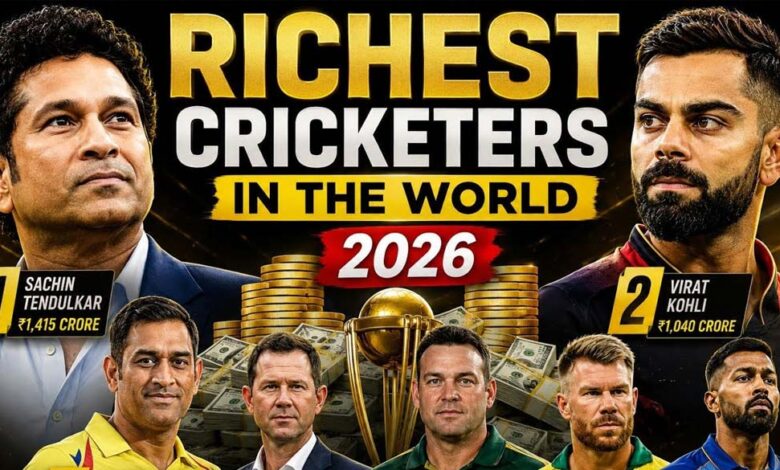

Sachin Tendulkar is widely placed first among the richest cricketers in the world, with a 2026 estimate of $170 million. MS Dhoni and Virat Kohli follow in this particular ranking, reflecting how extraordinary playing careers, endorsements, investments and continuing public appeal can build long-term wealth. These figures should be read as estimates rather than verified personal financial disclosures.
Top 10 richest cricketers by estimated wealth
The following list uses estimated 2026 net-worth figures published for leading cricket personalities. Rankings can vary between publications because personal assets, business holdings, taxes, liabilities and private agreements are not always publicly known. Currency conversions also change over time, so rupee equivalents should be treated as broad comparisons rather than fixed amounts.
| Rank | Cricketer | Country | Estimated net worth |
| 1 | Sachin Tendulkar | India | $170 million |
| 2 | MS Dhoni | India | $125 million |
| 3 | Virat Kohli | India | $120 million |
| 4 | Ricky Ponting | Australia | $75 million |
| 5 | Brian Lara | West Indies | $60 million |
| 6 | Jacques Kallis | South Africa | $48 million |
| 7 | Shane Warne | Australia | $45 million |
| 8 | Virender Sehwag | India | $42 million |
| 9 | Yuvraj Singh | India | $38 million |
| 10 | Rohit Sharma | India | $35 million |
The list illustrates an important feature of cricket’s modern economy: financial success is not determined by match fees alone. International cricket remains a foundation, but franchise leagues, commercial partnerships and post-retirement roles have expanded the ways elite players can earn. Some players have remained commercially prominent long after leaving international cricket.
Why Sachin Tendulkar leads the ranking
Tendulkar’s estimated $170 million fortune places him at the top of this 2026 list. His standing rests on much more than a long playing career. Even after retiring from all forms of cricket in November 2013, after his 200th Test, he remained one of Indian sport’s most recognisable figures.
A lengthy association with brands, business investments and enduring public interest have helped sustain his commercial value. The scale of Tendulkar’s popularity is significant because it spans generations of fans. For companies and cricket organisations, that kind of recognition can retain value well beyond a player’s final match.
His position also demonstrates why net-worth tables tend to favour cricketers with both sustained sporting achievement and a successful second phase away from the field. Retirement does not necessarily end the earning power of a leading player; it can shift it towards ambassadorial, investment and media-related opportunities.
India’s strong presence among cricket’s wealthiest names
Five of the 10 cricketers in this ranking are from India: Tendulkar, Dhoni, Kohli, Sehwag and Yuvraj Singh. Rohit Sharma also appears in the top 10, reflecting the commercial scale available to prominent Indian players through international cricket, domestic franchise competitions and sponsorships.
Dhoni, ranked second at an estimated $125 million, has expanded his profile through sports ventures, endorsements, agriculture projects and other business investments. His international retirement in 2020 did not remove his importance from Indian cricket culture, while his established public image has continued to support his commercial profile.
Kohli, ranked third with an estimated $120 million, represents a newer model of cricketing celebrity. Alongside cricket contracts, his earnings have been associated with brand partnerships, fitness ventures, fashion businesses and social-media influence. His personal brand has given him visibility across sport, lifestyle and consumer markets.
For supporters who follow the game closely, player form, conditions and team combinations often provide a more meaningful lens than celebrity value. A well-rounded Cricket Match Prediction discussion, for example, is better based on current cricket factors than on a player’s off-field wealth.
The value of a long career after retirement
Ricky Ponting, Brian Lara, Jacques Kallis and Shane Warne show how former international stars can remain financially influential years after their playing days. Their listed estimates range from $75 million for Ponting to $45 million for Warne, whose financial legacy was shaped by cricket, commentary, mentoring and ambassadorial work.
Ponting’s continuing involvement in coaching, broadcasting and franchise cricket has helped keep him connected to the sport. Lara’s commercial appeal has been supported by media appearances, endorsements and cricket-related roles. Kallis developed a post-retirement career through coaching and consultancy work, reflecting the value teams place on high-level experience.
Warne’s place on the list is a reminder that a cricketer’s financial legacy can outlast active competition. His career as a commentator, mentor and cricket ambassador added to the value created during his playing years. Each example underlines how technical knowledge and public recognition can translate into opportunities beyond the boundary.
How players build wealth beyond match payments
Cricket contracts and tournament payments form only one portion of a leading player’s income. The best-known names may also receive payments for advertising campaigns, appearances, broadcasting, coaching, content partnerships and personal-brand ventures. Investment activity, including business and real-estate interests, can further influence a net-worth estimate.
Franchise leagues have also changed the financial landscape. They create opportunities for players to earn outside traditional international schedules and can increase a cricketer’s visibility in new markets. For retired players, coaching, analysis and commentary positions offer another route to remain professionally involved in the game.
Virender Sehwag and Yuvraj Singh offer two distinct examples from India. Sehwag has remained visible through commentary, digital content, business ventures and endorsements. Yuvraj has moved into entrepreneurship and investment alongside commercial work. Their estimated fortunes reflect the fact that a player’s financial journey can develop in many directions.
Why net-worth rankings need caution
It is tempting to treat a net-worth list as a precise scoreboard, but it is not one. Unlike runs, wickets or centuries, personal wealth is rarely available as a complete public record. Estimates can include assumptions about company stakes, property values, sponsorship arrangements and investments that are not independently disclosed in detail.
This is why lists may differ on both order and amount. One report may put a higher value on a player’s brand partnerships, while another may take a more conservative view of business assets. Changes in exchange rates can also alter dollar and rupee conversions without any real change in the underlying assets.
The fairest way to read these rankings is as an overview of cricket’s biggest commercial success stories. They show the reach of the players involved and the range of opportunities that elite cricket has created, but they cannot provide an exact audit of anyone’s finances.
What the ranking says about cricket’s economy
The top 10 includes players from India, Australia, the West Indies and South Africa, highlighting cricket’s broad international commercial base. Yet India’s representation is especially notable, reflecting the country’s large cricket audience and the commercial opportunities available to its most popular players.
The ranking also includes different generations. Tendulkar, Lara, Ponting, Kallis and Warne built global reputations through long international careers, while Kohli and Rohit Sharma represent the commercial potential of the contemporary game. Dhoni, Sehwag and Yuvraj sit between those eras while maintaining substantial public profiles.
Ultimately, Tendulkar’s estimated first-place position is less a simple story about money than about longevity. The top names combined elite performance with a lasting connection to supporters, businesses and the wider sport. That combination remains the common thread behind cricket’s most significant wealth estimates.