Why Careful Writers Get Flagged by AI Checkers, and What Actually Helps

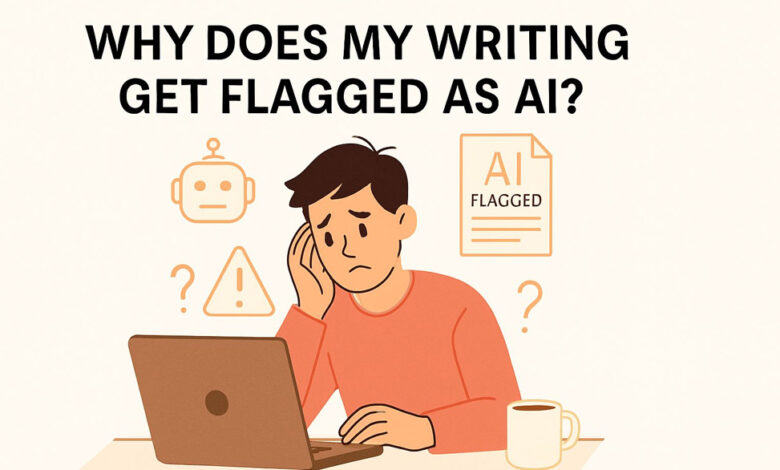
The writers most likely to be flagged by an automated AI checker are often the ones who worked hardest on their drafts. They cut filler, fixed every comma, ran the piece through a grammar tool, and ended up with prose so tidy that a statistical model reads it as machine output.
That is not a story about dishonesty. It is a story about what these checkers actually measure, and about why polish and predictability look identical to a system that never reads for meaning.
What a Checker Is Really Looking At
An AI checker does not understand an argument. It scores how predictable each word choice is given the words before it, and how evenly sentence length and structure are distributed across a passage. Text that is smooth, consistent, and free of rough edges scores as more machine-like, because language models also tend to produce smooth, consistent, rough-edge-free text.
Careful human writers produce the same signature for different reasons. Years of editing training teach them to remove the awkward phrase, the abrupt fragment, and the unexpected word. Those are precisely the features a checker treats as evidence of a person.
Who Gets Caught Most Often
The pattern shows up across very different kinds of writers, and none of them have anything to hide:
- Professionals writing in a second language, whose sentence structures are often more regular because they learned the language through rules rather than absorption.
- Writers who rely on grammar and style software, which smooths out the natural variation in rhythm that checkers read as human.
- Technical and legal writers, whose fields reward standardized terminology and predictable phrasing.
- Editors who revise the same paragraph several times, each round removing a little more irregularity.
The Number Worth Knowing
A 2023 study by Liang and colleagues, published in the journal Patterns, found that AI writing checkers misclassified non-native English writing as AI-generated at rates as high as 61 percent, even though every sentence had been written by a person. Separately, Weber-Wulff and colleagues tested 14 AI detection tools and found that none exceeded 80 percent accuracy.
Neither finding says checkers are useless. Both say a flag is a statistical hint, not a verdict, and that the people most exposed to a wrong hint are careful writers rather than careless ones.
Why Rewriting by Hand Often Makes It Worse
The instinctive fix is to reread the piece and roughen it up by hand, adding a fragment here and a contraction there. In practice that tends to produce text that sounds forced, because the writer is now imitating variation instead of generating it. Readers notice the effort, and the new patterns can be just as regular as the old ones.
Real variation comes from how a person thinks while writing: a long sentence that wanders into a qualification, then a short one that lands the point. It is hard to reproduce on demand, which is why a structured second round tends to work better than ad hoc tinkering.
A Practical Way to Restore Natural Rhythm
A purpose-built tool to humanize AI text is designed for exactly this situation. It reworks sentence length, word choice, and structure across a passage so the result reads the way a person would have written it on a good day, while the meaning, facts, and terminology stay intact.
Phrasly’s version offers three intensity levels, so a lightly polished memo and a heavily templated draft do not need the same treatment. A free account is enough to try all three modes, and the same account includes the free detector for checking the result.
The right sequence is simple. Finish the content first, confirm every fact and figure, and only then adjust rhythm. Changing style before the substance is settled just means doing the work twice.
What No Tool Should Be Asked to Do
A rewriting tool cannot supply expertise, original reporting, or a point of view. If a draft says nothing, smoother rhythm will not make it say something. The goal is narrower and more honest: make sure good writing is not penalized for being tidy.
It also helps to treat any single score with humility. A flagged paragraph in an otherwise ordinary document deserves a second look, not an accusation, and the same is true when the writer is checking their own work.
How the Misreading Spreads Through Everyday Work
The consequences are rarely dramatic, which is part of why the problem is easy to ignore. A freelancer notices that a client has become slightly cooler after a delivery. A job applicant hears nothing back. A contributor to a publication is asked a few probing questions about how a piece was written. Each case looks like a one-off, but the common thread is a number produced by a tool that was never designed to be treated as evidence.
Because the effects are scattered, nobody collects them. There is no register of honest writers who were doubted, only individual experiences that people tend to keep to themselves. That silence lets the assumption that a flag means something spread unchecked.
What Good Editing Looks Like to a Statistical Model
Editing teaches a writer to prefer the expected word over the surprising one, because the expected word is clear. It teaches them to keep parallel structure, to avoid abrupt shifts, and to trim anything that interrupts the flow. Every one of those habits is correct, and every one of them lowers the variation that a checker uses as a marker of a person.
The irony is complete. A draft that has been edited three times is a better draft and a more machine-like one at the same time. The checker is not wrong about the pattern. It is wrong about what the pattern means.
Questions to Ask Before Trusting a Flag
A short list of questions turns a flag from a conclusion into a starting point, and it works equally well for a writer checking their own draft and a reader evaluating someone else’s.
- How long is the sample, and is it long enough for a meaningful pattern to appear?
- What kind of document is it? Standardized writing is naturally uniform.
- Is the writer working in a second language or using editing software heavily?
- Does the content contain specific, checkable details that a generic draft would lack?
If the answers point toward a legitimate explanation, the flag deserves very little weight. If they do not, a conversation with the writer is still a better next step than a conclusion.
Where Natural Variation Comes From
People vary their writing without trying. They speed up when a point excites them and slow down when it is delicate. They interrupt themselves, qualify a claim, and then return to the thread. That variation is a byproduct of thinking in real time, which is why it is so hard to add afterward.
A rewriting tool does not replicate thought. What it can do is reintroduce a measure of the irregularity that thorough editing removed, which is often enough to bring a polished draft back into the range where it reads like a person wrote it.
Careful writers did not break any rule by editing well. As automated checking spreads through publishing, hiring, and client work, understanding how it misreads polished prose is part of professional literacy, and a short rhythm check is a reasonable last step before sending a draft anywhere that might be scored.