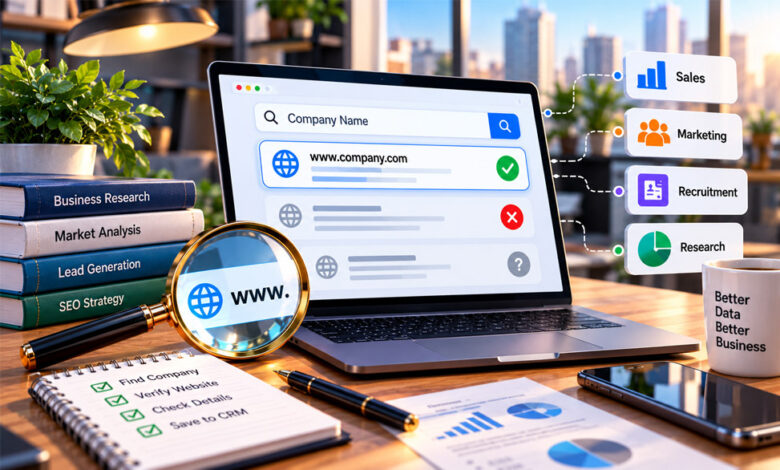

Target company URL research means finding the official website of a company and checking that it belongs to the right business.
Finding a website with the same company name is not enough. Different businesses can have similar names. Companies may also have different brands, regional websites, or old domains.
This type of research is useful for sales teams, SEO experts, recruiters, marketers, and business researchers.
This guide explains what target company URL research is, how it works, which tools can help, and how to check if a company website is correct.
What Is Target Company URL Research?
Target company URL research is the process of finding the official website or domain of a company and making sure it belongs to the right business.
A target company is simply a business you want to research. It could be a possible customer, employer, supplier, competitor, investment, or business partner.
For example, you may have a spreadsheet with 500 company names but no website addresses. Company URL research can help you find possible websites for those companies.
Finding a possible website is only the first step. You should also check the company name, location, industry, products, and other details before accepting the website as correct.
There is also a difference between a company, domain, and URL.
A company is the business you are researching.
A domain is the main website address, such as example.com.
A URL is a full web address, such as example.com/uk/careers/.
One company can have more than one website. A parent company and its subsidiary may also share a website. A brand owned by a company may have its own domain.
Target company URL research is a general business research term. It does not automatically mean research about the US retailer Target Corporation.
Why Target Company URL Research Is Important
A company’s official website can provide useful information about the business.
You may find its products, services, locations, careers, leadership, partnerships, news, and contact details.
However, this information is only useful if you have found the correct website.
Two businesses may have the same or similar names. A company may also have several brands, regional websites, or an old domain that still appears online.
Choosing the wrong website can affect all your later research. A salesperson may research the wrong customer. An SEO expert may study the wrong competitor. A recruiter may find jobs from another company.
This is why website verification is important.
Correct URLs also help keep CRM systems and business databases clean. It is better to have fewer verified websites than many URLs that may be wrong.
Who Uses Target Company URL Research?
Target company URL research can be useful for many types of business work.
B2B Sales and Lead Generation
Sales teams often have lists of possible customers.
Finding the correct company website helps them learn what the business does, what it sells, where it operates, and who it serves.
The verified domain can also be saved in a CRM for future research and outreach.
SEO and Digital Marketing
SEO professionals need the correct competitor websites before starting SEO research.
After finding the right domain, they can study keywords, backlinks, ranking pages, content, website structure, and search visibility.
These are two separate steps.
Company URL research finds which website belongs to the company. SEO research studies how that website performs in search engines.
Using the wrong domain can make competitor research inaccurate.
Recruitment
Recruiters can use company URL research to find official employer websites and careers pages.
This is helpful when several companies have similar names.
Some businesses use outside recruitment platforms for job applications. A good approach is to find the official company website first and then follow its careers link.
Market and Business Research
Business researchers can use verified websites to study products, services, markets, locations, customers, partnerships, and company news.
It can also help with competitor research, supplier research, business intelligence, and investment research.
However, a company’s own website represents its own information. Important claims may still need to be checked with other reliable sources.
How Target Company URL Research Works
The process normally starts with a list of company names.
Extra information can make the search easier. This may include the country, city, industry, brand name, parent company, social profile, or an old website.
Keep the original company name in your records.
You can also create a simpler search name. For example, you may remove extra spaces or legal endings such as “Ltd.,” “LLC,” or “GmbH” when searching.
For example, you could search for ABC Technologies Limited as ABC Technologies.
However, keep the full legal name because it may help you check the company later.
Next, search for possible websites. You can do this manually or use automated tools.
After finding a possible website, compare it with the information you already have. Check the company name, industry, location, products, contact information, and legal details.
If everything matches, the URL may be accepted.
If important details are missing or do not match, keep the result under review instead of guessing.
For large projects, save the evidence used to make each decision. This makes the research easier to check later.
Manual Company URL Research
Manual research is useful for small company lists and difficult cases.
You can search using phrases such as:
- Company name + city + official website
- Company name + country + product
- Full company name + contact
- Company name + industry
- Local company name + location
Adding more details can help when the company has a common name.
Do not automatically choose the first search result. Search engines may show directories, social media pages, news articles, marketplaces, or another company with the same name.
Business directories can help you find possible websites, but they should not always be treated as proof.
Manual research gives you more control. You can check unusual details and compare different sources.
The main problem is time. Checking hundreds or thousands of companies manually can take a long time.
Automated Company URL Research and Tools
Automated tools can make company URL research faster.
A company domain finder or URL lookup tool can take a company name and return a possible website.
Bulk lookup tools can process many company names at the same time.
Spreadsheet tools can also help researchers work with company lists in Excel or Google Sheets. Data-enrichment services may add website domains and other business details to existing records.
APIs can help with larger projects. Software can send company information to an API and receive possible domains or related data.
This can be useful for CRM systems, lead-generation tools, research systems, and data-cleaning projects.
AI can also help. It may clean company names, find possible duplicates, compare business details, organize evidence, and identify information that does not match.
However, automated tools are mainly useful for saving time.
They do not prove that a website belongs to the company.
A tool may return a website simply because the company names are similar. Important or unclear results should still be checked manually.
How to Verify a Company Website
Website verification means checking whether a possible domain really belongs to the company you are researching.
Do not accept a website only because its name looks correct.
Check the Company Identity
Start by checking the company name.
The name on the website may be slightly different from the legal company name. Some businesses use shorter names or public brand names.
Check the industry as well. If you are looking for a software company but the website belongs to a construction company, it is probably the wrong business.
Look at the products and services too. They should match what you already know about the company.
Location can also help. Compare the country, city, offices, headquarters, and markets served.
Different addresses do not always mean the website is wrong. A company may have different offices, warehouses, or branches.
Check the Website
Read the About page.
It may explain the company’s history, services, locations, founders, and business relationships.
Check the Contact page for addresses, phone numbers, and office information.
Legal pages can also be useful. Look at the privacy policy, terms, footer, and company information pages.
These pages may show the legal company name or registration number behind the website.
Check Independent Evidence
For important companies, check information outside the website too.
Official company registers may provide legal names, registered addresses, previous names, and other business details.
A parent company’s website or an official company announcement may also help connect a business with a website.
Official social media profiles can sometimes provide another link to the company’s website.
Domain registration information may also help, but it should only be used as supporting information. It does not prove by itself that a website belongs to a company.
Be careful with business directories too. Several directories may copy information from the same source.
A strong match usually has several details pointing to the same company.
Match Scores and Verification Status
Some URL lookup tools provide a match score or confidence score.
These scores can help you decide which results need more checking.
However, a high score does not always mean the website is correct. The score may only show how closely the company names match.
For example, a score of 95 does not always mean there is a 95% chance that the result is correct.
You can use simple statuses to organize results:
- Verified: The evidence supports the website.
- Needs Review: The website may be correct, but more checking is needed.
- Rejected: The website belongs to another business.
- Unresolved: There is not enough information to choose a website.
You can also save the evidence, verification date, and a short note about your decision.
Common Challenges in Company URL Research
Some company websites are easy to find. Others are harder because of similar names, brands, locations, or old domains.
Similar or Identical Company Names
Different businesses can have the same name.
Do not use the name alone to confirm a website.
Check the country, city, industry, products, contact information, and legal details.
If you still cannot confirm the correct company, mark the result as unresolved.
Parent Companies, Subsidiaries, and Brands
A company may be owned by a larger business.
The parent company may have one website while the subsidiary has another. A brand may also have its own website.
All of these websites can be real, but they may represent different parts of the business.
Choose the website that matches your research goal.
Regional and International Websites
Large companies may have different websites for different countries.
They may use a main .com website, country domains, subdomains, country folders, or different language pages.
The global website may be useful for general company research.
A local website may be better for local SEO, recruitment, sales, or market research.
If needed, save both the main domain and the regional URL.
Rebrands, Acquisitions, and Old Domains
A company’s website may change after a rebrand, merger, acquisition, or website move.
Old domains can still appear in directories and older articles.
An old website may also redirect to a new one.
Check why the redirect happened before changing your records.
It can also be useful to keep the old URL in your database for reference.
Careers and Hosted Platforms
A company’s careers page may not be on its main website.
Some businesses use outside recruitment platforms for job applications.
This can be normal if the official company website links to that platform.
Small businesses may also use hosted website services instead of having their own domain.
Save the full business page URL when needed.
If you cannot confirm an official website, mark the result as unresolved. This does not mean the company does not exist.
Benefits of Target Company URL Research
Target company URL research helps you identify businesses more accurately.
A verified website gives you a better starting point for later research.
Sales teams can research the correct prospects. Recruiters can find the right employer. SEO teams can study the correct competitor.
Market researchers can also use verified websites to study products, services, locations, markets, and company updates.
Verified URLs can also help keep CRM systems and company databases cleaner.
Limitations and Drawbacks
Company URL research can take time.
Manual research becomes slow when you have hundreds or thousands of companies.
Automated tools are faster, but they can return wrong results.
Common company names, parent companies, regional websites, old domains, and rebrands can also make research harder.
Different tools may have different data. One service may find a company while another may not.
AI can help, but its information may sometimes be old, incomplete, or incorrect.
Some companies may not have an official website that can be confirmed.
In these cases, it is better to leave the result unresolved than to guess.
Common Mistakes to Avoid
Do not choose the first search result without checking it.
Do not confirm a website only because the company name matches.
Always consider useful details such as location, industry, products, and legal information.
Do not trust match scores as final proof.
Be careful not to confuse brands, subsidiaries, and parent companies.
Old business directories may also contain outdated website information.
Check redirects because they may show that a company has changed its name or website.
Avoid adding large numbers of unverified URLs to a CRM. Incorrect records can create more work later.
A broken website also does not prove that a company has closed. The website may only be temporarily unavailable.
How to Organize Company URL Research
Keeping clear records makes company URL research easier.
Give each company a record ID and keep its original name.
Useful fields can include:
- Original company name
- Search name
- Country
- Industry
- Candidate URL
- Accepted website URL
- Main domain
- Regional URL
- Parent or subsidiary
- Evidence URL
- Verification note
- Verification status
- Reviewer
- Verification date
- Previous URL
- Next review date
Save the exact evidence page when possible.
For example, if a legal page helped you confirm the company, save that page instead of only saving the homepage.
A Last Verified date can show when the website was last checked.
Do not hide unresolved results. An empty URL with a clear note is better than an incorrect URL.
Measuring the Quality of Bulk URL Research
Finding a URL for every company does not mean the research is accurate.
Three simple measurements can help.
Coverage shows how many companies received a possible website.
Sample precision shows how many checked results were correct.
Usable yield shows how many companies ended with an accepted website.
For example, imagine you have 100 companies.
A tool finds possible websites for 90 companies. After checking them, 72 are correct.
The coverage is 90%. The checked-result precision is 80%. The usable yield is 72%.
These numbers show different parts of the research quality.
It is also useful to check some results that look correct, not only the uncertain ones. This can help find hidden mistakes.
Using AI for Company URL Research
AI can make some research tasks easier.
It can clean company names, find possible duplicates, compare company information, organize evidence, and find details that do not match.
For example, AI can compare a company’s name, country, and industry with a possible website.
It can then show which details match and which ones do not.
AI can also help write short verification notes.
However, important information should have supporting evidence.
If AI gives an address or company relationship without a reliable source, do not automatically treat it as a fact.
AI is most useful as a research helper. It should not always make the final verification decision.
Privacy and Responsible Research
Company URL research normally uses public business information.
Even so, researchers should only collect information that is useful for their work.
Avoid collecting unnecessary personal information, especially for sales, recruitment, and marketing databases.
Businesses should also follow the privacy, data-protection, communication, and data-retention rules that apply to them.
Information being public does not always mean it can be used in any way.
Tips for More Accurate Company URL Research
These simple tips can improve your results:
- Keep the original company name.
- Use a simpler search name when needed.
- Add the city, country, industry, or product to difficult searches.
- Try local-language company names when useful.
- Do not trust a matching name alone.
- Compare several company details.
- Check important companies manually.
- Use current company information when possible.
- Save evidence for verified websites.
- Do not guess when the result is unclear.
- Recheck old company records.
- Check redirects and domain changes.
- Look for rebrands and acquisitions.
- Keep old URLs when they may be useful.
- Test automated tools on a small list before processing thousands of companies.
Include some difficult companies in your test. This can help you see how well a tool handles common names, small businesses, and regional companies.
Bottom Line
Target company URL research helps connect the right business with the right website.
Finding a possible domain is not enough. You should check the company’s name, industry, location, products, legal details, and other useful information.
Manual research is useful for difficult cases. Automated tools, APIs, and AI can save time when working with large lists.
A good process can use automation to find possible websites and human review to check important or unclear results.
If there is not enough evidence, leave the result unresolved instead of guessing.
Frequently Asked Questions
What is target company URL research?
It means finding a company’s official website and checking that it belongs to the right business.
How do I find a company’s official website?
Search the company name with its location or industry. Check the website details before accepting it as official.
What is the difference between a company URL and a domain?
A domain is the main address, like example.com. A URL can be a specific page, like example.com/careers.
Can company URL research be automated?
Yes. Tools, spreadsheets, APIs, and AI can help find company websites faster.
Are automated company URL results always correct?
No. Automated tools can sometimes find the wrong website, so important results should be checked.
What should I do when two companies have the same name?
Check their location, industry, products, and legal details. If you are still unsure, do not guess.
How often should company URLs be checked?
Check them again when a website stops working, a company changes its name, or your information becomes old.
Does finding an official website prove that a company is legitimate?
No. It only helps confirm the company’s website. It does not prove the business is safe or trustworthy.
What Is Masgonzola Made Of? Taste, Nutrition, Storage, and Uses
Straightforward Talk: Complete Guide to Honest and Respectful Communication