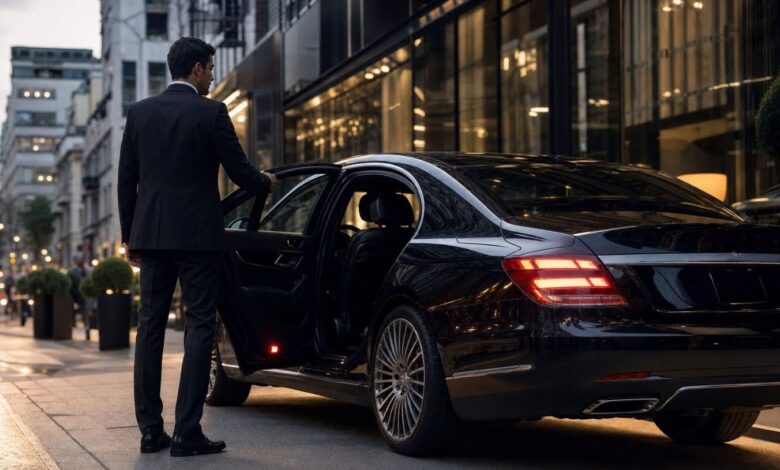
Chauffeur service Milan for fashion events, trade fairs and international business appointments

Should a chauffeur be booked ahead for a Milan event day, or will a taxi outside the hotel do the job? It depends on the itinerary. A single, well-defined transfer — airport to hotel, hotel to one meeting — can often be handled with a taxi or a ride-hailing app, both usually available without advance notice. A day built around several stops, a show call that might run late, or a badge collection with an unpredictable queue tends to run more smoothly when the car, the driver and the time window are agreed before the day starts. The guiding criterion is not speed; it is reducing the number of open variables.
What a chauffeur service for Milan events really means (and what it isn’t)
A pre-booked chauffeur service differs from a street taxi or a ride-hailing app mainly in when the details are fixed. With a taxi or an app, the vehicle is typically requested on the spot, and the driver, route and exact timing are not known in advance. With a pre-booked chauffeur, the pick-up point, the approximate timing and — depending on the booking — a block of disposal time are agreed before the day begins, rather than negotiated at the curb.
That difference matters more on a day with several stops than on one with a single leg. If a show ends late and the next appointment is across town, a car already booked for a time window can absorb the delay more easily than a ride requested fresh at that moment. Whether a given operator structures this as hourly disposal, a day rate, or point-to-point legs only, depends on how that operator sets up its booking terms — it is not a fixed format across the market, and it is worth confirming before booking rather than assumed from one provider to the next.
If you are comparing options for a Milan event week, it helps to check what is actually included — waiting time, routing flexibility, vehicle type — rather than relying on the headline offer alone. Vivaldi, for instance, outlines a chauffeur-driven car rental service in Milan on its site, which can serve as a reference point for the kind of detail worth checking with any operator before confirming a booking.
What tends to catch a schedule off guard is rarely the drive itself. It is what surrounds it: finding the right entrance among several, a credential check that runs longer than expected, or a pick-up point that turns out to sit at a different corner than the one on the map. On an ordinary day these are minor frictions. On a day with four or five appointments stacked back to back, a few unplanned minutes at each stop can be enough to compress the ones that follow.
Why timing breaks first during event weeks
Milan is not large by distance standards, which is partly why event-day logistics can be deceptive. A transfer that would normally take a quarter of an hour can take considerably longer when a drop-off point sits a short walk from the actual entrance, when several vehicles converge on the same block at the same time, or when access to a street is restricted for the day. Planning by expected access conditions, rather than by raw distance, tends to produce a more realistic schedule.
Venues also cluster differently depending on the event type. Fashion shows and showrooms are often spread across several districts in the city centre, while trade fairs frequently run from a dedicated fairground — Rho Fiera, west of the centre, is one example — that sits at a different distance and access profile than a venue inside the city. That detail changes the realistic drive time more than the map distance alone suggests, and it is worth factoring into any itinerary that moves between a central hotel and a fairground on the same day.
Call times are rarely fixed in practice. A show due to end at six can run to a quarter to seven; a meeting meant to close an agenda can run into the next one. A fashion week day might move from hotel to showroom, showroom to venue, venue to dinner, dinner to the airport — several legs, each with a different tolerance for delay. A fair day can look different again: fairground in the morning, a meeting across town in the afternoon, and a narrow window to get back before a stand closes. Both patterns share the same risk — one late leg can push back everything scheduled after it.
Build a resilient itinerary: a layered planning approach
A schedule built to survive last-minute change is usually layered, rather than listed as a flat sequence of appointments.
- Fixed anchors — flight or train times, badge pickup windows, and meeting start times that cannot move easily. These form the frame everything else is built around.
- Soft commitments — show calls, showroom slots and press appointments that can shift by minutes or hours. Treating them as ranges, with a margin built around the latest plausible end time, tends to work better than planning to the time stated on the invitation.
- Scenario-based margins — a buffer that covers a short hop within the centre is rarely enough for a longer run toward a fairground or an airport; what counts as a safe margin can change through the day as traffic and schedules shift.
- Handoff logic — deciding in advance whether one vehicle can realistically cover a full day, or whether parallel agendas, such as two people attending different meetings at the same hour, call for splitting into separate cars.
- Contingency triggers — a short, agreed list of conditions that change the plan, such as a show call delayed well beyond its slot, and who has the authority to approve a change on the spot, usually an assistant or travel manager rather than the passenger in the car.
Venue access and drop-off reality: what to clarify before the day starts
An address is a starting point, not a usable entrance. Fashion venues and fair pavilions often have a main gate for guests, a separate service entrance, and — in the case of hotels — a lobby that can sit some distance from where cars are allowed to stop. Confirming which entrance applies, and whether it changes between a fitting, a rehearsal and the show itself, can remove one of the more frequent sources of lost time.
A dropped pin on a map is useful for orientation, not for planning a pick-up. Drop-off conditions near major venues can depend on temporary restrictions, traffic density or simple layout that a map does not show. Confirming the actual pick-up point directly — with the venue, the organiser or the driver on the day — tends to save more time than adding extra buffer alone.
Credential checks and badge collection can add time at the curb that is easy to underestimate, particularly in the minutes around a show’s start when several guests arrive together. If the show ends ten minutes early and the car is parked two streets away because of a restriction nobody flagged, that gap has to be absorbed somewhere in the schedule. Building this into the plan, rather than treating it as part of the transfer itself, helps keep the rest of the day on track.
Garment bags, sample cases and equipment change the calculation too. A sedan that comfortably takes two passengers and hand luggage may not have room for a rack of garments or several hard cases. In these situations a van, or a second vehicle, is often the more realistic option — worth raising with the operator ahead of time rather than discovering it at the curb.
Fashion events vs trade fairs vs corporate appointments: different mobility needs
Fashion week days tend to involve frequent, short transfers with uncertain end times: a show that overruns, a fitting added at short notice, a dinner confirmed only a few hours ahead. Flexibility — a car that can wait, or be redirected, without a full new booking — tends to matter more here than raw speed between two points.
Trade fairs run on a different rhythm. Hours are usually fixed and published, and exhibitors often start early and finish late across several consecutive days. Here the planning challenge is less about sudden change and more about covering a longer, repeated corridor between a hotel, the fairground and any off-site meetings, often across more than one day in a row.
International business appointments bring their own requirements: discretion inside the car, consistent punctuality across several days, and — where a programme spans multiple meetings — a service level that does not vary noticeably between one transfer and the next.
Point-to-point booking tends to suit a single, well-defined transfer such as an airport pick-up. Hourly or day-based disposal, where offered, suits a day with several stops and some uncertainty about timing, which covers most fashion and fair days. Full-day or multi-day booking suits a programme where the same car and driver are needed across a longer stretch, which can reduce the number of handovers and briefings required along the way.
Coordination that prevents delays: what to share with the operator
A short brief tends to prevent more delays than a long one with gaps. Passenger names, a direct contact number, the languages spoken, and which meetings carry the least flexibility — this is usually enough for a driver to plan the day realistically, rather than reacting to it stop by stop.
Someone needs to own live updates — an assistant, a travel manager, or the guest directly — and it helps to agree in advance which channel that goes through, so a changed call time reaches the driver before the car is already en route.
Over a multi-day programme, keeping the same driver and vehicle can reduce the time spent re-explaining preferences and venue quirks each morning. Rotating drivers can still work, provided the brief travels with the booking rather than living only in one person’s head.
When flight or train times shift, arrival coordination depends on how the handover is agreed beforehand — where the driver waits, how a delay is communicated, and what happens if a passenger is held up at passport control. These points are worth confirming case by case with the operator rather than assuming a default.
Quality signals: what to ask before a high-stakes day
Operational reliability is difficult to judge from a website alone, but a short set of questions tends to reveal more than a feature list. Is there a way to reach dispatch outside standard office hours? Is a backup vehicle held in reserve in case the first car has a problem? How are changes on the day actually communicated back to the passenger, and through which channel?
What is included in the quoted price — waiting time, tolls, parking — and what triggers an extra charge, is worth confirming before booking rather than at the end of the invoice. Policies on cancellation and rescheduling vary between operators and are usually set out in their own terms and conditions, which are worth reading rather than assumed to be standard across the market.
Fleet fit matters more than it first appears. An executive sedan suits one or two passengers with reasonable luggage; a van or minivan becomes the more sensible choice for a small team travelling together, for extra luggage, or for equipment that would not fit in a sedan’s boot. Confirming real capacity with bags and garments loaded, rather than nominal seating, avoids a surprise at the curb.
A practical pre-event checklist for assistants and travel managers
Most of what causes friction on an event day can be caught 48 to 72 hours earlier, when itinerary anchors, passenger lists, luggage and garment needs, and any entrance notes are confirmed with the operator while there is still time to adjust the booking. Pick-up points and the contact chain are usually worth reconfirming once more within 24 hours, together with which contingency options are available if a call time changes.
On the day itself, updating call times as they change, and agreeing in advance whether a wait or a reposition is the default while a meeting overruns, keeps the plan from falling apart at the first deviation. After the event, a short note on what actually caused delay — an entrance that was hard to find, a buffer that was too tight — tends to make the next show or fair day easier to plan.
A useful comparison: how one booking can bundle the essentials
None of this requires a complex system. It requires deciding, before the day starts, which parts of the schedule are fixed and which are not, and giving an operator enough detail to plan around both. One illustration of this comes from outside Milan: the same operator mentioned earlier also advertises a transfer service for the Monte Carlo Formula 1 weekend, built around a driver meeting the client at a preferred location — home, hotel or airport — rather than a fixed public point, with extra luggage space factored into the vehicle choice. The destination differs from a Milan trade fair day, but the underlying logic transfers directly: pick-up point and vehicle capacity agreed first, with the itinerary built to fit around them, rather than improvised once the group and its bags are already standing at the curb.
Quick answers for common planning questions
Is a chauffeur necessary for a single Milan appointment, or is a taxi enough? For one well-defined transfer, a taxi or ride-hailing app can usually cover it. For a day with several stops, uncertain end times, or luggage and garments to manage, a pre-booked driver reduces the number of open variables.
What does NCC mean in Italy? NCC is a term commonly used locally for hire-with-driver services, booked in advance with an agreed pick-up point and timing. The exact scope and rules attached to the term can vary and are best checked with a local or official source rather than assumed.
Should a fashion week day be booked hourly or point-to-point? Hourly or block-time formats, where an operator offers them, tend to suit days with multiple stops and uncertain show calls. Point-to-point tends to suit a single fixed leg, such as an airport transfer.
How far ahead should ground transport be arranged during a major fair or fashion week? There is no fixed rule, but arranging transport with some lead time generally leaves more room to confirm pick-up points and vehicle capacity before the rest of the schedule is locked in.
Before the car is booked: six questions worth asking
A short list, checked against the itinerary rather than against an operator’s marketing page, tends to catch most of what causes delay on an event day:
- Which appointments are fixed, and which can realistically shift by twenty or thirty minutes?
- What is the confirmed pick-up point at each venue, rather than just the street address?
- Is the vehicle’s real capacity, with luggage and garments loaded, enough for the group?
- Who is authorised to approve a change to the plan if a call time moves?
- What is included in the quoted time or price, and what counts as an extra?
- How are last-minute updates communicated, and to whom?
None of these questions guarantee a schedule that runs exactly as written — event days in Milan rarely do. But answering them before the first pick-up gives a plan something to fall back on, rather than leaving every delay to be improvised on the spot.