

Start at the shoulders, not the chest
When trying on a shirt, most men naturally judge the part they are most conscious of first. If that is the chest, a shirt that clears the chest can immediately feel like the safer choice.
Ignore the chest for a moment. Look at the shoulder seam.
On a conventional T-shirt, polo or casual shirt, it should still make sense relative to your actual shoulder. If moving up a size sends the seam noticeably down your upper arm, the shirt may not really fit better. It has simply become bigger.
That matters because the shoulders establish the frame of the garment. Once they become too wide, everything hanging beneath them changes too.
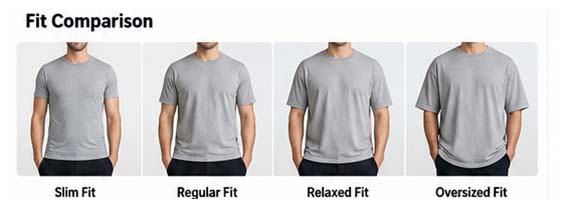
Instead of automatically sizing up, compare different cuts in your normal size. A regular or slim T-shirt may be too restrictive through the upper torso, while a relaxed cut in the same nominal size can give more usable chest room without adding several inches of unnecessary length.
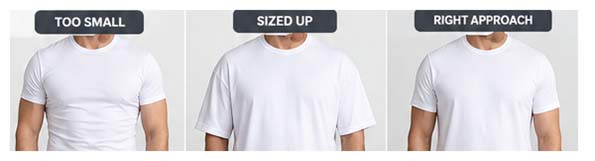
Sizing up changes more than chest room: it also changes shoulders, sleeves and waist.
“Relaxed,” “boxy” and “oversized” are not the same fit
These terms are often treated as synonyms. They are not. A relaxed fit generally adds ease through the torso while remaining recognizably proportioned to the wearer. A boxy fit tends to be wider relative to its length. That can be useful when you want room through the chest without turning a T-shirt into a long tunic. An oversized garment is intentionally larger across multiple dimensions: shoulder, body width, sleeves and sometimes length.
Any of the three can work. The mistake is believing that the largest silhouette automatically conceals the most.
Sometimes an oversized shirt hangs cleanly from the shoulders and barely touches the chest. Another oversized tee may collapse inward, catch on the most projected point of the chest and then hang loose everywhere below it. You technically have more fabric, yet the chest remains the visual anchor.
This is why the label on the product page matters less than what the fabric does once the shirt is on your body.
Fabric has to bridge the chest before it can drape
Two black T-shirts in the same size can behave completely differently. A very light, soft jersey tends to follow whatever is underneath it. Under directional light, even small changes in contour can create highlights and shadows.
A fabric with a little more body behaves differently. Instead of tracing every change in shape, it can span between contact points and fall away from the torso more cleanly.
This is one reason medium- and heavier-weight tees frequently feel easier to wear when chest definition is something you would rather not emphasize.
But “thicker” is not enough on its own. A heavy shirt can still cling if it contains a lot of stretch or has an especially close cut. A lighter woven shirt can conceal more effectively because its construction holds a shape of its own.
Look for structure, not simply weight. Useful examples include substantial cotton jersey, pique polos, Oxford cloth, textured casual shirts and overshirts. The common characteristic is that the garment contributes something to the silhouette instead of asking the body underneath to create the entire shape.
Check where the shirt becomes tight
Here is a useful fitting-room distinction: a shirt can be close to the body without being pulled by the body.
Look for tension rather than proximity. If the fabric sits fairly near your chest but remains smooth, that may be completely fine. If lines begin radiating outward from the chest toward the armhole, side seam or buttons, the garment is telling you where it is running out of room.
Sizing up is one possible response. Changing the cut is often better. Try a shirt with a slightly straighter torso, more chest ease, a different armhole, or a fabric that stretches less aggressively around the body.
The goal is not to create the maximum possible distance between your chest and your clothes. It is to stop one part of the body from controlling the fit of the entire garment.
Use color after you fix fit
Dark shirts are recommended so often for this problem that they can begin to sound like a rule. They are useful: dark, matte surfaces generally make small changes in contour less visually obvious than bright, reflective surfaces. But color cannot rescue a bad fit.
A black stretch T-shirt pulled tightly across the chest can reveal more shape than a lighter, structured Oxford shirt that hangs cleanly. Fix the garment-body relationship first. Then use color, pattern and texture as secondary tools.
Small irregular patterns, heathered surfaces and textured fabrics can also make subtle contour changes less visually dominant because the eye has more information to process than it does on an ultra-smooth solid surface. That does not mean you need to build an entire wardrobe around camouflage. It means fabric surface is another variable you can use.
A base layer can let the outer shirt stay in its correct size
There is another way to approach the sizing problem. Instead of making the outer garment increasingly large, change what happens underneath it.
A close-fitting undershirt can reduce friction between the skin and the outer shirt. And when more shaping is wanted, purpose-built men’s compression tank tops can create a smoother base under everyday clothing while they are being worn.
That can be particularly useful when the outer garment already fits correctly through the shoulders, arms and waist. Rather than sacrificing all of those proportions for extra chest room, the base layer deals with the first layer of the silhouette while the shirt is allowed to remain a shirt.
There is a trade-off, however. Adding a layer means adding heat. The neckline must also remain hidden, the straps should not print visibly through thin fabric, and the bottom of the garment needs to stay where it belongs as you sit, walk and reach.
A compression layer that becomes visible through the outfit has simply replaced one clothing problem with another. That is why compression should be judged with the clothes you intend to wear over it, not only in front of the mirror by itself.
Illustration only: outer-shirt drape varies by body, base layer, fabric and fit.
Summer needs a different strategy
Cold weather makes this problem easy. A T-shirt can sit beneath an open overshirt, jacket, knit or other structured layer. Summer removes most of those options.
Trying to recreate winter layering in hot weather usually creates an outfit you will hate wearing by lunchtime. Instead, reduce the system.
One discreet base layer plus one good outer shirt is often more practical than stacking several pieces. Or skip the base layer and put more responsibility on the outer garment: a structured tee, textured polo or lightweight woven shirt with enough chest room to hang rather than cling.
This is where owning several different solutions becomes more useful than finding one supposed “perfect shirt.” The tee that works brilliantly under a jacket in October may not be the shirt you want in July.
Button-down shirts fail differently from T-shirts
T-shirts mainly reveal fit through drape and tension. Button-down shirts give you another warning system: the buttons.
If the shirt is calm everywhere except for horizontal pulling around the chest, moving one size larger may seem obvious. But again, inspect the rest of the garment first.
If the collar, shoulders, sleeves and waist already fit well, you may need a different shirt pattern rather than more size everywhere. A straighter casual shirt, a cut offering more room through the upper torso, or a fabric with firmer structure can solve the problem more elegantly.
When the setting allows it, an open overshirt or lightweight blazer can also create a useful vertical frame without forcing the shirt underneath to become oversized.
The 90-second fitting-room test
Do not judge a shirt from one straight-on mirror pose. A shirt is something you move in. Give a new one about ninety seconds.
- Drop your arms naturally. Do the shoulders still belong where shoulders should be?
- Turn sideways. Does the fabric fall from the chest, or does it grip the chest and then suddenly release underneath it?
- Sit down. A shirt that looks perfect while standing may tighten dramatically once the torso shortens.
- Reach forward and then overhead. Watch whether the entire shirt migrates upward and stays there.
- Return to a neutral position. If you are immediately pulling the front away from your chest, dragging the hem downward or rearranging the fabric, pay attention to that instinct.
A good garment should recover by itself. This simple test tells you considerably more than staring at the size printed inside the collar.
Build around the clothes you actually wear
There is no single correct wardrobe for gynecomastia. Someone who spends five days a week in Oxford shirts has a different problem from someone who lives in T-shirts. Someone in a hot climate has different options from someone who can wear jackets for six months of the year.
Some men want only a small change in how fabric sits across the chest, while others prefer stronger smoothing underneath their clothing.
That is why the broader category of men’s shapewear makes more sense when viewed as part of a wardrobe system rather than as a replacement for learning how clothes should fit. The outer clothes still matter. So do temperature, fabric, movement and the amount of compression you actually find comfortable enough to wear.
Stop buying the whole shirt for one part of your body
This is the main idea worth keeping. If a medium fits your shoulders, sleeves and waist but not your chest, the answer is not automatically a large.
You may need:
- a different cut,
- a different fabric,
- a different layer underneath,
- or simply a different shirt.
Modern menswear gives you far more options than the old choice between “tight” and “baggy.” Use them.
The best result is not necessarily the shirt that conceals the most when you stand perfectly still in front of a mirror. It is the one you can put on, move around in, and then stop thinking about.