Mercaptan Removal in NGL & Condensate: Comparing Caustic, Oxidative & Catalytic Approaches

Catalytic and adsorption-based systems offer the best mix of low chemical use and steady product quality. This holds true for most NGL mercaptan treatment comparison cases. Caustic and oxidative methods still work well too. It depends on your volume, mercaptan load, and disposal capacity. Here’s the breakdown.
Mercaptan removal from natural gas liquids and condensate isn’t just a compliance checkbox. Left untreated, mercaptans cause corrosion in downstream piping. They ruin product odor specs. They can even knock a cargo out of pipeline or marine shipping tolerance.
That’s why mercaptan removal from natural gas processing facilities is so heavily engineered. You might run a caustic wash, an oxidative unit, or a catalytic bed. The goal stays the same. Pull sulfur compounds down to spec without wrecking your economics.
Why Mercaptans Matter in NGL & Condensate Quality?
Mercaptans (R-SH compounds) are organosulfur species. They occur naturally in raw NGL and condensate streams. They corrode carbon steel. They smell terrible at parts-per-million levels. They also interfere with combustion characteristics in finished LPG products.
Pipeline operators and marine terminals set strict sulfur and mercaptan limits. These often sit below 10 ppm. That’s why mercaptan removal NGL processing sits at the front of the value chain. Get it wrong, and you risk rejected cargoes, corrosion failures, or regulatory citations.
What is The Design of Caustic Wash Systems and What are Their Limitations?
Caustic washing uses concentrated sodium hydroxide to extract mercaptans. It converts them to sodium mercaptides through a simple acid-base reaction. It’s one of the oldest condensate sweetening methods still in use today.
- Works well on light mercaptans (methyl and ethyl mercaptan) with high water solubility
- Struggles with heavier mercaptans (propyl, butyl) due to poor partition into the caustic phase
- Requires fresh caustic makeup as extraction capacity depletes with each pass
- Generates spent caustic that carries high COD, sulfide, and phenolic loading
- Needs regeneration or disposal infrastructure that adds ongoing operating cost
Caustic washing loses power as mercaptan carbon number goes up. That’s why many operators pair it with a downstream oxidizer.
This helps them hit tighter mercaptan removal NGL targets. On its own, caustic washing rarely stands as the final step among modern condensate sweetening methods.
What is Oxidative Sweetening or the Merox Process?
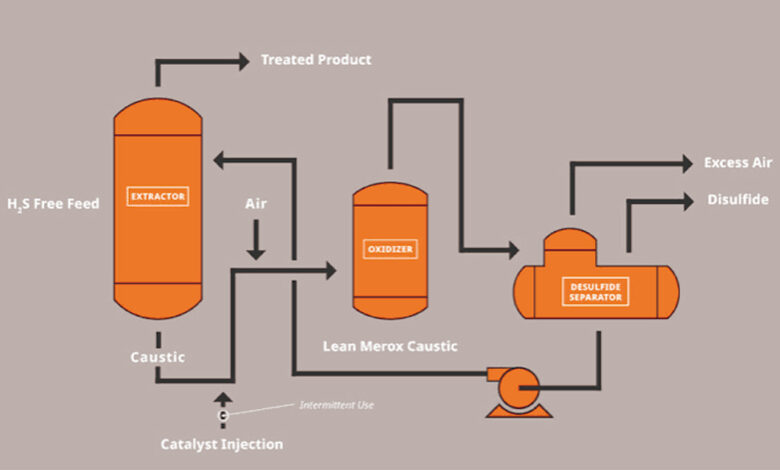
The Merox process comes from UOP. It regenerates spent caustic by oxidizing mercaptides back into disulfides. This uses a cobalt phthalocyanine catalyst plus air or oxygen.
This means caustic gets reused instead of thrown away. That’s a big economic win over once-through caustic washing. Here’s how the reaction works:
- Mercaptans extract into caustic, forming sodium mercaptides
- Catalyst-driven oxidation converts mercaptides to disulfides
- Disulfides separate out as an oil-insoluble, water-insoluble layer
- Regenerated caustic recycles back to the extraction step
Merox units come in liquid-liquid and fixed-bed setups. Your choice depends on whether you treat LPG, condensate, or a specific NGL cut. Among condensate sweetening methods, Merox remains the benchmark. It pairs moderate capital cost with strong turndown flexibility.
Catalytic & Adsorption-Based Alternatives
Beyond caustic and oxidative routes, catalytic and adsorption technologies have gained ground. This is especially true where caustic disposal faces tight regulation.
- Fixed-bed catalytic oxidation systems that convert mercaptans directly without a caustic circuit
- Molecular sieve adsorption, which physically captures mercaptans and H2S onto zeolite media
- Chemical scavenger injection using triazine or metal-oxide-based formulations for lower-volume streams
- Hybrid systems combining scavenger pretreatment with a polishing catalytic stage
These approaches shine in remote or offshore settings. Caustic logistics get expensive there. Wastewater discharge permits can be hard to secure too.
These methods cost more per barrel treated. But they skip the spent caustic liability entirely. That matters a lot for any NGL mercaptan treatment comparison built on full lifecycle cost, not just upfront capital. Choosing between these paths is really the heart of any serious NGL mercaptan treatment comparison, since capital cost alone rarely tells the full story.
Disposal & Environmental Considerations for Spent Caustic
Spent caustic disposal often decides which mercaptan removal NGL method fits your site.
Spent caustic from mercaptan extraction carries disulfide oil, residual sulfides, and elevated pH. This mix classifies it as hazardous waste in most US jurisdictions under RCRA guidelines. Common handling routes include:
- Wet air oxidation to break down sulfide and mercaptide content before discharge
- Neutralization followed by biological treatment at a permitted wastewater facility
- Third-party disposal via licensed hazardous waste haulers
- On-site incineration for high-sulfide streams where permitted
Facilities near sensitive waterways face tighter NPDES permits. Many now favor catalytic or adsorption routes instead. This helps them dodge the spent caustic disposal burden altogether.
Selecting the Right Approach Based on Volume & Composition
There’s no single winner here. The right call depends on:
- Feed mercaptan concentration and carbon number distribution
- Available caustic disposal or regeneration infrastructure
- Facility footprint and whether offshore or remote logistics apply
- Downstream sulfur specification (pipeline tariff versus marine export grade)
- Capital budget versus long-term operating cost tolerance
High-volume onshore plants usually have caustic logistics already in place. They default to Merox-style oxidative sweetening. Smaller or remote condensate operations often lean toward scavenger injection or adsorption media instead. These condensate sweetening methods scale down more cost-effectively.
Industry Trends: Tighter Specs & Evolving Regulations
Sulfur specs keep tightening. This spans pipeline tariffs, LPG odorant rules, and marine bunker fuel standards. Regulators also scrutinize spent caustic discharge more closely now. This pushes operators toward technologies with a smaller waste footprint.
This shift is fueling interest in hybrid catalytic systems and non-aqueous scavenger chemistries. These reduce reliance on traditional caustic circuits. They still meet an increasingly strict NGL mercaptan treatment comparison bar set by buyers and regulators alike.
Bottom Line
Caustic washing is cheap upfront. But it struggles with heavier mercaptans and carries real disposal costs. Merox-style oxidative sweetening solves the regeneration problem and remains the workhorse for high-volume operations.
Catalytic and adsorption alternatives cost more per unit, but they skip the spent caustic liability entirely. That makes them the practical choice for remote or environmentally constrained sites.
Match the method to your feed composition, volume, and disposal access. With proven treatment approaches and industry expertise from companies like Q2 Technologies, you can select a mercaptan removal NGL solution that delivers reliable performance and fits your operational needs.