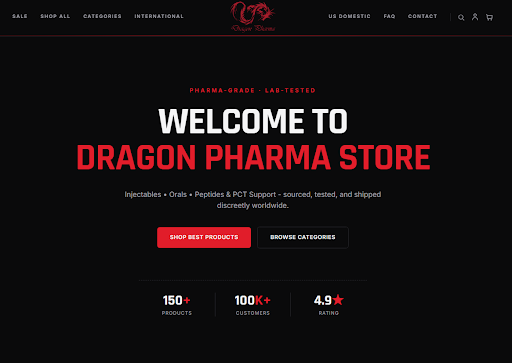

In a market with no regulator, no pharmacy chain and no manufacturer directory, a brand name does more work than it would anywhere else. It is the only thing that survives from one order to the next, and it is the only shorthand a buyer has for a set of expectations about what a product contains.
That is why Dragon Pharma is one of the handful of names that gets searched by name rather than by compound. It is also why the name is worth understanding properly, because the same absence of oversight that makes a brand meaningful makes it easy to imitate.
Why brand identity carries weight here
In a regulated market, a brand is a guarantee backed by a licence. A pharmacist can tell you what is in the box because somebody inspected it. In this market a brand is a reputation backed by accumulated experience, and it functions as a filter: buyers learn which names have been consistent, which have been inconsistent, and which appear on packaging with no product behind it.
That makes brand literacy a practical skill rather than a preference. Someone who can tell a genuine listing from a copied one is doing the work that a regulator would otherwise do, and the brand name is the starting point for it.
What the range actually covers
The Dragon Pharma catalogue is broad rather than specialised, and that breadth is itself informative. It runs across three distinct product families.
The oral range is the widest: oxandrolone, stanozolol, methandienone, oxymetholone, turinabol and the rest of the C17-alpha-alkylated group, most of them presented in 10 mg and 50 mg tablets with stated counts per pack. The injectable range covers the testosterone esters and the 19-nors, in the familiar 10 ml vials at concentrations from 100 mg/ml upward, plus the blends that combine two compounds in one vial.
The third family is the one that has grown fastest and is the one most often overlooked: peptides and growth hormone, including the HGH presentations and the GLP-1 compounds that now dominate a large share of the searches landing on a store like this. A Dragon Pharma Anavar listing and a peptide listing from the same brand have almost nothing in common technically, and that is the point: the brand is a label across several categories rather than a single product line.
The naming convention, and why it matters
Dragon Pharma product names follow a convention that is worth learning because it tells you what you are looking at before you read a word of the description. The testosterone esters carry the ester name in a slightly European spelling: Enantat rather than enanthate, Cypionat rather than cypionate, Propionat rather than propionate. The blends carry the compound and the total milligram strength, so Sustanon 270 or Test 400 or Superbolan 400 each state their own arithmetic in the name.
This is useful for two reasons. First, it makes a listing easy to check against the manufacturer’s own naming, and a product named in a way the brand does not name it is a warning rather than a variant. Second, it makes the concentration explicit, which is the single figure most often misstated by resellers.
Where the brand sits in the market
Dragon Pharma is not the cheapest name on the shelf and not the most clinical-sounding. Its position is closer to the middle: a range broad enough to cover a full cycle from one label, priced above the budget tier, and old enough that the name carries recognition in forums where buyers compare notes.
That position is why it attracts copying. A brand that is recognised, mid-priced and widely discussed is the ideal thing to put on packaging that contains something else, because the buyer’s recognition does the selling.
The counterfeit problem
Counterfeiting is the defining risk with any established name in this market. It takes three forms, and they are worth separating because they are caught by different checks.
The first is a complete fake: packaging that imitates the brand, containing a product that is not what the label says, sometimes not an active compound at all. The second is a substituted ester or concentration: a real compound at the wrong strength, or a cheaper ester sold under a more expensive name. This is the hardest to detect from the outside and the most common in practice, because the packaging is not obviously wrong. The third is a diverted or expired batch relabelled as current.
None of these are visible from a product photograph. All three are visible from one thing: an assay on the specific batch.
What verification actually looks like
The check that matters is a laboratory result tied to the batch number on the packaging you receive, not to the product name in general. A certificate that covers a product range, or that is reused across every listing on a site, tells you nothing about the vial in your hand.
The useful result shows identity by mass spectrometry, confirming that the molecule present is the molecule named, and an assay figure confirming the concentration against the label. Purity figures without identity are the least informative part of the document and are the part most often quoted.
Packaging checks come second and are worth doing anyway: print quality, consistency of the batch numbering, the seal, and whether the presentation matches the commercial format the brand actually uses. Counterfeit packaging is usually good enough to pass a glance and rarely good enough to pass a comparison.
The lookalike domain problem
Anyone searching this brand by name will encounter a set of domains that are variations on it: the same words with a different ending, the store name with a letter added, and sites that present themselves as official without saying who operates them. Some are legitimate resellers, some are the same operator using several addresses, and some are simply fronts for copied product.
For a buyer the practical rule is unglamorous: the domain in the address bar is part of the product specification. A listing is only as verifiable as the site you are buying from, and a brand name in a page title is not evidence of anything.
What a good listing looks like
Putting the checks together, a listing for this brand that is worth taking seriously will do four things. It will state the compound and the concentration per unit. It will show the presentation, including the number of units. It will name the manufacturer rather than implying it. And it will produce a batch-specific laboratory result on request.
A Dragon Pharma Store listing that does all four is doing what is within a seller’s control. One that shows a stock image, a brand name and a price, and nothing else, is asking you to supply the missing verification yourself.
Frequently asked
Is Dragon Pharma a manufacturer or a reseller?A manufacturer label. The products carry the brand on the packaging; the sites selling them are resellers, and their reliability is a separate question from the brand’s.
Why are the ester names spelled differently?The naming follows a European convention: Enantat, Cypionat, Propionat. A listing using a different spelling for a branded product is worth a second look.
What is the single most useful check?A batch-specific laboratory result showing identity and assay, matched to the batch number on the packaging you receive. Nothing else in this market substitutes for it.
Does a recognised brand mean a safe product?No. Brand recognition is a filter for consistency, not a guarantee of content, and it is exactly the recognition that makes a name worth counterfeiting.
Are the peptides the same brand as the injectables?They share the label and the distribution, not the manufacturing or the risk profile. Treat a peptide listing on its own documentation rather than on the brand’s reputation in injectables.
The bottom line
The value of a name like Dragon Pharma is that it compresses a lot of experience into two words, and the risk is that the same two words are easy to print. Neither of those facts is going away in a market without oversight.
The practical conclusion is not to trust the brand more or less, but to trust it for the right thing. The name tells you what the product is supposed to be and which commercial formats exist. It does not tell you what is in the vial. If you want to see how the range is presented when a seller is being specific about concentrations and pack sizes, buy Dragon Pharma online takes you to the catalogue, and the difference between a listing that answers the four questions and one that does not becomes obvious quickly. The category pages for the oral range show the same discipline applied to the products where dose per tablet matters most.