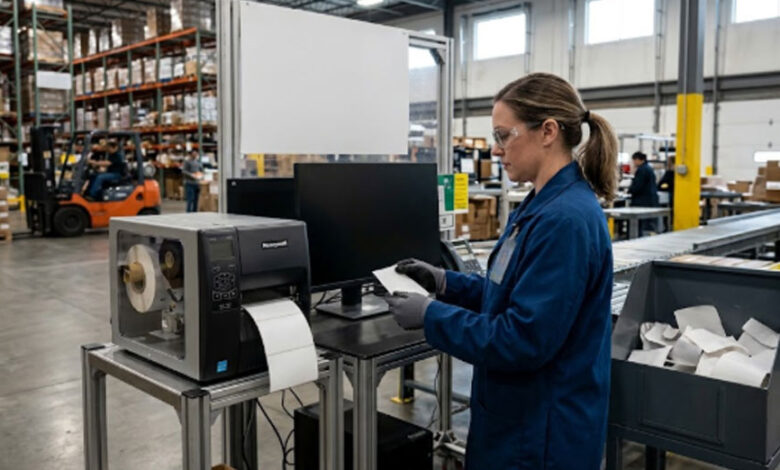

A reprint policy should answer four questions at the workstation: why may a label be printed again, which data must be reused, what happens to the old label, and who checks the replacement on the physical item. Without those rules, a paper jam can become a duplicate shipment, a corrected date can remain visible beside an old one, or a lost serial can be replaced with an invented identity. The policy need not be long. It needs to match the events staff actually face and leave a reliable audit trail.
Classify the reason before clicking reprint
Common reasons include a printer jam, torn label, poor print, wrong template, damaged package, corrected address, changed product data, or a label applied to the wrong item. These are not equivalent. A jam after a shipment was created usually calls for the same tracking number. An address change may require the carrier shipment to be corrected or replaced. A label placed on the wrong item requires both items to be checked. Put clear options in the software rather than a single button that silently creates a new record.
Require the operator to select a reason and, for higher-risk cases, a supervisor to approve it. The aim is not bureaucracy for a single damaged sticker. It is to make an unusual second label visible before an error leaves the building. Keep the list short enough that workers will use it honestly.
Reprint from the current record
The authoritative order, product, lot, or asset record should supply the replacement data. Do not copy text by eye from a damaged label. If a field was corrected, show both the previous and current values in the audit history while printing only the approved current value. For unique IDs, make the default behavior “reprint same ID” unless a controlled process specifically creates a linked new one. A reprint is not automatically a new shipment, a new sample, or a new serial number.
Display the key fields before confirming: item or order ID, destination where relevant, template name, printer, and the identity that will be encoded. A confirmation step is valuable when two similar items sit at the same bench. It is less useful if staff can click through without seeing the physical item, so pair it with a scan or visual verification at application.
Retire the old physical label
The replacement must leave one unambiguous active code for the job. Remove the damaged sticker when safe for the package, or fully obscure obsolete machine-readable data with a suitable opaque overlabel. Do not place a new barcode beside the old one and expect a scanner to know which is current. Preserve unrelated product or safety marks that are still required. In a return workflow, distinguish the original product barcode from an obsolete shipping route code before covering anything.
If the first label never left the printer, mark that print attempt as failed if the system supports it. If it reached a package, record which package received it and whether it was destroyed or covered. These details help when an extra parcel later appears with a valid-looking number.
Verify the applied result
After the new label is applied, scan it on the finished item or parcel. The scan should resolve to the current record and the human-readable details should match the object. Scanning a loose sheet before application is not sufficient. A packer could still attach it to the wrong carton. For a high-volume line, sample checks alone may be inadequate for unique shipment IDs; decide the checkpoint based on the cost of a wrong identity.
Print quality belongs in the policy too. If staff repeatedly reprint because the image is weak, investigate printer cleaning, darkness, calibration, and roll quality. Buying thermal label rolls that feed consistently may reduce the reprint burden, but the purchasing decision should be based on a production trial and recorded failure rate, not a promise on a product page.
Build a small exception queue
When the physical item and digital record disagree, the worker should hold the item in a named exception area. A supervisor or data owner investigates using the original documents, scans, and package contents. The system should not encourage workers to choose whichever label is easiest to print. Define how the item returns to production after correction and who closes the exception. A visible hold is cheaper than sending an incorrectly labeled item downstream.
The exception queue also reveals patterns. Several reprints from one printer may indicate a hardware problem. Reprints clustered after a product changeover point to template control. Reprints clustered on one bag film suggest an adhesion problem. Use reason codes for diagnosis rather than blaming staff for every extra label.
Audit without counting every sheet
Record the user, time, workstation, reason, original ID, replacement ID if different, and disposition of the old label. Reconcile unique IDs or carrier labels at the end of the shift. Review a weekly sample of reprints against the physical or shipping result. The useful measure is reprints that caused ambiguity, wrong dispatch, or manual recovery, not simply the number of labels printed.
A supplier of direct thermal labels can provide stock and roll specifications, but the organization must own its identity rules. Keep a retained sample of approved media and document what changes require retesting. If a substituted roll causes more jams, the reprint log will show the operational cost.
A policy staff can actually follow
Post a one-page decision guide: verify the record, choose the reason, print from the current data, remove the obsolete active code, scan the finished item, and log an exception when identity is uncertain. Add the specific carrier or regulated-product rule where the business needs one. Train with real scenarios, including a jam, an address correction, and a label applied to the wrong package.
A strong reprint policy protects the link between physical objects and digital records. It does not try to eliminate every extra print. It makes each extra print explainable and prevents a routine correction from creating a second, conflicting truth.