
Your wastewater system is designed for a typical day. Manufacturing rarely delivers one. Seasonal production peaks, batch discharges, and equipment maintenance can push flows and loads past what your permanent treatment can handle.
When that happens, you face a short window and a hard decision. You can slow production, haul water off site, or risk a permit violation. A fourth option is temporary, mobile treatment. This article explains how to plan for surges and downtime, and how to decide when a mobile unit makes sense for your plant.
Why Surges Strain Permanent Treatment Systems
A permanent system is sized for a design flow and a design load. When you run above either one, performance drops. Solids carry over, effluent quality slips, and operators spend more time chasing problems.
Common causes of surges and downtime include:
- Seasonal production peaks
- Batch or cleanout discharges
- Planned maintenance on clarifiers or filters
- Unplanned equipment failures
- Tightening discharge limits
Each cause runs on a different timeline. A seasonal peak may last weeks and return every year. A maintenance outage may last days. An equipment failure arrives with no warning. Knowing which one you face shapes the best response.
The cost of an overload is rarely just a fine. Hauling untreated water off site adds trucking and disposal expense. Slowing production costs revenue. Poor effluent can trigger permit exceedances and added reporting. Even a short event can carry a real price.
Start by tracking these events. Log flow, solids, and oil levels during every peak or outage. Over a year, the data shows how often you exceed capacity, by how much, and for how long. That record supports every decision that follows.
Know Your Contaminants: Solids, Fats, Oils, and Grease
Treatment choice starts with what is in your water. Two contaminant groups cause most surge problems in manufacturing: suspended solids and fats, oils, and grease (FOG).
Gravity settling works well for many suspended solids. FOG and light solids behave differently. They resist settling and tend to float. Dissolved air flotation (DAF) uses that behavior. Fine air bubbles attach to particles and lift them to the surface, where a skimmer removes them.
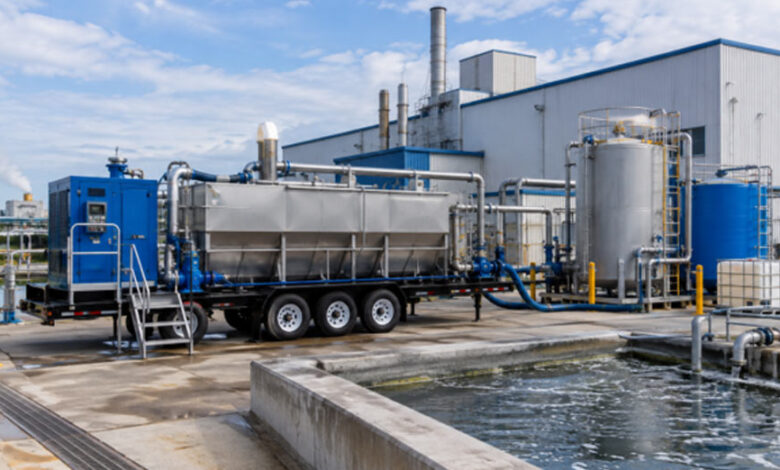
A trailer-mounted system such as the Mobile Dissolved Air Flotation (DAF) Clarifier brings this process to your site on a temporary basis. It targets suspended solids, FOG, and hydrocarbons. You can run it alone or as one stage in a multi-stage mobile treatment system.
Common uses include industrial pretreatment, bypass treatment during clarifier or filter maintenance, and waste activated sludge (WAS) thickening. As pretreatment, DAF also protects downstream equipment by removing oil and solids before they reach filters or membranes.
Chemistry still matters. DAF can run without chemicals, but coagulants or flocculants often improve separation. Jar testing on a sample of your wastewater shows what your water needs before you deploy any equipment.
Mobile Treatment or Permanent Expansion: How to Decide
Permanent expansion makes sense when high flows or loads become the norm. Mobile treatment makes sense when they come and go. Your event log helps you tell the difference.
Consider mobile treatment when:
- Surges are seasonal or short-term
- A maintenance outage needs a temporary bypass
- A permanent upgrade is still in design or construction
- A sudden failure demands a fast response
Consider permanent expansion when:
- Higher flows or loads continue year-round
- Production growth is planned and ongoing
- Long-term operating costs favor owned equipment
Mobile equipment also reduces your upfront commitment. Flexible contract terms often let you add capacity without a capital purchase. Some plants combine both approaches: permanent treatment for the baseline and mobile units for peaks.
Picture a plant with a busy eight-week season. Permanent expansion would give it capacity that sits idle most of the year. A mobile unit covers the season and leaves when production slows. Now picture a plant that grows every year. Mobile treatment buys time, but permanent capacity becomes the better long-term plan.
Size any mobile unit against your logged peaks, not your average day. Every unit has a working flow range, and your data tells you where your peaks fall.
Site Readiness Checklist for Mobile Equipment
Site readiness often decides how quickly a unit goes online. Before the equipment arrives, confirm:
- A level, stable surface, with no permanent foundation required
- Space for the trailer, plus clearance around it for access and service
- Power that meets the unit’s electrical requirements
- Piping connections for influent, effluent, float, and drain
- A plan for floated solids, including storage, hauling, or further thickening
- Chemical storage and feed, if your wastewater needs coagulants or flocculants
Delivery planning matters too. Check the access route, turning room, and any site rules for trailers.
Then decide who will run the unit. Trained plant staff can operate this type of equipment, and training can come from the supplier. Name an operator before startup so someone owns daily checks and adjustments.
Planning for Startup, Operation, and Support
A mobile unit performs best when the people around it are prepared. Plan support in three stages:
- Setup and commissioning
- Daily operation and optimization
- Demobilization and review
During setup, a field services team can support installation and commissioning so the unit starts up on solid footing. During operation, you can run the unit with your own trained staff or ask your supplier to operate it temporarily under a service package.
Either way, track results daily. Compare effluent quality, float solids, and chemical use against your targets, then adjust.
When the event ends, plan demobilization. Drain the unit, manage the remaining solids, and review the data. That review shows whether you faced a one-time spike or a pattern that justifies permanent capacity. It also gives you a head start on the next event.
Temporary treatment also supports your environmental goals. Removing solids and oils before discharge lowers the load that reaches receiving waters or your downstream treatment. It also helps you stay within permit limits during the events most likely to cause exceedances.
Putting It Together
Planning for surges and downtime follows a clear order:
- Log flow, solids, and FOG during every peak or outage
- Identify the contaminants that drive the problem
- Compare mobile treatment with permanent expansion
- Prepare your site before equipment arrives
- Line up startup, operation, and review support
You do not need to wait for the next surge to start. Your data, your contaminants, and your site layout are all things you can document today.
If your plant faces seasonal peaks or planned maintenance, review your options early. A process-based evaluation of your wastewater shows whether temporary treatment fits, what size it should be, and how to run it. Then the next surge becomes a planned event instead of an emergency.