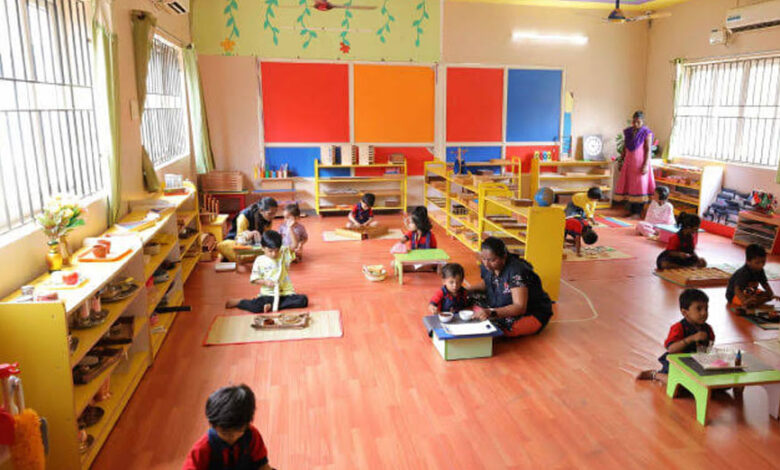
Montessori Preschool Near Me – How Child-Led Learning Builds Independence in Chennai

A young child rarely needs encouragement to explore. Give them an interesting object, a little time, and a safe place, and curiosity takes over. This natural desire to discover lies at the heart of Montessori-inspired education. Parents searching for a montessori preschool near me in Chennai can benefit from understanding how child-led activities, thoughtful classroom design, and patient educators support early development.
What Does Child-Led Learning Mean?
Child-led learning gives children opportunities to make age-appropriate choices about their activities.
Rather than expecting everyone to complete the same task simultaneously, educators observe interests and introduce suitable learning experiences.
Children develop confidence when they can explore independently.
Freedom Within Clear Boundaries
Independence does not mean children can do anything without guidance.
Educators establish expectations that protect safety and encourage respect.
Within those boundaries, children can choose activities, repeat tasks, and practise decision-making.
Why Classroom Organisation Matters
A prepared environment is an important feature of Montessori-inspired education.
Materials are arranged so children can identify, access, and return them with increasing independence.
An organised classroom also reduces unnecessary distractions.
Learning Through Accessible Materials
When materials are suitable for children’s developmental stages, they can explore confidently.
Activities involving shapes, textures, patterns, and everyday objects encourage concentration.
Children learn to take responsibility for their surroundings.
Practical Life Activities and Independence
Simple daily tasks offer meaningful learning opportunities.
Children may practise pouring water, arranging objects, organising belongings, or caring for shared spaces.
These activities strengthen coordination and attention.
Building Confidence Through Repetition
A child may repeat the same activity several times before feeling satisfied.
Repetition supports mastery.
Educators should allow sufficient time for children to practise without unnecessary interruptions.
Developing Early Mathematical Understanding
Mathematical learning begins with recognising relationships.
Children compare sizes, sort objects, count familiar materials, and identify patterns.
Moving From Concrete to Abstract Ideas
Hands-on activities make early mathematical concepts easier to understand.
For example, arranging objects from smallest to largest introduces sequencing.
Children gradually build understanding through practical experiences.
Supporting Language Development
Language grows through conversation, storytelling, songs, and observation.
Children benefit from environments where adults listen attentively and encourage expression.
Encouraging Meaningful Conversations
Educators can ask children to describe what they notice or explain their choices.
Open-ended questions support vocabulary and independent thinking.
Children should feel comfortable communicating without fear of making mistakes.
Social Development in Montessori-Inspired Settings
Independent learning does not eliminate opportunities for cooperation.
Children also learn to respect shared materials, communicate with peers, and participate in group experiences.
Developing Empathy
Everyday interactions introduce different emotions and preferences.
Educators can guide children toward respectful behaviour and patient communication.
These experiences contribute to social confidence.
What Parents Should Observe
When evaluating a montessori preschool near me, parents should look beyond classroom decoration.
Observe how educators guide children, whether materials encourage independent exploration, and how individual interests are accommodated.
Families researching preschool options in Chennai can check the local preschool map location before planning an enquiry.
Conclusion
Choosing a montessori preschool near me involves understanding how independence, exploration, and meaningful guidance contribute to development. A thoughtfully organised environment encourages children to practise responsibility, concentration, communication, and problem-solving. When learning respects individual interests and allows children to discover through experience, early education can nurture curiosity and confidence that continue well beyond preschool.