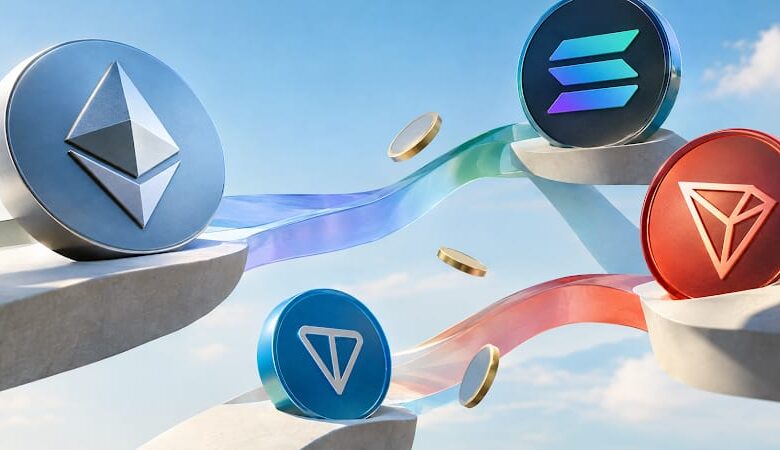

Until a few years ago, sending tokens to another blockchain meant picking a bridge by hand and accepting a wrapped version of the asset on the other side. In 2026 most swap services do the routing themselves: the user signs once and receives the asset they asked for on the destination chain. The five platforms below handle that job in quite different ways, so which one suits a particular route?
Why people swap across chains
Ethereum mainnet still holds most DeFi collateral. Trading, meanwhile, has drifted to Arbitrum and Base, and Solana, TRON and TON have grown stablecoin and payment economies of their own. Someone holding USDT on TRON who wants SOL would face a bridge, a swap and an empty gas balance on Solana.
Two kinds of services remove those steps. Aggregators scan bridges and DEXs and hand back one route with an estimated output, with every leg executed by smart contracts. Instant exchange services take the deposit themselves, source liquidity on their side and pay out to whatever address the user gives, with destination gas already priced into the rate.
Bridges paid heavily for the early growth. Chainalysis counted 13 bridge hacks in 2022 by its August report, with about $2 billion stolen, close to 69% of everything taken from crypto that year up to that point.
The top 5 platforms compared
A growing share of retail transfers ends up on cheap payment chains. Anyone comparing TON and Solana for everyday transfers will likely reach either network through a swap, which is why chain coverage and ease of use carry the most weight in the ranking below. Security records are covered platform by platform.
| Platform | Settlement model | Strongest use | Main trade-off |
| ChangeNOW | Instant exchange, service-side routing | Swaps between non-EVM and EVM chains with network costs built into the quote | Service executes the swap, AML checks can hold a transaction |
| LI.FI (Jumper) | Aggregator of bridges and DEXs | Broad DeFi route coverage, wallet integrations | Inherits the risk of each underlying bridge |
| Across | Intents, UMA-verified repayment | Ethereum to L2 in seconds | Strongest on EVM routes |
| deBridge (DLN) | Intents, 0-TVL design | EVM to Solana swaps | Large orders depend on filler inventory |
| THORChain | Native pools paired with RUNE | Native BTC swaps | 2026 vault exploit, laundering exposure |
ChangeNOW
The typical ChangeNOW user wants to fast swap crypto across blockchains without opening a wallet or a bridge on each network. USDT on TRON into TON is a common case, as is BTC into an EVM token, and DeFi routers handle both routes poorly. According to the company, it supports more than 1,000 cryptocurrencies on over 110 networks, including Bitcoin, TRON, TON and Solana. You send funds to a generated deposit address, and the target asset arrives in your own wallet. Network costs are folded into the quoted rate, and pricing can be fixed or floating. Standard swaps need no account. The service itself executes each swap and screens it for AML risk, and it can hold a flagged transaction until the check clears.
LI.FI (Jumper)
Many wallet swap screens, Jumper’s included, run on LI.FI’s routing engine. It weighs bridges against DEX aggregators and bundles the legs into one transaction where possible. Its weak spot surfaced in July 2024, when a freshly deployed contract abused users’ unlimited token approvals and about $10 million was lost before LI.FI disabled the component. The team later published a post-mortem.
Across
Sending ETH or USDC from mainnet to Arbitrum or Base through Across usually takes seconds. A relayer pays the user on the destination chain first and claims repayment once UMA’s optimistic oracle confirms the fill. Liquidity is split between a HubPool on Ethereum and SpokePool contracts on each supported chain. Fees on the common routes tend to be low.
deBridge
deBridge’s DLN keeps no pooled liquidity, a design the team markets as “0-TVL.” Market makers fill each order from their own inventory, and user deposits never collect in a shared vault. For swaps between EVM chains and Solana, it is in the author’s view the strongest option today. Very large or unusual orders are the exception, since they clear only when a filler accepts them at a fair price.
THORChain
THORChain swaps native assets on-chain without wrapping them: bitcoin from the Bitcoin network can come out as native ETH, and ETH can come out as bitcoin.
The past two years have been hard on it. Node operators froze THORFi lending and savers in January 2025 with roughly $200 million owed. Weeks later, Lazarus-linked actors pushed ETH stolen from Bybit through the protocol into bitcoin. TRM Labs also names THORChain as the main laundering route for the April 2026 KelpDAO hack, which came close to $300 million.
The May 2026 exploit hit the protocol directly. A node operator abused a flaw in the GG20 threshold-signing scheme and drained about $10.7 million from one vault. Automated solvency checks halted trading within minutes, and swaps resumed roughly five weeks later. Native bitcoin liquidity keeps THORChain in the top five, though large transfers here call for extra caution.
How these platforms settle a swap
Lock-and-mint and pooled liquidity
Wrapped tokens are the oldest answer. The source chain locks the original and the destination mints a copy, which is only as safe as the contract and validators issuing it. Wormhole showed the cost of that in February 2022, when an attacker minted about 120,000 wETH on Solana against no collateral. Stargate and similar pooled designs pay out native assets from liquidity pools on each chain, and those pools become targets in their own right.
Intents and solvers
Across and deBridge both run on intents: signed messages in which the user states the result they want on the destination chain. A relayer or market maker fills the order from its own funds, usually within seconds, and the protocol pays it back later. Uniswap Labs and Across co-wrote ERC-7683 in 2024 as a standard format for these orders, so one network of fillers can serve many apps.
Burn-and-mint for native stablecoins
Circle’s Cross-Chain Transfer Protocol moves USDC by burning the tokens on the source chain and minting the same amount on the destination, with no wrapped copy in between. Version 2 came out in 2025 and cut settlement on supported chains to a few seconds. Where the USDC lands still affects what a user pays and what they can do with it afterward, and comparisons of how Solana and Ethereum fit different use cases are a good place to check that before sending.
What the bridge hack record teaches
Concentrated control sits behind most of the largest bridge losses:
- Ronin lost about $625 million in March 2022 after attackers obtained five of its nine validator keys. The FBI attributed the theft to Lazarus Group.
- A faulty upgrade at Nomad in August 2022 let anyone replay a valid message, and about $190 million drained out within hours.
- Multichain collapsed in July 2023 once Chinese police detained its CEO, who personally controlled key infrastructure.
Since those failures, contract-based platforms have cut the time funds spend inside contracts, and aggregators such as LI.FI let users exclude specific bridges from a route. Instant exchange services keep user funds away from bridge contracts, so evaluating them comes down to the operator’s track record and compliance process. On any platform, check who controls the funds while they are in transit.
Large transfers of major assets can still go through a centralized exchange, at the cost of identity checks and custody risk. European users also deal with MiCA. Since December 2024 it has required crypto-asset service providers to be licensed, which partly decides which services they can reach.
Outlook to 2027: three scenarios
| Scenario | Driver | Likely effect |
| Base | Stablecoin supply keeps growing and more protocols adopt ERC-7683 | Fills under 10 seconds become standard on EVM routes. Instant exchange services hold their position on TRON, TON and Bitcoin corridors |
| Optimistic | Major wallets build in chain abstraction, and the GENIUS Act of July 2025 settles US stablecoin rules | Users swap straight from a wallet without picking a route, while aggregators and exchange APIs work in the background |
| Stress | A large solver or messaging-layer exploit, or sanctions against a protocol | Volume moves to CCTP and a few licensed or audited routes, with tighter compliance screening across the market |
Route first
The quoted fee shows only the spread and network cost, while the largest losses in cross-chain history came from custody failures. That makes the custody model and incident record part of the price comparison. A small test transfer and a revoked router approval afterward guard against the two problems seen most often: a misrouted swap and an exploited approval.
FAQ
What is a cross-chain swap?
One transaction that trades an asset on one blockchain for a different asset on another.
How is a bridge different from an aggregator?
Bridges move assets through a single mechanism. Aggregators compare several bridges and DEXs before choosing a route.
What is the safest way to move USDC between chains?
Circle’s CCTP, on the chains it supports. It burns and mints native USDC, so no wrapped token is involved.
Can I swap native bitcoin without wrapping it?
Two platforms on this list do it: ChangeNOW as a service and THORChain through on-chain pools.
Why do some swaps get held for review?
Usually because of AML screening. A transaction tied to flagged addresses can be paused until the check is complete.
What is the biggest risk in cross-chain swaps?
Compromised contracts or keys in the bridge layer have caused the largest losses to date.
Why revoke token approvals after swapping?
An open approval lets a compromised router contract pull tokens from your wallet. That is how users lost funds in the 2024 LI.FI incident.
Do regulations affect which swap services I can use?
They can. In the EU, MiCA licensing applies to service providers, and availability varies by country.
Disclaimer: This article is for informational purposes only and does not constitute financial, investment or legal advice. Crypto assets carry high risk, including total loss. Do your own research before using any platform.