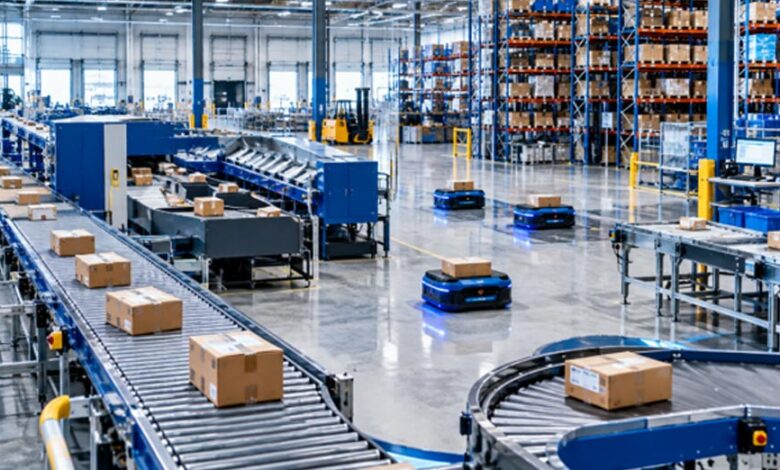

A distribution center sizes a new sortation line for its average day. The line performs well through spring and summer. Then peak season arrives, order volume nearly doubles for six weeks, and the equipment that looked right on paper becomes the choke point. Temporary labor fills the gaps, errors climb, and the investment meant to bring stability turns into the thing everyone works around.
The root cause is a sizing decision made against one number, average volume, when the operation actually lives across a range. This article explains why variability belongs at the front of any automation design, how fixed and flexible systems behave differently across that range, and how to match the option to the pattern your own order data shows.
Why the Average Day Makes a Poor Design Target
Sizing to the average leaves peak days underserved. Sizing to the peak leaves expensive capacity idle for most of the year. Neither choice is wrong in every case, but both are guesses unless the swing in demand has been measured and written into the requirements.
Variability has several dimensions, and each one affects equipment choice differently:
- Magnitude is the gap between a normal day and the busiest day.
- Duration is how long the peak lasts, whether a few days around a promotion or a full quarter.
- Ramp speed is how quickly volume climbs, which determines how much time there is to add labor or capacity.
- Mix shift is the change in what moves during a peak, such as more single-unit orders, more returns, or different SKUs.
A system that handles a tall, short spike may struggle with a long plateau, and the reverse is also true. Knowing which pattern applies is the first step in comparing options.
Fixed and Flexible Automation in Plain Terms
Automation falls along a spectrum from fixed to flexible. Most real projects land somewhere in the middle, so it helps to understand the ends.
- Conveyor and sortation move cases, totes, and cartons along defined paths. Throughput is high and consistent once the system is tuned, and cost per unit tends to be attractive at steady, high volume. Changing the flow later usually means physical rework.
- Automated storage and retrieval systems raise storage density and retrieval speed in a compact footprint. They suit predictable flow and high-mix inventory, and they are sized around a defined capacity.
- Mobile robots transport or bring work to associates and adapt to layout changes without major infrastructure. Capacity grows in increments as units are added, and units can be reassigned when priorities shift.
- Manual and hybrid labor remains the flexible layer in nearly every operation. Automation changes where labor is applied, and the plan should say so.
The central trade-off is commitment against adaptability. Fixed systems reward stable, high-volume flow. Flexible systems reward uncertainty and change. Neither wins by default, and the right balance depends on the demand pattern.
Measure Variability Before Comparing Options
Comparing options without data produces opinions. Pull at least a full year of order history, and more if it is available, then calculate the figures that describe your pattern.
- Peak-to-average ratio for orders, lines, and units, measured by day and by hour.
- Peak duration and frequency, including how many peaks occur in a year and how long each lasts.
- Ramp rate, or how many days it takes to move from normal volume to the peak.
- SKU velocity skew, which shows whether a small share of items drives most of the activity.
- Order profile, including lines per order and the split between each, case, and pallet handling units.
- Growth forecast, with a conservative case and an ambitious case, because the right system today may be too small in three years.
Charting normal weeks and peak weeks side by side is often revealing. A tall narrow peak points toward capacity that can be added temporarily. A broad plateau points toward systems that hold throughput over time.
Match the Option to the Pattern
With the numbers in hand, patterns tend to suggest a direction. These are tendencies to test, and every site has details that can change the answer.
- Steady, high volume with stable flow often favors fixed systems, where predictable throughput and lower cost per unit pay off.
- Sharp seasonal peaks on a modest baseline often favor flexible capacity, since extra units can be added for the season and redeployed afterward, or a hybrid with temporary labor.
- Mixed patterns often call for a fixed backbone with flexible capacity at the edges, such as a conveyor spine handling the base load while mobile robots absorb surges and handle changes in layout.
- Rapid growth or uncertain product mix often favors modular choices that can be expanded without tearing out what was already installed.
The most reliable way to confirm a direction is to compare several automation options side by side against the same order data, with layouts, labor savings, space impact, and cost laid out for each. When each option is judged at both the quiet end and the peak end of the range, the trade-offs become visible before money is committed.
Build In Room to Scale
Whatever the choice, design for the next phase as well as the first. A few habits keep options open.
- Phase the project. Start with the bottleneck that costs the most, prove the return, and expand from there.
- Reserve space and utilities. Leave floor area, power, and network capacity for added units or extensions.
- Confirm the software can grow. Control and execution software should handle additional equipment and workflows without a rebuild.
- Define trigger points. Agree in advance on the volume or performance level that justifies the next phase.
- Plan for the downside. Volume can fall as well as rise, so ask how each option behaves at low utilization and whether equipment can be repurposed.
Back to Peak Season
The sortation line in the opening was fine on an average Tuesday. It was never tested against the busiest week of the year, and that is the week that defined the operation’s year. Before choosing equipment, put the busiest and slowest weeks on the same page and ask each option how it behaves at both ends. The answer will say more about fit than any specification sheet.