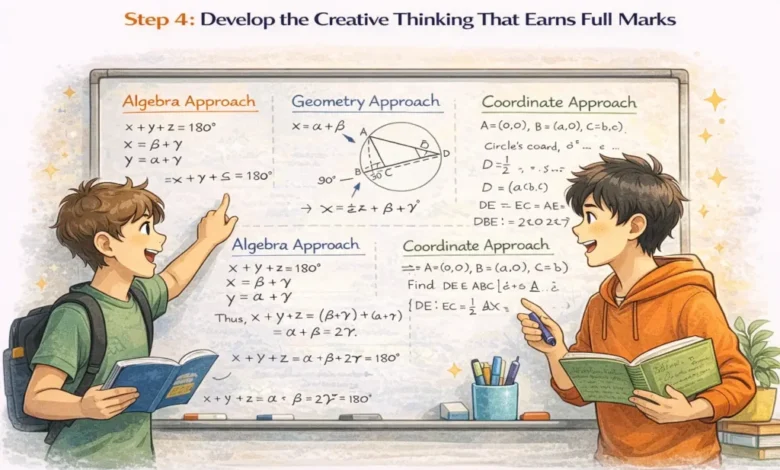

Mathematics becomes more meaningful when students learn to think beyond memorised formulas and familiar question patterns. As they encounter challenging problems, Maths Olympiad books can encourage them to use observation, reasoning, creativity, and careful decision-making. Instead of simply asking students to find an answer, these resources encourage them to understand why a solution works and explore different ways of reaching it.
Table of Contents
|
Why Olympiad Mathematics Requires a Different Mindset
School mathematics often introduces students to concepts through explanations, examples, and familiar applications. Olympiad-style mathematics can work differently. A problem may present information without clearly identifying which formula or method should be used.
This uncertainty is valuable because it encourages students to make decisions before beginning the calculation. They must identify relevant information, consider possible approaches, test their ideas, and decide whether the result makes sense.
The goal is therefore not simply to make mathematics harder. It is to make mathematical thinking more deliberate. Students gradually become comfortable with unfamiliar questions and learn that struggling with a problem can be part of the learning process.
From Answer Finding to Idea Finding
A strong problem solver does not immediately search for an operation to perform. Instead, the student first asks:
- What information is available?
- What exactly is the problem asking?
- Is there a relationship between the numbers?
- Can the problem be represented visually?
- Is there a simpler version of the same problem?
- What could be tried first?
These questions create a thinking routine that can eventually become automatic.
Moving From Recognising Patterns to Investigating Problems
One important benefit of challenging mathematical practice is that it changes how students approach unfamiliar questions. Rather than looking for a familiar template, they begin investigating the structure of the problem.
For example, a question involving a sequence of numbers may not directly state the rule. Students might need to compare differences, examine multiplication patterns, or consider how one term relates to another.
This type of investigation develops mathematical curiosity. Children learn that numbers often contain relationships that are not immediately visible.
Looking for Relationships
Students can investigate:
- Repeated numerical relationships
- Increasing or decreasing differences
- Symmetry
- Grouping possibilities
- Odd and even properties
- Spatial arrangements
- Number constraints
The purpose is not to teach students to guess patterns randomly. It is to help them collect evidence and use that evidence to form a reasonable mathematical idea.
Building the Habit of Asking Better Questions
Strong problem solving begins with good questions. When students encounter a difficult problem, they may initially feel that they do not know where to start. Learning how to question the problem can provide a practical starting point.
A student might ask whether the numbers can be rearranged, whether a diagram would help, or whether the problem can be solved by working backwards. Each question opens another possible route.
Over time, this approach makes students less dependent on being shown a method before they attempt a problem.
Questions That Open New Routes
Useful prompts include:
- Can I simplify the problem?
Removing unnecessary information can reveal the central mathematical relationship. - Can I work backwards?
Starting from the desired result can sometimes make the steps easier to identify. - Can I draw it?
A diagram can turn an abstract relationship into something easier to examine. - Can I test a small example?
A simpler case may reveal an underlying rule. - Can I solve it another way?
Comparing methods can deepen understanding of the mathematics involved.
These prompts encourage students to become active participants in the problem-solving process.
Learning to Break Complex Problems Into Smaller Parts
A challenging problem can appear intimidating when students view it as one large task. Breaking it into manageable components can make the reasoning clearer.
For instance, a problem might contain several conditions involving numbers, positions, or quantities. Instead of attempting everything simultaneously, students can identify each condition and examine how the pieces interact.
This process develops an important mathematical skill: decomposition. Students learn to transform a complicated situation into smaller questions that can be understood separately.
A Practical Breakdown Method
A student can approach a complex question by identifying:
- The known information
- The unknown quantity
- The conditions that must be satisfied
- The relationship between different pieces of information
- The possible first step
- The evidence needed to confirm the answer
This method does not guarantee an immediate solution, but it provides structure when a problem initially seems unclear.
Using Patterns as Clues Rather Than Shortcuts
Patterns are powerful in mathematics, but recognising one is only the beginning. Students need to determine whether a pattern is supported by the available information.
Suppose a sequence appears to increase by a particular amount in its first few terms. A student might predict the next number, but a stronger mathematical approach asks whether the observed relationship continues consistently.
This distinction matters because Olympiad-style problems often reward careful reasoning rather than quick assumptions.
Turning Observations Into Evidence
Students can strengthen their thinking by following a simple progression:
Observe → Hypothesise → Test → Explain → Conclude
First, they notice something unusual or repeated. Next, they form a possible explanation. They then test the idea using additional examples or logical reasoning. Finally, they explain why the conclusion is valid.
This process teaches children to distinguish between a guess and a mathematically supported conclusion.
Developing Multiple Ways to Approach a Problem
There is rarely only one interesting way to think about a mathematical problem. A question might be solved through arithmetic, a diagram, logical elimination, pattern recognition, or another strategy.
Exploring multiple approaches helps students understand that mathematics is not always a fixed sequence of steps.
For example, one student might organise information in a table while another draws a diagram. Both methods can be valuable if they reveal the underlying relationship and lead to a justified conclusion.
Why Alternative Methods Matter
Comparing solutions can help students:
- Identify efficient strategies
- Understand why a method works
- Recognise similarities between different approaches
- Discover errors in their own reasoning
- Develop flexibility when facing unfamiliar questions
The emphasis should be on understanding the reasoning behind each method rather than simply finding the fastest technique.
Understanding the Role of Mistakes in Mathematical Thinking
A difficult problem naturally produces incorrect attempts. Rather than treating every mistake as failure, students can examine what the attempt reveals.
An incorrect solution may show that a condition was overlooked, a pattern was assumed too quickly, or an operation was applied in the wrong context. Analysing that point can be more educational than simply seeing the correct answer.
Resources that encourage students to think about why an answer is incorrect can therefore support deeper mathematical development.
From Error to Insight
A useful reflection process is:
Attempt → Identify the difficulty → Reconsider the assumption → Try a revised approach → Explain the improvement
This encourages students to see problem solving as an iterative process. It also helps develop persistence without reducing learning to repeated attempts at the same question.
Strengthening Logical Reasoning Through Challenge
Olympiad mathematics naturally creates opportunities to develop logical reasoning because many problems contain conditions that must be considered together.
Students may need to determine which possibilities are possible, impossible, or guaranteed. This requires more than calculation. It requires attention to relationships and evidence.
For example, a problem may ask students to arrange objects according to several restrictions. The solution depends on understanding how one condition affects another.
Reasoning Skills Students Can Develop
Regular exposure to well-designed problems can encourage:
- Classification
- Deduction
- Comparison
- Elimination
- Estimation
- Spatial reasoning
- Sequential thinking
- Conditional reasoning
These skills can support mathematics beyond competitions because they are also useful when students encounter unfamiliar school problems.
Connecting Olympiad Thinking With School Mathematics
Olympiad preparation should not be viewed as completely separate from regular mathematics. Many challenging problems rely on familiar foundations such as arithmetic, fractions, geometry, measurement, ratios, and number properties.
The difference is often found in how those concepts are presented.
A familiar school concept might ask students to apply a known procedure. An Olympiad-style question may require them to discover which concept is relevant and determine how it can be used.
This makes foundational understanding especially important. Advanced problem solving is difficult when basic mathematical ideas are uncertain.
Where an Assessment Book Can Fit
As part of a broader learning plan, students can use different resources for different purposes. When they need to check their understanding of curriculum-based concepts, assessment books can provide structured practice, while Olympiad resources can challenge them to apply those foundations in less familiar situations.
Using both types of resources according to their individual purposes can create a more balanced learning experience. One can support structured evaluation, while the other encourages exploration, flexible thinking, and deeper reasoning.
Choosing Practice That Encourages Independent Thinking
Not every collection of difficult questions automatically develops strong problem-solving skills. The quality and structure of the practice matter.
A useful resource should give students opportunities to encounter different kinds of thinking rather than repeatedly presenting the same question with different numbers.
When selecting materials, parents and educators can consider whether the resource:
- Includes a range of problem types
- Gradually introduces greater complexity
- Encourages reasoning instead of memorisation
- Provides explanations that clarify the thinking process
- Uses age-appropriate language
- Allows students to attempt problems independently
- Includes questions that require more than one step
The objective is to create productive challenge. Questions should stretch students without making every activity feel inaccessible.
Creating a Problem-Solving Progression
Instead of treating Olympiad practice as a collection of unrelated difficult questions, learners can move through a progression of thinking skills.
The following framework shows how different activities can contribute to that development:
| Stage | Student Focus | Example Thinking Action | Skill Developed |
| Notice | Identify important information | Circle useful clues | Observation |
| Explore | Consider possibilities | Test a simple case | Curiosity |
| Organise | Structure the information | Draw or group data | Organisation |
| Reason | Connect conditions | Eliminate impossible options | Logic |
| Solve | Select an approach | Apply a suitable strategy | Problem solving |
| Verify | Check the conclusion | Test the answer against conditions | Accuracy |
| Explain | Communicate the reasoning | Describe why the method works | Mathematical communication |
This progression highlights an important point: problem-solving ability is made up of several connected behaviours. A student who struggles to solve a difficult question immediately may still be developing valuable skills through observation, organisation, and reasoning.
Moving Gradually Toward Independence
At an early stage, students may need prompts such as “What information do you know?” or “Can you draw the problem?” As their confidence develops, those prompts can become less frequent.
Eventually, students can learn to choose their own strategy, explain their reasoning, and decide how to verify their answer. That movement from guided thinking to independent decision-making is one of the most valuable outcomes of challenging mathematics practice.
How Parents and Educators Can Support Deeper Problem Solving
Adults can support Olympiad learning without immediately providing solutions. The most useful intervention is often a question that helps the child reconsider the problem.
Instead of saying, “Use this formula,” an adult might ask, “What information could you use first?” This keeps the thinking with the student.
Encourage Explanation, Not Just Answers
After a child reaches an answer, ask them to explain:
- How did you begin?
- Why did you choose that method?
- What information helped you most?
- Did you consider another approach?
- How do you know the answer satisfies the question?
These conversations make mathematical reasoning visible and give students practice communicating their ideas.
Making Difficult Mathematics More Enjoyable
Challenge becomes more productive when students feel that they are investigating rather than being tested constantly.
Parents can introduce interesting problems as puzzles, allow children to discuss different solutions, and celebrate thoughtful attempts even when the first answer is incorrect.
Short discussions about how a solution was discovered can also make mathematics feel more exploratory. Over time, students may begin to approach unfamiliar questions with curiosity instead of immediately expecting a standard procedure.
Final Takeaway
Strong mathematical thinking develops when children have opportunities to observe, question, organise, reason, test, and explain. By working through challenging problems, Maths Olympiad books can encourage students to move beyond routine calculations and develop the flexibility needed to approach unfamiliar questions. With regular practice, these challenges can help children become more confident and thoughtful problem solvers.
The most effective approach is not simply to increase the difficulty of questions. It is to help learners understand the thinking process behind challenging mathematics and gradually become more independent in choosing strategies.
Giving students room to experiment with ideas and consider different approaches can make mathematics practice more engaging and purposeful. For families looking to add suitable practice materials at home, resources from Singapore Asia Publishers can complement regular mathematics learning while giving children more opportunities to work through varied questions. This regular exposure can help students become more comfortable with unfamiliar problems and gradually strengthen their reasoning skills.
Frequently Asked Questions
1. What are Maths Olympiad books used for?
Maths Olympiad books are designed to expose students to challenging mathematical problems that require reasoning, creativity, pattern recognition, and strategic thinking. They can complement regular school mathematics by introducing less familiar problem formats.
2. Are Maths Olympiad books suitable for beginners?
Yes. The right resource should match the learner’s current mathematical ability. Beginner-friendly books can introduce reasoning gradually before moving toward more complex multi-step problems.
3. How do Maths Olympiad books improve problem-solving skills?
They give students opportunities to analyse unfamiliar situations, identify relationships, test strategies, and justify conclusions. Repeated exposure to different problem structures can improve flexibility in mathematical thinking.
4. Can Maths Olympiad practice help with school mathematics?
Yes. Olympiad problems often use foundations such as arithmetic, geometry, fractions, ratios, and number properties. Applying these concepts in unfamiliar situations can strengthen conceptual understanding and reasoning.
5. Should students use an assessment book along with Olympiad resources?
They can be used for different purposes. An assessment book can help evaluate curriculum-based understanding, while Olympiad resources can provide additional opportunities for reasoning and challenging applications.
6. How can parents help children with difficult Olympiad questions?
Parents can ask guiding questions instead of immediately giving the solution. Encouraging children to explain what they know, draw the problem, test an example, or consider another approach can support independent thinking.
7. Is getting the correct answer the main goal of Olympiad practice?
The correct answer is important, but the reasoning process is equally valuable. Understanding why a method works helps students develop transferable problem-solving skills that can be applied to new mathematical situations.