
When evaluating an Albion magnesium bisglycinate alternative, procurement and R&D teams should start with the exact reference product code, the formula under review, and pre-defined change-acceptance criteria. Sharing a chemical or common name such as magnesium bisglycinate or magnesium glycinate does not establish automatic equivalence, shared certifications, or a one-to-one drop-in replacement. Every substitution decision must rest on project-specific documentation, side-by-side specification alignment, and controlled bench or pilot trials for that individual stock-keeping unit.
Name the reference ingredient precisely
An evaluation record fails before bench work begins if the internal request lists the reference material only as a generic brand name. Balchem’s February 1, 2016 SEC announcement states that it acquired Albion International, Inc., a manufacturer of mineral amino acid chelates; Balchem presents Albion® Minerals as its chelated mineral brand. Balchem describes TRAACS® (The Real Amino Acid Chelate System) as a trademarked designation that can be co-branded with Albion and is available for more than 20 products; it is not a single universal material code. Product codes and specifications under that brand family are product-specific, so treat each exact code as its own baseline rather than assuming a brand name defines one grade.
Before requesting samples from any alternative supplier, lock the baseline record: exact supplier product code, current specification sheet revision, certificate of analysis ranges from historical lots, and the ingredient’s role in the master batch record. If the reference material in a capsule formula has a defined tapped density and elemental magnesium assay, name those parameters. Do not ask for a generic brand match.
Write the change question before requesting candidates
Once the reference ingredient is documented, technical and procurement leads should define why the evaluation is happening. Frame the work around a concrete change question tied to formula compatibility, processing behavior, or finished-product constraints already written into the project brief. Do not invent a shortage or cost narrative that is not part of the documented scope.
A contract manufacturer or brand technical team might ask whether a candidate stays within tablet weight and tooling limits on an existing press, or whether a powder blend keeps target pH and dispersion behavior in a flavored stick pack. The project brief should state dosage form, target elemental magnesium contribution per serving as a development calculation, processing steps, and non-negotiable finished-product release limits. Those boundaries tell prospective suppliers which grade to submit and give quality assurance a pass/fail rubric before material enters the lab.
Compare candidate grade with reference grade
Compare the candidate against the reference at the same target elemental magnesium load and under the constraints of the final formula. Do not treat raw price per kilogram as the primary decision metric. Two materials with the same nominal chemical name can behave differently if elemental assay, moisture limits, or flow properties diverge.
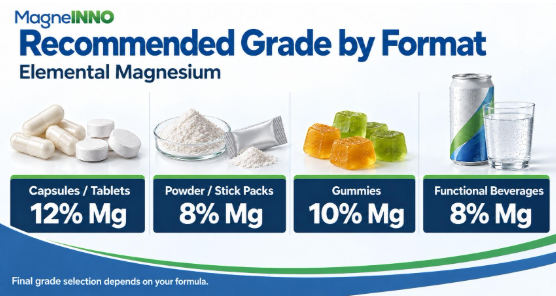
Match the grade to the delivery system first. Within the MagneINNO magnesium glycinate grades, three elemental magnesium levels serve as application selection starting points:
- 12% elemental magnesium grade: starting point for capsules and tablets where fill weight and compression or encapsulation flow matter.
- 10% elemental magnesium grade: starting point for gummy matrices where gel texture, thermal staging, and active load per piece must stay balanced.
- 8% elemental magnesium grade: starting point for powders, stick packs, and beverage applications where dispersion and sensory alignment in liquid or dry-mix bases matter.
These percentages are elemental magnesium content and initial application direction. They are not purity percentages, rigid usage boundaries, or proof of functional identity with a reference product. In a hypothetical R&D mass-balance calculation, at an assayed as-supplied elemental magnesium content of 12%, delivering 100 mg elemental Mg requires about 833 mg of material (100 ÷ 0.12); at an assayed as-supplied 8%, about 1,250 mg (100 ÷ 0.08). If a specification is reported on a dry basis, adjust for moisture. This mass-conversion example is not a dose recommendation; it changes remaining space for flavors, organic acids, and flow agents, and should be refined with bulk density and sieve data before bench trials.
| Decision item | Reference ingredient | Candidate evidence required | Project decision |
|---|---|---|---|
| Material identity and grade | Exact reference product code, specification version, and nominal elemental Mg assay | Product specification sheet, method of analysis for elemental Mg, and batch COA across multiple lots | Verify alignment or flag assay adjustment needed in the master formula |
| Physical and flow profile | Current bulk/tapped density, mesh distribution, and loss on drying ranges | Sieve analysis, density test data, and physical handling notes for the target equipment | Approve for bench trial or reject if incompatible with current tooling |
| Formula mass balance | Current input weight per serving and excipient ratio in the master batch record | R&D recalculation of active input weight and excipient adjustments at target elemental load | Document required formula revision level before pilot scale-up |
| Label and regulatory claims | Approved finished-product label copy, third-party marks, and customer agreements | Independent documentation for the candidate grade; do not assume inherited claims | Confirm whether label artwork or quality agreements need formal amendment |
| Trial performance | Historical in-process control data and finished-product stability baseline | Side-by-side control vs. candidate trial records, sensory check, and accelerated stability plan | Accept for next trial phase, revise formula, or reject for this SKU |
Keep brand co-occurrence factual
Putting a candidate on the same evaluation schedule as an established reference brand is normal B2B documentation. Listing a candidate beside an Albion or Balchem reference product only means both materials are being tested against the same project specification. It does not mean the candidate is a recognized equivalent, uses identical processing technology, or carries interchangeable certifications.
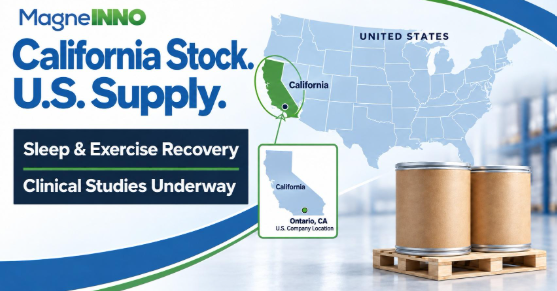
MagneINNO™ magnesium glycinate is supplied by NutraINNO USA Inc., the U.S. company behind the MagneINNO brand, and is built on proprietary MagniLift™ technology. Record each supplier’s proprietary nomenclature and corporate entity on its own merits. TRAACS® remains a trademarked designation associated with Balchem’s Albion® Minerals portfolio rather than a single material code; MagniLift™ is the proprietary technology designation for MagneINNO grades. Keep those identities distinct during audits, label reviews, and quality sign-offs. Other mineral salt suppliers such as Jost Chemical and Dr. Paul Lohmann may appear in a tender file only when their exact product codes match the written technical brief; evaluate each grade against that specification rather than assuming cross-brand parity.
Run a bounded change-control trial
Specification alignment only clears a candidate for laboratory evaluation. To see how it performs inside a specific formula, R&D and quality run a bounded change-control trial: a control batch with the current reference lot against a test batch with the candidate lot, under identical processing conditions.
Define the trial boundaries before blending starts:
- Lock the trial batch design. State whether the candidate is tested at equal raw-material weight or equal elemental magnesium weight. If the elemental assay differs, document the excipient offset used to keep total batch weight constant.
- Monitor in-process parameters. Select in-process parameters according to the dosage form and risk assessment. For tablets, consider blend uniformity, weight variation, breaking force (hardness), friability, and, where relevant, ejection force. For dry mixes or gummies, consider formula-specific measures such as dispersion time, pH, Brix, and viscosity, sampled at defined points during the hold period.
- Evaluate sensory and appearance. Run blind side-by-side checks against the control for color, odor, mouthfeel, and solution clarity or sedimentation where applicable.
- Route quality and regulatory sign-off. Confirm whether any process parameter or minor excipient change stays inside existing master batch tolerances or triggers customer notification, stability re-entry, or label revision.
A candidate can fail compressibility in a high-load direct-compression tablet and still meet every requirement in a flavored powder blend. Record the exact mechanical or chemical reason for pass or fail so the data remains useful for later projects.
Record a project-specific decision
Close the evaluation with a formal, project-specific disposition: accept for the next trial phase (scale-up or accelerated stability), revise the formula or process and re-test, or reject the candidate for this project. Approving a grade for a stick-pack SKU does not qualify it for a high-speed capsule line. Rejecting a grade for bulk density mismatch in a rigid capsule shell does not bar that supplier from a new gummy or beverage brief where density is less restrictive. Tie every outcome to a named reference code, a formula version, and documented trial evidence.
Frequently Asked Questions
Does the same ingredient name establish interchangeability?
No. Sharing a chemical or common name such as magnesium bisglycinate or magnesium glycinate does not by itself establish identical elemental magnesium content, bulk density, particle size, moisture profile, or sensory behavior in a finished matrix. Interchangeability should be demonstrated for each formula through specification review and controlled trial batches.
Does a candidate inherit the reference brand’s certifications or claims?
No. A candidate material does not inherit the trademarks, third-party certifications, regulatory dossiers, or marketing claims of a reference material. Quality and regulatory teams should verify the candidate supplier’s own documentation, including specifications, certificates of analysis, and certification scope, before approving a change.
Should raw price per kilogram drive the first comparison?
No. Price per kilogram ignores elemental assay (including as-is versus dry basis), moisture limits, and flow behavior that change mass balance and process fit. Compare candidates at the same target elemental magnesium load under the formula’s constraints, then bring cost into the decision after the technical gates are clear.
Can approving a candidate for one SKU cover other dosage forms?
No. A pass for a stick-pack or flavored powder does not automatically qualify the same grade for high-speed capsules, tablets, or gummies. Each disposition should stay tied to a named reference code, formula version, and documented trial evidence for that SKU.
Why lock the exact Albion or Balchem product code before sampling alternatives?
Balchem and Albion publish product-specific codes and specifications, and a brand name alone may cover more than one grade or format. Locking the exact reference code, specification revision, and historical COA ranges before sampling alternatives gives side-by-side evaluation a defined baseline.