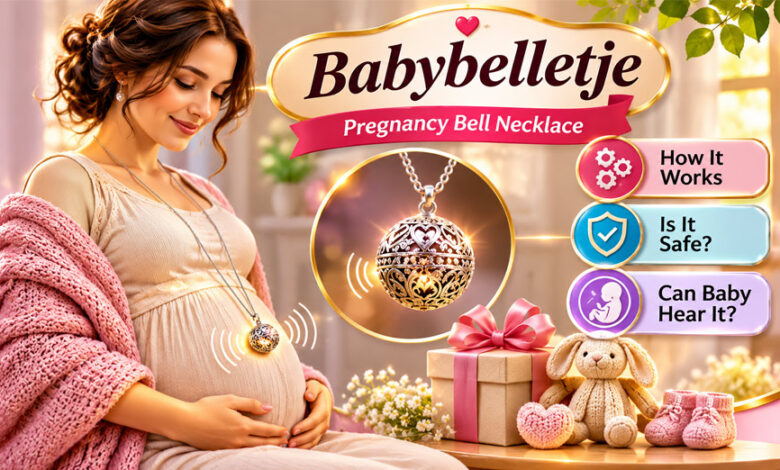

A Babybelletje is usually a long pregnancy necklace with a small pendant. The pendant makes a soft sound when the person wearing it moves.
It is also called a pregnancy bell, pregnancy bola, or harmony ball.
People often search for Babybelletje to learn how it works, whether a baby can hear it in the womb, and whether it is safe during pregnancy.
The word can also be confusing. Belletje means “little bell” in Dutch. Babybelletje is also sometimes used online when talking about Mini Babybel cheese.
This guide explains what a Babybelletje is, how it works, why people wear it, and what is known about its safety.
What Is a Babybelletje?
A Babybelletje is a type of pregnancy jewelry. It usually has a long chain or cord with a small pendant at the end.
There is a small moving part inside the pendant. When the person walks or moves, the pendant makes a gentle chiming sound.
The necklace is usually long enough for the pendant to hang around the lower part of the baby bump.
Babybelletjes come in different shapes, colors, materials, and designs. Some have simple round pendants. Others have decorative patterns or symbols.
Similar jewelry may be called a pregnancy bola, pregnancy bell, harmony ball, baby bell, or angel caller. The Dutch term zwangerschapsketting is also used for pregnancy necklaces.
A Babybelletje is jewelry. It is not a medical product or pregnancy treatment.
What Does Babybelletje Mean?
Babybelletje has a connection with the Dutch language.
In Dutch, bel means “bell.” The word belletje means “little bell.”
Dutch speakers often use smaller forms of words. These forms can describe something small. They can also make a word sound more friendly or affectionate.
This helps explain the name Babybelletje because the necklace contains a small pendant that makes a bell-like sound.
However, Babybelletje does not always have one fixed meaning. Its meaning can depend on where and how the word is being used.
In pregnancy-related content, it can mean a pregnancy necklace. In food-related content, it may sometimes have another meaning.
Is Babybelletje Related to Mini Babybel Cheese?
The similar names can easily cause confusion.
Mini Babybel is the small, round cheese snack sold under the Babybel brand.
Some people may use Babybelletje online as a cute or informal name for a small Babybel cheese.
However, Babybelletje is not shown as an official Babybel product name in the information we reviewed.
If you see Babybelletje in content about pregnancy, jewelry, or maternity gifts, it probably means the pregnancy necklace.
If you see it in a discussion about snacks or cheese, it may simply be an informal name for Mini Babybel.
This guide mainly focuses on the pregnancy necklace.
Babybelletje, Pregnancy Bola, and Harmony Ball
Different names are used for similar types of jewelry.
A Babybelletje usually means a pregnancy necklace with a small pendant that makes a gentle sound.
A pregnancy bola is also normally a long necklace with a round chiming pendant.
A harmony ball is another type of jewelry that makes a soft sound. Harmony balls are not always made specifically for pregnant people.
The Dutch word zwangerschapsketting means pregnancy necklace. However, not every zwangerschapsketting has a bell or makes a sound.
Some sellers also use the name angel caller. These products may be sold with spiritual or symbolic meanings.
The name of the product is not the most important thing. Check its material, size, weight, sound, and build quality before choosing one.
How Does a Babybelletje Work?
A Babybelletje has a simple design.
There is usually a small loose part inside the pendant. It may be a small ball or another piece inside a metal shell.
When the person moves, the small part inside moves too. It touches or rolls against another surface and creates a gentle sound.
Normal walking and daily movement are usually enough to make the pendant chime.
The sound is meant to be soft. It should not sound like a loud handbell.
Some pregnant people also use the sound as a small reminder to pause, breathe, or notice their baby bump.
However, this is a personal use. A Babybelletje does not provide medical treatment.
Can a Baby Hear a Babybelletje in the Womb?
A baby starts developing the ability to hear during pregnancy.
The ears are developed by around 20 weeks, and babies can start responding to sounds at around 24 weeks.
However, a baby inside the womb does not hear outside sounds in the same way an adult does.
Sound must travel through the mother’s body before reaching the baby. This can make outside sounds quieter and less clear.
How much of the Babybelletje sound reaches the baby can depend on several things. These include the volume, pitch, clothing, pendant position, movement, body tissue, and stage of pregnancy.
Lower sounds generally travel through the body better than higher sounds. A very light or high-pitched chime may therefore be difficult for the baby to hear clearly.
Research shows that babies can sometimes remember repeated sounds heard before birth. However, this does not prove that a Babybelletje has the same effect.
What We Know
Babies develop the ability to respond to sound during the second half of pregnancy.
Some outside sounds can reach the womb. Babies may also remember certain sounds they heard repeatedly before birth.
For the pregnant person, wearing the necklace can also become a simple personal routine.
What Has Not Been Proven
There is no strong proof that every baby can clearly hear a Babybelletje.
There is also no strong evidence that wearing one:
- Calms every newborn
- Makes a baby more intelligent
- Improves hearing or development
- Helps a baby sleep
- Makes a baby follow the sound
- Causes or prevents a breech position
Be careful with products that promise these results.
Why Do People Wear a Babybelletje?
People wear Babybelletjes for different personal reasons.
Some simply like them as pregnancy jewelry. Others enjoy the gentle sound or use the necklace as part of their daily pregnancy routine.
For example, someone may touch the pendant when they feel their baby move. The necklace may later become a memory of the pregnancy.
Babybelletjes can also have different symbols, such as hearts, stars, moons, flowers, trees, wings, initials, or birthstones.
The necklace is sometimes given as a pregnancy or baby-shower gift. It is mainly a gift for the pregnant person rather than for the baby.
Some people may give the necklace spiritual or personal meaning. However, these meanings should not be confused with proven medical benefits.
What Is the History of the Pregnancy Bell?
The exact history of pregnancy bells is not completely clear.
Some sellers connect pregnancy bolas and harmony balls with traditions from Indonesia, Bali, Mayan culture, Celtic culture, or other places.
However, many of these historical claims do not have strong sources.
For this reason, it is better not to say that every modern Babybelletje comes from one ancient culture.
Modern pregnancy bells are generally long necklaces with a small chiming pendant. People may wear them for their sound, design, or personal meaning.
Traditional stories can still be interesting, but they should not be presented as confirmed history without good evidence.
When Should You Start Wearing a Babybelletje?
There is no medical starting week for wearing a Babybelletje.
It is jewelry, so you can start wearing it whenever it feels comfortable.
Some people start around 20 to 24 weeks because this is around the time when a baby’s hearing and response to sound are developing more clearly.
As the baby bump grows, you may need to adjust the necklace so the pendant hangs comfortably.
The necklace should not feel too heavy or pull on your neck.
Normal movement is enough to make it chime. There is no proven benefit from shaking the pendant against your stomach.
How to Choose a Babybelletje
Choose a Babybelletje that feels comfortable and is well made.
Check the necklace length first. An adjustable chain or cord can be useful as the baby bump grows.
Many pregnancy necklaces are around 100 to 120 cm long, but the exact size can vary.
Also check the weight of the pendant. It should not feel too heavy around your neck.
Look for smooth edges and strong connections between the pendant, chain, and clasp.
A good seller should clearly explain the product’s size, materials, care instructions, and return policy.
Check the Material
Babybelletjes can be made from stainless steel, silver, brass, gold-plated metal, and other materials.
Some also use textile cords instead of metal chains.
If you have sensitive skin, check what the necklace is actually made from. Do not depend only on words such as “hypoallergenic.”
Nickel can cause skin problems for some people.
Gold-plated and other plated jewelry can also lose its finish over time. Water, sweat, perfume, lotion, and rubbing can make this happen faster.
Listen to the Sound
The sound is an important part of a Babybelletje.
If possible, listen to an audio or video sample before buying one.
Choose a sound that you find comfortable. You may hear it many times during the day, so louder does not always mean better.
Remember that an online recording may sound slightly different from the real pendant.
Check the Cord and Clasp
Check how the pendant connects to the necklace.
Look at the clasp, knots, rings, cord, and pendant loop. They should feel strong and secure.
A textile cord can be flexible, while a metal chain may look more like normal jewelry.
Also remember that long necklaces can catch on handles, zippers, exercise equipment, or other objects.
Take the necklace off when doing activities where it may get caught.
Is a Babybelletje Safe During Pregnancy?
For most adults, wearing a well-made Babybelletje is generally a low-risk activity.
The main risks are similar to other long necklaces. These include skin irritation, metal allergies, loose parts, heavy pendants, and the necklace getting caught on something.
If you notice itching, a rash, pain, or another skin problem, stop wearing it and check what material it contains.
A Babybelletje should never replace normal pregnancy care.
It cannot tell you if your baby is healthy. It should not replace medical checks, scans, or advice about your baby’s movement.
There is also no good evidence that wearing the pendant in a certain position can make a baby breech.
Be Careful With Aromatherapy Babybelletjes
Some Babybelletjes have a small pad or stone that can hold essential oils.
These are sometimes called aromatherapy pregnancy necklaces.
Be careful when using them. Something being “natural” does not automatically mean it is safe during pregnancy.
Some essential oils may not be suitable for everyone during pregnancy.
If you are unsure, ask your doctor, midwife, or pharmacist before using an essential oil.
Do not let undiluted oil touch your skin through the pendant.
Stop using it if the scent causes nausea, headache, dizziness, breathing problems, or skin irritation.
Can You Use a Babybelletje After Birth?
Yes. You can continue wearing a Babybelletje yourself after your baby is born.
You can also keep it as a memory of your pregnancy.
However, do not put the necklace around a baby’s neck.
Long necklaces and cords can cause strangulation. Small parts can also become choking hazards if they break off.
Do not put the Babybelletje in the baby’s cot or attach it to sleepwear. Keep it away from the baby during sleep.
Some parents may wear the necklace themselves while feeding or holding their baby.
If the baby starts pulling, chewing, or becoming tangled in the necklace, move it away.
You can also store the necklace in a memory box instead of wearing it.
How to Care for a Babybelletje
Taking care of your Babybelletje can help it last longer.
Remove it before showering or swimming. It is also better to take it off before sleeping or doing hard exercise.
Try to keep it away from perfume, lotions, cleaning products, and too much moisture.
Use a soft, dry cloth to clean it. Follow the maker’s instructions if they provide special cleaning advice.
Do not soak a sealed chiming pendant in water. Water may enter the pendant and change its sound.
Keep the necklace somewhere clean and dry when you are not wearing it.
Storing it separately from other jewelry can also help prevent scratches and tangled chains.
If the sound suddenly changes or the pendant becomes loose, check it before wearing it again.
Common Babybelletje Myths
There are several claims about Babybelletjes that have not been proven.
One common claim is that the necklace is scientifically proven to calm a newborn.
Babies may remember some sounds they heard before birth, but this does not prove that a Babybelletje will calm every baby.
Another claim is that the sound makes a baby smarter or improves brain development. There is no strong evidence for this.
Some people also believe that a baby will move toward the bell inside the womb. There is no good evidence that a Babybelletje causes or prevents a breech position.
Certain symbols or metals may also be linked with protection during pregnancy.
These ideas may have personal, cultural, or spiritual meaning. However, they should not be treated as medical facts.
Benefits and Limitations of a Babybelletje
A Babybelletje can be a simple piece of pregnancy jewelry.
It can also become a keepsake, pregnancy gift, or part of a personal daily routine.
Some people enjoy the gentle sound and use it as a reminder to pause and enjoy a quiet moment.
There are also many styles and materials available, so people can choose one that feels comfortable and suits their taste.
However, there are important limits.
There is no strong evidence that a Babybelletje improves a baby’s health, intelligence, sleep, hearing, or development.
It is also not guaranteed to calm a baby after birth.
A baby may hear some outside sounds later in pregnancy, but it is difficult to know exactly how clearly the Babybelletje can be heard.
Some people may also find the repeated sound annoying. Certain metals can irritate sensitive skin, and a long necklace can catch on objects.
Quality can also differ between products. Check the material, weight, sound, construction, and seller information before buying.
Bottom Line
A Babybelletje is usually a pregnancy necklace with a small pendant that makes a soft chiming sound.
The name has a Dutch connection because belletje means “little bell.” Similar jewelry may also be called a pregnancy bola, harmony ball, pregnancy bell, or zwangerschapsketting.
People may wear a Babybelletje as jewelry, use it as part of a pregnancy routine, give it as a gift, or keep it as a memory.
A baby starts responding to sound during the second half of pregnancy. However, there is no strong proof that a Babybelletje provides special health or development benefits.
Choose one based on its comfort, material, sound, and quality. Be careful with claims that promise better sleep, higher intelligence, a certain fetal position, or guaranteed calming.
Babybelletje can also be used informally online when talking about Mini Babybel cheese. However, it is not shown as an official Babybel cheese product name in the information we reviewed.
Frequently Asked Questions
What is a Babybelletje?
A Babybelletje is a long pregnancy necklace with a small pendant that makes a gentle sound when the wearer moves.
What does Babybelletje mean?
Belletje is Dutch for “little bell.” Babybelletje is commonly used for a small chiming pregnancy pendant.
When can a baby hear a Babybelletje?
A baby’s ears develop by around 20 weeks, with responses to sound starting around 24 weeks. It is not known exactly how clearly the baby hears the pendant.
Does a Babybelletje calm a newborn?
It may become a familiar sound, but there is no strong proof that a Babybelletje will calm every newborn.
Can a Babybelletje cause a breech baby?
There is no good evidence that a Babybelletje causes a baby to become or stay breech.
When should I start wearing a Babybelletje?
There is no medical starting week. Some people start around 20 to 24 weeks, while others wear it earlier or later.
Can a baby wear a Babybelletje after birth?
No. Do not put the necklace around a baby’s neck. The cord and small parts can cause choking or strangulation.
Is Babybelletje the same as Babybel cheese?
Not always. Babybelletje usually refers to a pregnancy bell in this context. It can also be used informally for Mini Babybel cheese, but it is not an official Babybel cheese product name.
What Is Quick10sec.com? Content, Safety, and Key Facts
Growth Navigate Funding: What It Is, How It Works, and Key Facts