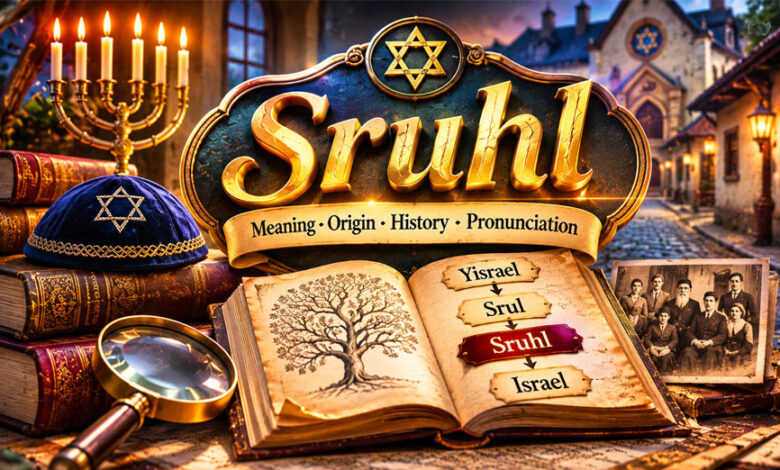

Sruhl is a rare name linked to Srul, a Yiddish form of the Hebrew name Yisrael, or Israel in English. The name is mainly connected with Ashkenazi Jewish history.
People may find Sruhl in old family records, census papers, passenger lists, cemetery records, or family trees. Because the spelling is unusual, it can be difficult to understand where the name came from.
This article explains the meaning, origin, history, pronunciation, and different spellings of Sruhl. It also explains why the name can be useful in Jewish family research.
What Does Sruhl Mean?
Sruhl gets its meaning from its connection with the Hebrew name Yisrael. There is no clear separate meaning for Sruhl itself.
Yisrael is often explained as “one who struggles with God” or “one who strives with God.” Other meanings include “God prevails” and “God contends.”
There is more than one English meaning because old Hebrew names are not always easy to translate into one exact phrase.
The name is also connected with ideas such as faith, strength, struggle, and endurance. However, this does not mean that every person named Sruhl has these qualities.
The Biblical Connection to Yisrael
The name Yisrael comes from the biblical story of Jacob in the Book of Genesis.
According to the story, Jacob wrestled through the night with a mysterious figure. After the struggle, Jacob was given the name Israel.
This story is why Israel is often connected with the idea of struggling or striving with God.
Sruhl is connected to this history through Srul and Yisrael. The spelling changed over time, but the name still has the same Hebrew roots.
Where Does Sruhl Come From?
Sruhl has connections with both Hebrew and Yiddish.
The original Hebrew name is Yisrael, written as יִשְׂרָאֵל in Hebrew. It is an old masculine name with an important place in Jewish history and religion.
Among Yiddish-speaking Ashkenazi Jewish families, Hebrew names often had shorter forms for everyday use.
Yisrael or Yisroel could become Srul. Other familiar forms included Sruli and Srulik.
Sruhl appears to be a rare spelling related to Srul. It can therefore be described as a Yiddish form with Hebrew roots.
It is not clear exactly when people first started using the Sruhl spelling.
Sruhl in Ashkenazi Jewish History
Sruhl is mainly connected with Ashkenazi Jewish communities.
For many years, Ashkenazi Jewish families lived across Central and Eastern Europe. This included areas that are now part of Poland, Ukraine, Lithuania, Romania, and nearby countries.
Many of these communities used more than one language.
Hebrew was important in religious life, while Yiddish was commonly spoken at home and in daily life. People might also use Polish, Russian, German, Romanian, Hungarian, or another local language.
Because of this, one person could have different forms of the same name.
For example, someone might use Yisrael in a religious setting and Srul with family members. Later, an English document might record the same person as Israel.
This did not always mean the person officially changed his name. The version used could simply depend on the language and situation.
How the Sruhl Spelling Developed
Names did not always have one fixed spelling in old records.
One reason was transliteration. In simple words, transliteration means writing a name from one alphabet using another alphabet.
Hebrew and Yiddish traditionally use Hebrew letters. English, Polish, German, and many other languages use Latin letters. Russian uses Cyrillic letters.
When a name moved between these writing systems, its spelling could change.
Officials sometimes wrote a person’s name based on how it sounded. Someone called Srul could therefore be recorded as Sruhl, Shrul, or another similar spelling.
Regional accents also mattered. Yiddish did not sound exactly the same everywhere. Different families could also pronounce familiar names in slightly different ways.
Old handwriting created more problems. Some handwritten letters were difficult to read. When old records were later copied or added to online databases, more spelling differences could appear.
The extra “h” in Sruhl may have been added to show how the name sounded. However, there is no clear proof that this happened in every case.
For this reason, Sruhl should not always be treated as a completely different name from Srul.
Common Variations of Sruhl
There are several names and spellings related to Sruhl. Some developed because of language, pronunciation, migration, or family traditions.
Common forms include:
- Srul
- Shrul
- Srol
- Sroel
- Srule
- Sruli
- Srulik
- Yisrael
- Yisroel
- Isroel
- Israel
Srul is the closest and better-known Yiddish form. Yisrael is the Hebrew form, while Israel is the common English form.
Sruli and Srulik can also be used as familiar or affectionate forms.
These different spellings are important when looking at old records. A person called Sruhl in one document might appear as Srul or Israel in another.
However, a similar name does not prove that two records belong to the same person. Other details should also match.
How Is Sruhl Pronounced?
There is no one pronunciation that can be confirmed for every person who used the name.
Sruhl may sound roughly like “Srool.” In some families or Yiddish dialects, it may sound closer to “Shrool.”
The pronunciation could change depending on the region and family tradition.
Old written records usually cannot tell us exactly how a person said the name. Other family records may sometimes provide useful clues.
If a living person or family uses the name, their own pronunciation should be followed.
Is Sruhl a First Name or a Surname?
Sruhl is mainly known as a masculine first name.
Its connection with Srul and Yisrael also supports its use as a given name.
However, old documents can contain mistakes. A person’s first and last names may sometimes be placed in the wrong order. There can also be spelling or transcription errors.
Sruhl should not automatically be connected with similar-looking surnames such as Ruhl or Stuhl. These names may have different origins.
If the meaning of the name in a document is unclear, other records can help confirm whether it was being used as a first name.
How Migration Changed the Name
Migration caused many Jewish names to change in spelling.
A person moving from Eastern Europe to another country might meet officials who spoke a different language. The person’s name could then be written in a new way.
For example, someone known as Srul in Europe might later appear as Israel in an English record. His family might still call him Srul at home.
This was not always an official name change.
A person could use one form at home, another in religious life, and another on government papers.
Borders also changed many times in Central and Eastern Europe. Because of this, the same person could list different countries as their birthplace in different records, even if they were born in the same town.
This is important when researching old family records.
Why Sruhl Is Important in Jewish Genealogy
Sruhl can be a useful clue in Jewish genealogy, which means researching Jewish family history.
Old databases often use the spelling written in the original document. Sometimes the spelling comes from a person who later copied the record into a database.
A person listed as Sruhl in one document may appear as Srul, Yisroel, Yisrael, or Israel in another.
Researchers should therefore search several possible spellings instead of searching only for Sruhl.
Some genealogy websites also allow wildcard or similar-sound searches. These can help when the exact spelling is unknown.
A matching name alone is not enough to prove that two records describe the same person.
Researchers should also compare the surname, age, birthplace, address, job, spouse, parents, children, and immigration details.
If these details also match, there is stronger evidence that the records belong to the same person.
Where Can the Name Sruhl Appear?
Sruhl may appear in many types of old records, including:
- Census records
- Passenger lists
- Immigration records
- Birth records
- Marriage records
- Synagogue records
- Naturalisation papers
- Military records
- Cemetery records
- Gravestones
- Family letters
- Family trees
- Memorial books
- Holocaust records
- Community archives
Different records may use different spellings for the same person’s name.
When possible, it is useful to check the original document instead of depending only on information copied into an online database.
Handwriting and Transcription Problems
Old handwriting can make names difficult to read.
Letters such as r, n, h, and l may look similar in some handwriting styles. Old documents can also become faded or damaged.
Mistakes may happen when these records are added to online databases. A person reading the old document may misunderstand an unfamiliar name and type the wrong spelling.
This is known as a transcription error.
When possible, look at an image of the original record. Comparing the handwriting with other names on the same page can also help.
One unclear record should not be treated as final proof. Several matching records provide stronger evidence.
Is Sruhl Still Used Today?
The exact spelling Sruhl appears to be rare today.
Names such as Israel and Yisrael are much more familiar. Sruhl is more likely to be found in old documents, genealogy records, archives, and family trees.
There is not enough reliable information to say exactly how many people use Sruhl today.
For this reason, exact claims about the modern popularity of the name should be avoided.
Its rarity also does not mean the spelling is always a mistake. Some families may have genuinely used Sruhl as their preferred spelling.
Cultural Importance of the Name
Sruhl helps show how names can change when families move between different languages and countries.
A person might use Yisrael in a religious setting and Srul with family and friends. Later, English records might use Israel.
Names could also help families remember earlier generations. In some Jewish families, children were traditionally named in memory of relatives.
An unusual spelling can also give researchers useful clues. It may show how a family pronounced a name or how an official heard and wrote it.
Understanding these different forms can help families connect old records that may at first look unrelated.
Tips for Researching the Name Sruhl
If you find Sruhl in an old family record, first write down the name exactly as it appears. Do not change the spelling in your notes.
Next, search for other forms such as Srul, Shrul, Yisroel, Yisrael, Isroel, and Israel.
If the genealogy website offers similar-sound or wildcard searches, try those as well.
Do not use the first name alone to identify someone. Compare dates, family members, addresses, jobs, birthplaces, and immigration information.
Check the original document when possible. The spelling shown in an online database may be wrong because of a transcription mistake.
Also remember that borders changed often in Central and Eastern Europe. The same town may appear under different countries in different records.
Older family members may also know useful information. They may remember a family nickname or older form of a name that does not appear in official English records.
Bottom Line
Sruhl is a rare historical name connected with Srul, a Yiddish form of the Hebrew name Yisrael, or Israel in English.
The spelling may have changed because of language, migration, pronunciation, handwriting, and the way officials recorded names.
Sruhl is mainly known as a masculine first name. It can also be useful when researching Jewish family history because the same person may appear under several different name forms.
When researching Sruhl, check different spellings and compare other personal details before deciding that two records belong to the same person.
Frequently Asked Questions
What does Sruhl mean?
Sruhl is linked to Yisrael. The name is often explained as “one who struggles with God” or “one who strives with God.”
Is Sruhl a Jewish name?
Yes. Sruhl is connected with Ashkenazi Jewish naming traditions and the Yiddish name Srul.
Is Sruhl Hebrew or Yiddish?
Its root is Hebrew through Yisrael. Sruhl is a rare spelling connected with the Yiddish form Srul.
Are Sruhl and Srul the same name?
They are closely related forms of the same name tradition. However, other details should be checked when comparing historical records.
Is Sruhl another form of Israel?
Yes. Sruhl is connected to Israel through Sruhl → Srul → Yisrael → Israel.
How do you pronounce Sruhl?
It may sound like “Srool.” Some families or Yiddish dialects may pronounce it closer to “Shrool.”
Is Sruhl a first name or surname?
Sruhl is mainly known as a masculine first name. Any use as a surname should be checked carefully.
How should I search for Sruhl in historical records?
Search for Sruhl, Srul, Shrul, Yisroel, Yisrael, Israel, and similar spellings. Also compare ages, places, relatives, and other personal details.