
Twenty-eight pairs of pants sit under one heading here, and the price column reads $60 the whole way down it. Nothing extra for the heavy fleece, nothing knocked off the plain one. The first time you scroll it you assume half the page hasn’t loaded, so you open three more tabs and find the same figure sitting there again, which is roughly the moment the sweatpants rail at Bapehoodies stops being a budgeting job and turns into a wall of prints you have to actually look at.
One number, twenty-eight times over
$60 is the whole pricing story here. Every single pair. Not a band, not a range with a cheap end and a flashy end — one figure repeated until you stop checking. And it isn’t a quirk of the pants page either. Seven of the shop’s ten rails carry a single price each, so the tees all land on $35, the shorts on $45, the crewnecks on $70, and the jackets on $95 whichever one you click.
Which means the number has stopped doing the job you expect of it. On most shops the price quietly ranks things for you — dearest at the top, filler at the bottom, and you make your peace somewhere in the middle without ever really deciding. Here the figure only tells you which rail you’re standing on.
Not all of these are sweatpants
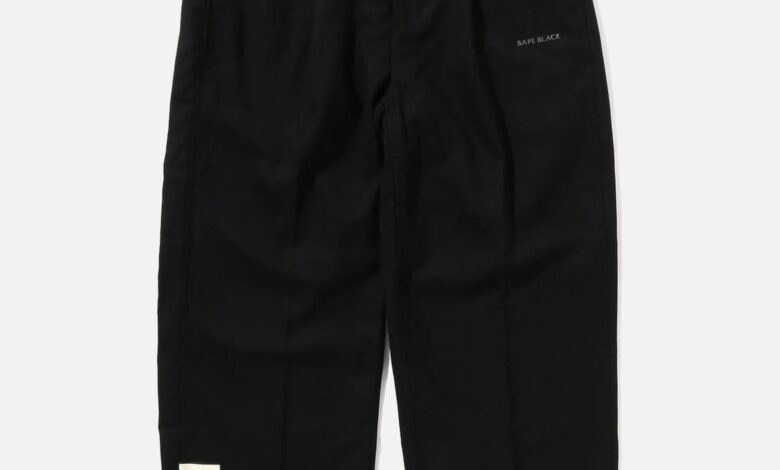
This bit catches people out. The heading says sweatpants, but the twenty-eight pieces under it run wider than fleece joggers with a drawcord. There are 13 Oz Denim Pants in there. Painter Work Pants, a pair of Black Washed Chore Work Pants, Taper Chino Overall Pants, Sashiko Patchwork Jeans, even Black Dress Pants with Ornaments, which is about as far from a jogger as trousers get.
So a Paisley Pattern Denim Flared Pant and a plain pair of One Point Sweatpants cost the same $60, with almost nothing in common beyond the label inside. Treat the category name as a shelf, not a description — the pair you’d actually wear might be filed three rows past what you searched for.
Camo does most of the talking
Once money is off the table, print is what separates one pair from the next, and the camo variations carry most of that weight. They aren’t interchangeable. Scale matters here, and so does colour temperature:
- ABC Camo One Point Relaxed Fit Sweatpants, the familiar one, print across the leg with a small logo as the only interruption.
- Color Camo Sweat Pants, where the pattern breaks into brighter blocks and reads loud from across a room.
- Tiger Camo One Point Sweatpants, warmer in tone, closer to a stripe than a blotch.
- Marbling Camo Jogger Sweat Pants, which softens the edges until it looks more like ink in water.
- Hybrid Camo Multi Badge Cargo Pants and Asia Camo Army Pants, both busier, both with pockets doing visual work of their own.
If you already own one camo piece, a second one in a different scale usually fights it. Two pairs from this list, worn with the same top, will read as two completely different outfits. That’s worth more than it sounds when the price is identical and you’re trying to justify a second pair.
February slush decides more than the print does
Canada makes this choice for you about five months a year. A pair of Nylon Track Pants is fine in a damp Vancouver November — water runs off them, they dry on the radiator, and they shrug off the kind of drizzle that soaks cotton through. Put the same pair on in Winnipeg at −20 °C, and you’ll feel every bit of wind that gets near them.
Fleece and French terry go the other way. Warm, forgiving, comfortable on a cold platform — but Toronto slush in late February soaks into the cuff and stays there all commute. Honestly, the cuff is where I’d look first.
| Pro Tip: Check the hem before the print. An elasticated or ribbed cuff keeps slush off the fabric and tucks into a boot; a wide straight leg sits in the puddle. On a rail where every pair costs the same, the hem is doing more for you in a Canadian winter than any pattern will. |
Buying two pairs instead of agonizing over one
There’s a side effect to flat pricing that nobody mentions. When a cheap option and a dear option sit on the same rail, you spend twenty minutes deciding whether the extra $30 is worth it. Take that away and the question flips: you’re no longer asking which pair is better value, you’re asking which two pairs don’t do the same job.
A plain pair for the days you aren’t thinking about clothes, plus a printed one for the days you are. That split covers a week without either pair feeling wasted, and two of them land where one $120 hoodie would. Two beats one here.
What to look at once price stops helping
With the number out of the picture, the rail rewards a slower kind of browsing. Four things actually change between these twenty-eight pairs:
- The cut — relaxed fit, taper, flare and cargo are all in here, and they sit on the leg in completely different ways.
- The fabric — terry, nylon, denim and chino cloth, which decides the season more than the colour does.
- The hem — ribbed cuff versus a straight open leg, slush versus no slush.
- The print scale, which decides whether the pair anchors an outfit or just quietly participates.
Work through those four, and the decision takes three minutes. Skip them, and you’ll keep refreshing the page hoping something stands out on price. It won’t.
Does a flat price mean the pairs are the same?
No, and that’s the bit worth sitting with. A shop can price by category for reasons that have nothing to do with how good any single piece is. Denim and fleece landing on one figure says something about how the rail got put together, not that patchwork jeans and terry joggers are equivalent garments.
So read the pair, not the tag. Look at the photos properly — most pieces have more than one shot, and the leg shape in the second image usually tells you more than the first one did. Sizing and shipping show up at checkout rather than being guessed from a listing.
Twenty-eight pairs on one price is a strange way to shop until you lean into it. Give the rail a proper scroll, pick by cut and cuff and print rather than by cost, and the pair you land on will be the one you actually reach for in a Canadian February. That’s about all you can ask from $60.