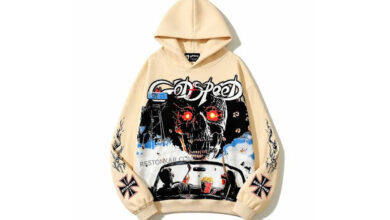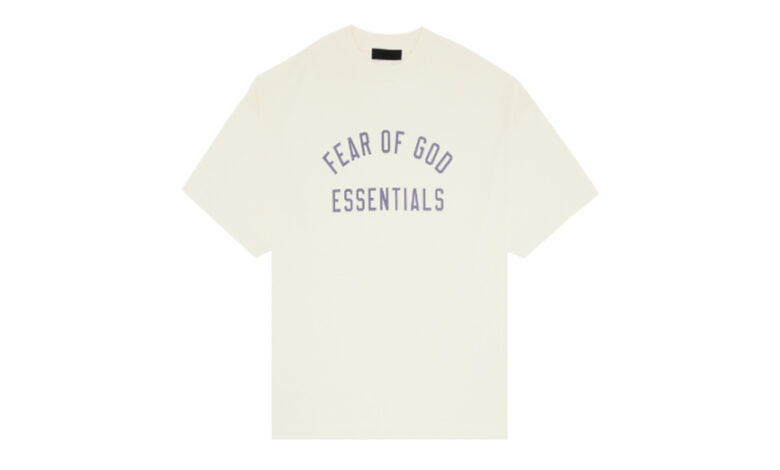

You pull the tee on, turn to the mirror, and something sits wrong. Not the size — the size is fine, the chest has room, the hem lands where you wanted it. It’s the shoulders. The seam that’s meant to sit near the corner of your shoulder has slid down your arm a couple of inches (maybe three), and now the shirt reads like you borrowed it off somebody a head taller than you. And that narrow gap between boxy and just plain baggy lives in one seam, pretty much, so it’s worth knowing what you’re looking at before you click add-to-cart on anything at Essential Clothing.
So what does boxy really mean?
Boxy is about proportion, not about excess. There’s no pinch at the waist on these, so the body just drops from the armhole to the hem in a straight-ish line, and that’s why it looks a bit square once you’ve laid the thing flat on a bed. Width and length sit in rough balance. It stands away from your ribs instead of following them, and that small pocket of air is sort of the whole point of the cut.
Baggy is surplus, basically — more width than you need, more length, sleeves that run on a bit, fabric the frame underneath isn’t filling. A boxy tee can look sharp on somebody slim and somebody broad, because the shape is doing the work there. A baggy one asks the wearer to carry it, and plenty of us can’t, honestly.
Where the shoulder seam wants to sit
On a classic fit, that seam ends up on the bony point at the outside edge of your shoulder — you can find that point with two fingers, no measuring tape needed. On an Essentials tee it tends to sit a bit lower than that — pushed out onto the upper arm by an inch, maybe two — which widens the look across the top without piling bulk anywhere else.
There’s a limit, though. Once the seam slides past roughly the middle of your upper arm the sleeve stops behaving like a sleeve, because the fabric starts folding where your deltoid ends, and you end up with that soft collapsed ridge that photographs badly and feels worse under a jacket. Shoulders are the one thing a tee can’t really fake.
The two-finger test in a fitting room
Stand up straight with your arms loose, then put two fingers flat on the outside of your shoulder, right at the edge of it. If the seam is sitting under your fingers or just below them, you’ve got a modern boxy cut and you’re fine. If your whole hand fits between the edge of your shoulder and the seam, that’s a drop shoulder in the extended sense, and you’d probably be happier a size down.
Drop shoulder: what it does above the elbow
A drop shoulder moves the armhole outward and downward, so the sleeve head gets sewn into the arm rather than the shoulder. The armhole opens up. Lifting your arm no longer drags the hem up with it, which is pretty much why the cut spread out of workwear in the first place.
What it also does is round off your silhouette. A set-in sleeve draws a hard corner at the shoulder and your eye reads structure there; drop the seam and that corner softens into something more like a slope. Some people love it. Others find it makes them look narrower through the chest than they are, and if you’re in that second group, a smaller size won’t rescue it — a smaller size shortens the body and leaves the seam more or less where it already was. You want a different cut instead.
Reading all this off a product photo
Most of us buy tees off a grid of images on a phone, so the real skill is spotting the cut before anything ships. A few things in a photo give it away:
- Look at the sleeve’s inner edge where it meets the side seam — on a drop shoulder those two seams meet low, and the armhole looks like a wide, lazy curve rather than a tight one
- Follow the side of the body from armpit down to hem; a boxy cut runs almost parallel to the floor-line of the photo, while a regular fit narrows in as it goes
- Compare hem width against chest width, and if they look about equal you’ve got a square body, which is more or less what boxy means in practice
Flat-lay shots tell you more than worn shots do, honestly, because a worn shot has been styled, and a flat lay hasn’t. So if a listing in the Essentials Shirts category gives you both, start with the flat lay, and use the worn photo for one thing only — how long the body runs on somebody who’s standing up.
Two cuts, side by side
| What you see | Boxy | Baggy |
| Shoulder seam | At the edge or an inch or two past it | Well down the upper arm |
| Body line | Straight from armhole to hem | Straight but noticeably wider |
| Sleeve | Short, sits flat on the arm | Longer, folds near the elbow |
Neither column is wrong, they’re just different clothes, and the tee grid at Essentials Clothing runs across that range — cream and off-white through iron and matte black — which is also why two shirts in the same size can hang so differently on the same person.
Frequently Asked Questions
Can I size down to fix a drop shoulder that’s too low?
Not really, no. You’d pull some width out of the chest and a bit of length out of the body, which might feel better overall, but seam placement is drawn into the pattern itself, and it barely moves between one size and the next. Which means a seam problem is a cut problem rather than a sizing one, and swapping the number on the label won’t shift it.
Is a drop shoulder just another word for oversized?
No, they’re separate things, even though they tend to turn up together. Oversized is about how much room the garment has overall, while a drop shoulder only describes where that one seam got placed, so you can find a fairly trim shirt with a dropped seam or a huge one without it.
Does Essentials Clothing publish a size chart for its tees?
The shop doesn’t list chest or length measurements, so going by the photos plus your own shoulder width is the practical route here. If something lands wrong, exchanges and store credit get handled within thirty days on unworn pieces that still have their tags.
Spend a minute on the shoulder line before you buy and a surprising number of fit problems just sort themselves out, since the chest, the hem and the way the sleeve breaks on your arm all follow from wherever that one seam ended up. Browse the tee grid slowly, pull up the flat lays, and go with the cut that suits how you actually dress rather than how the photo was styled.