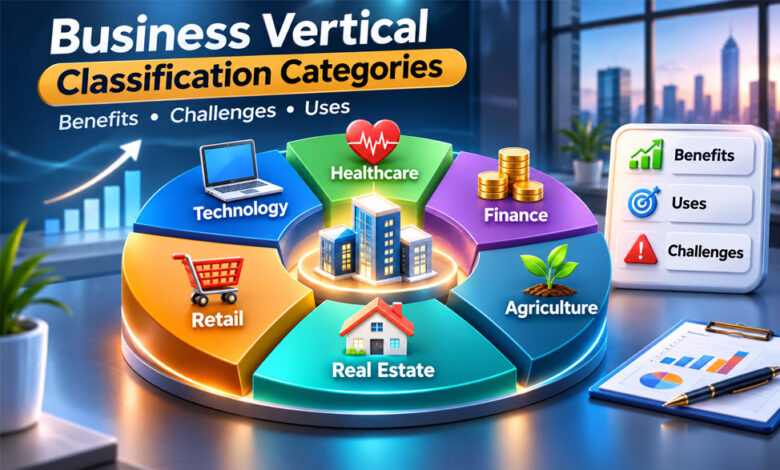

Business vertical classification categories are used to group companies by the type of business they do. They can be based on industry, products, services, customers, or main business activities.
These categories help business owners, investors, marketers, and researchers understand where a company fits in the market. This guide explains the main business verticals, classification systems, benefits, uses, and challenges.
What Are Business Vertical Classification Categories?
Business vertical classification categories are groups used to organize companies by what they do and which market they serve.
Technology, healthcare, finance, retail, agriculture, and real estate are common examples.
Each vertical can also have smaller categories. For example, healthcare can include hospitals, pharmacies, medical device companies, biotechnology firms, and telemedicine services.
A company can also fit into more than one vertical. A software company that creates tools for hospitals may fit under both technology and healthcare.
Business vertical is a broad business term. It is not one official classification system. Different countries and organizations use systems such as NAICS, SIC, GICS, and NIC.
How Business Vertical Classification Works
Business classification usually starts with a broad category and then moves to a more specific one.
A common structure is:
Sector → Industry Group → Industry → Sub-Industry
For example, healthcare can be the main sector. A company can then be placed into a smaller healthcare group based on the services or products it provides.
Different classification systems may place the same company into different categories. This happens because each system has its own purpose.
A business can look at its main products, services, customers, and business activities when choosing its main vertical.
Large companies can be harder to classify because they may work in several industries at the same time.
Major Business Classification Systems
Different systems are used to classify businesses. Some are mainly used by governments, while others are used by investors and financial companies.
NAICS
NAICS stands for North American Industry Classification System.
It was introduced in 1997 and replaced SIC for many statistical uses in North America.
NAICS groups businesses based on their main economic activities. Government agencies use its codes to collect and organize business and economic information.
The system is updated from time to time as industries change.
Businesses may see NAICS codes in government records, industry research, and other official business information.
SIC
SIC stands for Standard Industrial Classification.
It is an older system that dates back to the 1930s. It was widely used before NAICS became the main system for many statistical purposes in the United States.
SIC codes are still found in some old databases, financial records, and business research tools.
A company may have both SIC and NAICS information available. However, the categories in these systems are not always exactly the same.
GICS
GICS stands for Global Industry Classification Standard.
It was developed by MSCI and S&P for investment and financial research.
Its main structure is:
Sector → Industry Group → Industry → Sub-Industry
GICS helps investors compare companies and study different parts of the market.
It is different from NAICS because it is mainly focused on financial and investment analysis.
NIC
NIC stands for National Industrial Classification. It is used in India to classify different economic activities.
NIC 2008 uses different levels, including:
Section → Division → Group → Class
For example, information and communication can be a broad section, while computer programming can fall under a more specific category.
Businesses working in different countries may need to understand different classification systems.
Major Business Vertical Classification Categories
There are many business verticals. Some are broad, while others focus on a specific type of business.
Technology
Technology includes companies that provide software, digital products, computing systems, and related services.
Common areas include software, cloud computing, artificial intelligence, cybersecurity, enterprise software, and consumer apps.
Technology can also connect with other industries. For example, financial technology combines technology with finance.
Financial Services
Financial services include companies that deal with money, payments, credit, investments, and financial risk.
Examples include banks, payment companies, investment firms, credit providers, digital wallets, and online banking services.
FinTech is also part of this area. It combines finance with technology.
Insurance is another important financial area. It can include life, health, property, car, and specialty insurance.
Healthcare
Healthcare includes businesses that provide medical services, products, and health-related technology.
Examples include hospitals, clinics, pharmaceutical companies, biotechnology companies, medical device makers, and telemedicine services.
Healthcare companies may also need to follow strict rules depending on what they do and where they operate.
Technology has also created areas such as HealthTech, telemedicine, and digital health.
Retail and E-Commerce
Retail companies sell products to customers through physical stores or online platforms.
This vertical can include physical shops, e-commerce stores, online marketplaces, direct-to-consumer brands, wholesalers, and subscription businesses.
E-commerce businesses may have different needs from traditional stores. They often depend more on websites, digital payments, online advertising, delivery, and order fulfillment.
Real Estate
Real estate includes businesses connected with property.
It can include residential property, commercial property, property management, construction-related services, and real estate investment trusts.
PropTech is another growing area. It combines real estate with technology.
PropTech companies may provide software and digital tools for property management and real estate services.
Agriculture
Agriculture includes businesses involved in crops, animals, farming services, and food processing.
It can also include equipment and technology used by farmers.
AgriTech combines agriculture with technology. It may include sensors, farm management software, data tools, and precision farming technology.
Industrial and Manufacturing
Industrial and manufacturing businesses make products, materials, machines, and equipment.
Common areas include cars, machinery, electronics, aerospace, chemicals, and advanced materials.
These companies often depend on factories, equipment, suppliers, transport, and supply chains.
Professional and Business Services
Professional services are businesses that provide expert knowledge or specialized services.
Law firms are one example. Legal services can include corporate law, litigation, intellectual property, employment law, property law, and tax law.
Other professional businesses can also be classified based on the services they provide and the customers they serve.
Hospitality and Restaurants
Restaurants are generally part of the food service and hospitality industry.
Restaurants can also be divided by their service style.
Quick-service restaurants (QSRs) mainly focus on fast service.
Fast-casual restaurants usually offer counter service with more food choices or customization.
Casual dining restaurants normally provide table service in a relaxed setting.
Fine dining restaurants usually offer more formal service and premium food.
These categories make it easier to compare restaurants with similar business models.
Important Technology Sub-Verticals
Technology is a very broad vertical. It contains many smaller business categories.
SaaS
SaaS means Software as a Service.
It usually describes software that customers access as an ongoing service.
SaaS companies can be grouped by what their software does. Examples include CRM, accounting, and marketing software.
They can also be grouped by industry. Examples include healthcare SaaS, legal SaaS, and construction SaaS.
Some SaaS companies serve small businesses, while others focus on large companies.
Enterprise Software
Enterprise software is made for businesses and organizations.
It can help companies manage customers, employees, data, finances, and daily work.
Common examples include CRM, ERP, HCM, business intelligence, analytics, collaboration tools, and workflow software.
Many enterprise tools also need to connect with other business systems.
Cybersecurity
Cybersecurity is about protecting computers, networks, accounts, systems, applications, and data.
Important areas include network security, cloud security, identity management, threat intelligence, and security operations.
Cybersecurity is used across many industries, including banking, healthcare, retail, manufacturing, and government.
HR Tech
HR Tech means technology used for human resources.
It includes applicant tracking systems, payroll tools, employee benefits software, learning systems, employee engagement tools, and workforce analytics.
HR software may also connect with payroll, finance, and other business systems.
Artificial Intelligence
Artificial intelligence is used in many industries.
Common AI areas include machine learning, natural language processing, and computer vision.
AI can also be made for a particular industry. Healthcare AI may help with medical research or imaging. Financial AI may help detect fraud. Manufacturing companies may use AI to check product quality or predict equipment problems.
Hybrid Business Verticals
Some businesses combine two or more industries. These are often called hybrid verticals.
FinTech combines finance and technology.
HealthTech combines healthcare and technology.
EdTech combines education and technology.
PropTech combines real estate and technology.
AgriTech combines agriculture and technology.
These terms can make it easier to understand what a modern business does. However, official classification systems may use different names or codes.
Vertical Markets vs. Horizontal Markets
A vertical market focuses on one industry or a specific type of customer.
For example, software made only for medical practices is a vertical product.
A horizontal market serves customers across many industries.
Cloud storage and general business software are good examples because many different types of companies can use them.
Vertical businesses usually have deeper knowledge of one industry. Their products may include special tools made for that industry’s needs.
Horizontal businesses normally target a much larger group of customers.
Neither model is always better. The right choice depends on the product, customers, and business goals.
Benefits of Business Vertical Classification
Business vertical classification can make a company’s market position easier to understand.
It helps businesses explain what they do and who they serve.
It can also make market research easier because companies can compare themselves with similar businesses.
Marketing can become more focused. For example, software made for hospitals can use healthcare-focused content instead of general software marketing.
Investors can also use business verticals to compare companies with similar business models.
Classification may also help businesses understand which industry rules could apply to them. However, a business category alone does not decide every legal or regulatory requirement.
Common Uses of Vertical Classification
Governments use business classifications to organize economic information.
Investors use them to compare companies and study different markets.
Businesses use verticals for competitor research, sales, marketing, and market analysis.
Sales teams may divide customers by industry so they can provide more useful information to each group.
Business verticals can also be useful for advertising, content planning, startup positioning, business databases, and fundraising.
The right classification system depends on why the information is needed.
Business Verticals in SEO and Digital Marketing
Business verticals can help make SEO and marketing more focused.
A broad keyword such as “business software” can cover many different products. A more specific term such as “software for dental practices” clearly shows which customers the product is for.
Businesses can create content for the questions people in a particular industry search for.
They can also create separate landing pages, case studies, and advertising campaigns for different industries.
Using the right industry terms can make content easier for target customers to understand.
However, there is no fixed guarantee that using vertical keywords will always increase traffic, sales, or conversions.
Why Business Verticals Matter to Investors
Investors often compare a business with similar companies in the same market.
A clear business vertical can help investors understand the company’s competitors, market size, risks, business model, and growth opportunities.
Financial results can also mean different things in different industries. A software company and a retailer may have very different costs and profit margins.
Startups should therefore clearly explain their main vertical when talking to investors.
A company that works in several industries can also explain its secondary verticals.
However, a business vertical alone does not decide how valuable a company is. Revenue, growth, competition, management, market opportunities, and risks also matter.
Challenges of Business Vertical Classification
Some businesses are difficult to place in one category.
A large company may work in retail, technology, logistics, healthcare, and entertainment at the same time.
Technology has also caused many industries to overlap. FinTech, HealthTech, and PropTech are examples.
Another problem is that new industries can develop faster than official classification systems are updated.
Different countries may also use different classification systems. A category used in one country may not have an exact match in another.
Businesses can also change over time. A company may start with one product and later make most of its money from another service.
For these reasons, companies should understand why they need a classification before choosing one.
How to Choose the Right Business Vertical
Start by looking at what your business actually does.
Check your main products and services. Look at who your customers are and what problems you solve for them.
Your main source of revenue can also help you identify your primary vertical.
Next, check the classification system needed for your purpose. A company using U.S. government data may need a NAICS code. Investors may use GICS or another financial system.
It can also help to check how similar companies are classified.
Choose a category that clearly explains your main market. If your company has several important business areas, you can also record secondary verticals.
When Should a Business Change Its Classification?
A company may need to review its classification when its main business changes.
This may happen after a new product launch, business pivot, merger, acquisition, or move into another market.
A major change in the company’s main source of revenue can also be a reason to review its vertical.
Companies should also make sure their website, sales information, and investor materials still describe the business correctly.
Official business codes are different. Companies should follow the rules of the relevant government agency or authority before changing an official classification.
The Future of Business Vertical Classification
Business classifications may become more detailed as industries continue to change.
Smaller categories such as FinTech, HealthTech, LegalTech, PropTech, and AgriTech are already commonly used to describe specialized businesses.
AI may also help classify businesses by studying their products, customers, and business information.
Classification may become more flexible as companies change their products and enter new markets.
Environmental and sustainability information may also become more important in some types of business and investment analysis.
These are developing trends. They should not be treated as fixed future rules.
Bottom Line
Business vertical classification categories help organize companies by industry, market, products, services, and business activities.
NAICS, SIC, GICS, and NIC are examples of systems used for different purposes. Other terms such as FinTech, HealthTech, SaaS, PropTech, and AgriTech describe more specific business areas.
Choosing the right vertical can help with market research, marketing, competitor analysis, and investor communication.
A company may fit into more than one vertical. The best approach is to identify its main business activity and use the classification system that fits its needs.
Frequently Asked Questions
What are business vertical classification categories?
They are groups used to organize businesses by industry, market, products, services, or main activities.
What are the main business verticals?
Common verticals include technology, finance, healthcare, retail, real estate, agriculture, manufacturing, hospitality, and professional services.
What is the difference between an industry and a business vertical?
An industry is a broad group of similar businesses. A vertical usually focuses on a more specific market, customer group, or business area.
What is the difference between vertical and horizontal markets?
A vertical market focuses on a specific industry. A horizontal market provides products or services that can be used in many industries.
What are NAICS, SIC, and GICS?
NAICS is used for North American industry classification. SIC is an older system. GICS is mainly used for financial and investment analysis.
Can a company belong to more than one business vertical?
Yes. A company can work in several verticals, but it may still have one main business category.
How do I choose the right business vertical?
Look at your main products, services, customers, activities, and revenue. Then choose the classification system that fits your purpose.
Why are business verticals important?
They help businesses understand their market, compare competitors, improve marketing, and explain their work to customers and investors.
Insidenetwork.com Review: Business, Technology, Marketing, and More