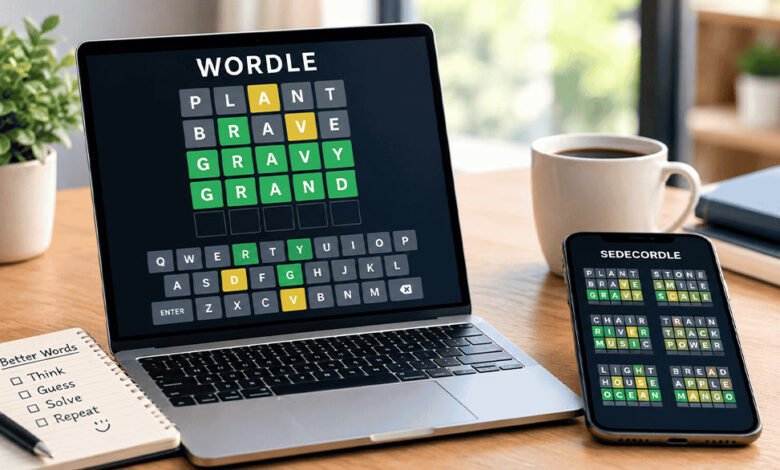

Word games have been part of popular culture for generations, from traditional crossword puzzles and anagrams to newspaper word searches and television quiz shows. However, the arrival of Wordle changed how people interact with simple word puzzles online. What started as a straightforward daily guessing game became a global digital phenomenon and helped inspire a new generation of browser-based word games.
The appeal of Wordle was not based on complicated graphics, extensive tutorials, or hundreds of features. Instead, the game combined a simple concept, limited attempts, familiar vocabulary, and a once-a-day format that encouraged players to return regularly.
That formula proved that an online game did not need to be technically complicated to become part of people’s daily routines. It also opened the door for developers and creators to experiment with new approaches to word-based gaming.
Today, players can find games based on multiple words, longer challenges, themed vocabulary, spelling, geography, numbers, and other variations of the familiar guessing format. Many of these experiences retain the basic idea that made Wordle attractive while introducing their own twists.
What Makes the World So Different?
Before NYTimes Wordle became popular, online puzzle platforms already offered countless word games. What made Wordle stand out was its combination of simplicity and restriction.
The basic objective was easy to understand. Players had to identify a hidden five-letter word within a limited number of attempts. After every guess, colored indicators helped players understand which letters were correct, misplaced, or absent.
There was no lengthy tutorial required. A new player could open the game and understand the rules almost immediately.
This simplicity made the experience accessible to people who might not normally consider themselves gamers.
Another important element was the daily puzzle format. Instead of presenting an unlimited collection of challenges, Wordle gave players a single puzzle to solve each day. This created a natural reason to return the following day.
The game therefore became less like a traditional gaming session and more like a daily habit.
The Power of a Daily Puzzle
One of Wordle’s most influential ideas was the concept of the daily challenge.
Many online games encourage users to keep playing for long periods. Wordle approached engagement differently. Once players solved the day’s puzzle, there was nothing else to complete until the next day.
This limitation actually became part of the attraction.
Players could spend a few minutes solving the puzzle and then move on with their day. The experience did not demand a major time commitment.
The daily format also created anticipation. Players knew another puzzle would arrive the next day, which encouraged consistent participation.
This concept has influenced numerous online puzzle experiences. Developers discovered that short, repeatable gameplay could be just as engaging as lengthy gaming sessions.
Wordle Made Sharing Part of the Experience
Another important factor behind Wordle’s cultural impact was its sharing system.
After completing a puzzle, players could share their results using a simple grid of colored squares. The shared result communicated how well someone performed without directly revealing the answer.
This created a social conversation around the game.
Someone could post their result online, and friends might immediately recognize what it represented. Players could compare their experiences without necessarily spoiling the day’s word.
This was particularly effective because the shared format was compact, recognizable, and spoiler-friendly.
Social sharing helped transform Wordle from an individual puzzle into something people could discuss with friends, coworkers, family members, and online communities.
How Wordle Turned Simple Gameplay Into a Habit
The structure of Wordle demonstrated an important principle in casual gaming: a game can become highly engaging without being complicated.
The player does not need to learn dozens of controls, understand a complex story, or spend hours building a character.
Instead, the game creates a small mental challenge that can be completed quickly.
The satisfaction comes from several places:
- Recognizing letters
- Testing possible words
- Eliminating incorrect options
- Discovering patterns
- Solving the final answer
- Sharing the result
Each step provides a small sense of progress.
This combination makes word puzzles particularly suitable for short breaks, morning routines, commuting, or relaxing at the end of the day.
The Rise of Wordle-Inspired Games
As Wordle became increasingly popular, developers began exploring ways to expand the basic concept.
Some games changed the number of letters. Others introduced multiple puzzles at once. Some added different categories or themes. Others transformed the underlying idea into completely different types of challenges.
This resulted in a growing ecosystem of Wordle-inspired online games.
Rather than simply copying the original format, many successful variations experimented with different mechanics.
For example, a game might ask players to solve several words simultaneously. Another might increase the difficulty by reducing the number of available guesses. Others might introduce unlimited gameplay for people who want to keep playing after completing a daily challenge.
The basic Wordle formula became a foundation for experimentation.
Why Multiple-Word Games Became Popular
One of the most natural developments from Wordle was the introduction of games involving multiple hidden words.
Instead of solving a single word, players could attempt several puzzles during the same session.
This increased the difficulty while keeping the underlying mechanics familiar.
Players already understood how letter feedback worked, so they could immediately adapt to a more challenging environment.
Multiple-word games also solved one limitation of the original daily format. Someone who enjoyed Wordle but wanted a longer gaming session could continue solving puzzles rather than waiting until the next day.
That created an important distinction between daily habit games and extended puzzle sessions.
Sedecordle Takes the Multiple-Word Concept Further
Sedecordle is an example of how the Wordle-style concept can be expanded into a substantially larger challenge. Instead of focusing on one hidden word, Sedecordle asks players to work through multiple word puzzles during the same game.
The increased number of puzzles changes the way players approach the experience. Rather than concentrating on one answer at a time, players need to manage information across several boards and use letter patterns strategically. This makes Sedecordle particularly appealing to players who enjoy the original Wordle concept but want a more demanding and extended word-game experience.
Wordle Inspired Developers to Experiment
Perhaps the biggest impact of Wordle is that it demonstrated the potential of minimalist browser games.
A successful online game does not necessarily need sophisticated 3D graphics or a large development team. A clear concept and satisfying interaction can be enough to attract a large audience.
This encouraged creators to experiment with browser-based games that are:
- Easy to access
- Quick to understand
- Lightweight
- Mobile-friendly
- Designed around repeat play
- Easy to share
The browser became an important part of the experience because players could simply open a webpage and start playing.
There was no requirement to download a large application or purchase specialized gaming hardware.
The Importance of Accessibility
Word games are naturally accessible because they rely primarily on language and reasoning rather than physical controls.
A player can participate using a keyboard or touchscreen. The rules can often be explained in a few sentences, making these games approachable for a broad audience.
Wordle helped demonstrate that accessibility can contribute to the popularity of an online game.
Its interface was visually simple, and the core interaction was easy to understand. This made the experience suitable for people with very different levels of gaming experience.
Someone who had never played a modern video game could still understand the basic idea almost instantly.
Mobile Browsing Changed How People Play
Another major development associated with modern word games is the shift toward mobile-friendly browser experiences.
People increasingly use smartphones for short periods throughout the day. A word puzzle fits naturally into these moments.
A player might solve a puzzle while drinking coffee, waiting for an appointment, taking a short break, or relaxing before bed.
This makes word games different from experiences that require long uninterrupted sessions.
Responsive web design also means players can switch between desktop and mobile devices without necessarily changing their basic routine.
The Psychology of Solving a Word Puzzle
Word games offer a particularly satisfying form of mental engagement.
A player begins with incomplete information. Each guess provides additional clues, which gradually narrow the possible answers.
This creates a cycle of prediction, feedback, adjustment, and discovery.
The player is constantly asking questions:
Which letters could fit?
Which common word patterns should I consider?
Could this letter appear in another position?
What possibilities can I eliminate?
This process gives the player a feeling of progress even when the correct answer has not yet been discovered.
The final solution provides a clear endpoint, which makes the experience satisfying.
Learning Through Play
Word games can also encourage players to think about language in ways they may not consciously notice.
Players become more aware of:
- Spelling patterns
- Letter frequency
- Common word endings
- Vowel placement
- Prefixes and suffixes
- Word structure
- Unusual vocabulary
The game does not necessarily feel like traditional studying because the primary objective is solving a puzzle.
This combination of entertainment and mental stimulation has helped word games remain relevant even as gaming technology has become increasingly sophisticated.
The Role of Strategy in Modern Word Games
Although word puzzles appear simple, experienced players often develop their own strategies.
Some players begin with words containing several common vowels. Others prefer words with frequently occurring consonants. Some try to maximize the amount of information gained from every guess.
In multi-board games, strategy becomes even more important because one guess can provide useful information across several puzzles.
Players also learn to distinguish between guesses intended to solve a puzzle and guesses intended to collect information.
That strategic layer gives word games more depth than their simple interfaces might suggest.
Why People Keep Returning to Word Games
The strongest word games create a predictable but satisfying routine.
A player knows roughly what to expect, but the solution itself remains unknown.
That balance between familiarity and uncertainty is powerful.
The rules stay consistent, while the puzzle changes.
This means players do not have to relearn the game every time they return. Instead, they can focus their attention entirely on the new challenge.
Daily puzzles also create a sense of continuity. Players may begin to think of their puzzle-solving routine as part of their day.
Communities Formed Around Puzzle Games
Wordle and similar games also helped create online communities.
Players share strategies, discuss difficult answers, compare scores, and talk about unusual words.
Online discussions can turn an individual puzzle into a shared cultural experience.
At the same time, spoiler-free sharing allows players to communicate without revealing the answer to people who have not played yet.
This balance between competition and cooperation is one reason word games work so well on social platforms.
The Growth of Puzzle Variations
The Wordle-inspired ecosystem has expanded beyond traditional five-letter guessing.
Developers have experimented with different numbers of letters, multiple boards, themed puzzles, unlimited modes, mathematical challenges, geography-based games, music-related puzzles, and other formats.
The underlying principle remains similar: provide a recognizable interaction while introducing a fresh challenge.
This is important because players generally enjoy familiar mechanics with new goals.
A variation does not have to completely reinvent the puzzle genre. Sometimes changing one central mechanic is enough to create an entirely different experience.
Unlimited Games vs. Daily Games
One significant difference among modern online word games is whether they use a daily or unlimited model.
Daily games create anticipation and routine.
Unlimited games provide flexibility.
A player who has only five minutes might prefer a daily puzzle. Someone who wants a longer session may prefer a platform where multiple puzzles are available.
Both approaches have their own appeal.
The growth of Wordle-inspired games has therefore created a broader range of options for different playing habits.
Why Browser-Based Word Games Remain Relevant
Despite the popularity of downloadable mobile games, browser-based puzzles continue to have an important advantage: immediate access.
A player can search for a game, open the webpage, and begin playing.
There is no large installation process and often no account requirement.
This low barrier to entry makes browser games particularly effective for casual audiences.
The simplicity of the technology also allows creators to focus on the most important part of the experience: the puzzle itself.
Word Games in the Age of Short Attention Spans
Modern internet users are constantly exposed to short videos, notifications, social media posts, and rapidly changing content.
Word games offer a different kind of short-form entertainment.
Instead of passively consuming content, the player has to actively think.
A puzzle can take only a few minutes while still requiring concentration.
This makes word games a useful middle ground between quick entertainment and active mental engagement.
How Wordle Changed Expectations for Online Puzzles
Wordle helped demonstrate that users value clarity, speed, accessibility, and replayability.
Players do not necessarily need dozens of features to enjoy a game.
A focused experience can be highly effective when the central mechanic is satisfying.
The success of Wordle also showed the value of designing games around human habits. A daily challenge fits naturally into a person’s routine, while social sharing allows the experience to extend beyond the game itself.
These ideas have influenced the design of many modern browser-based puzzle experiences.
The Future of Wordle-Inspired Games
The evolution of online word games is unlikely to stop with the current generation of puzzles.
Developers can continue experimenting with multiplayer challenges, personalized difficulty, themed vocabulary, educational elements, collaborative puzzles, and new forms of social interaction.
Artificial intelligence may also make it easier to create dynamic puzzle experiences, although the most successful games will still need to maintain the qualities that make puzzles enjoyable: clear rules, meaningful challenges, useful feedback, and satisfying solutions.
The future may therefore involve more sophisticated technology behind experiences that remain intentionally simple on the surface.
What Makes a Great Online Word Game?
Looking at the evolution of Wordle and its successors, several characteristics repeatedly appear in successful word games.
A strong game usually has a clear objective that can be understood quickly. It provides feedback that helps players make better decisions. It offers enough difficulty to remain interesting without becoming unnecessarily frustrating.
Good word games also respect the player’s time.
Whether the game takes two minutes or thirty minutes, the experience should feel purposeful.
Finally, successful games often provide some form of progression or repeat motivation. That could be a daily challenge, a streak, a personal record, a harder level, or simply the desire to solve one more puzzle.
Conclusion
Wordle’s influence on online gaming goes beyond its simple five-letter format. It demonstrated how a minimalist browser game could become a daily habit and a shared social experience.
Its combination of easy-to-understand rules, limited attempts, daily availability, and spoiler-friendly sharing created a model that many other puzzle games could build upon.
Ultimately, Wordle helped remind the gaming world that complexity is not always necessary for engagement. Sometimes, a simple idea, a clever challenge, and a reason to come back tomorrow are enough to create an experience that people genuinely want to play.