The humidifying mask: what it is, why frequent flyers swear by it, and whether you actually need one

I flew SFO to Stockholm last month — about eleven hours — and by the time we started descending into Arlanda, my throat felt like I’d been chewing on cardboard. I’d been drinking water the whole flight. Didn’t matter. That scratchy, dried-out feeling had set in somewhere around hour three and just kept going.
Turns out there’s a name for what causes this, and a small but growing market of products trying to fix it. They’re called humidifying masks, and I wanted to know if they actually work or if they’re just another travel gadget that ends up at the bottom of a drawer.
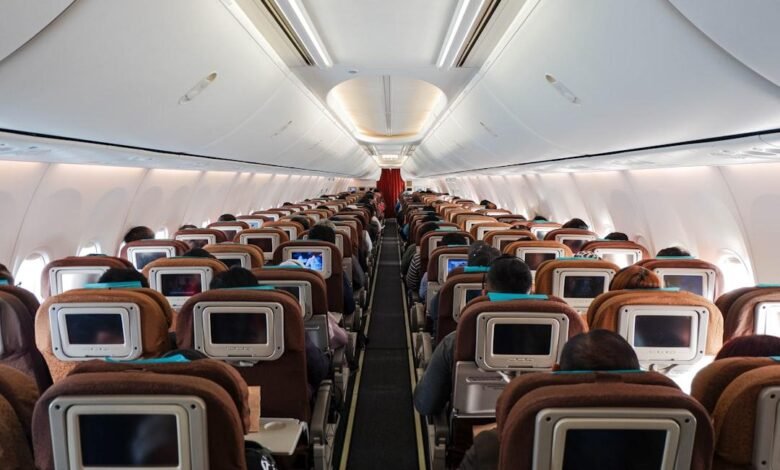
Cabin humidity can drop below 10% on flights longer than three hours. Photo: Mohammad Arrahmanur / Unsplash
What a humidifying mask actually does
A humidifying mask raises the moisture level of the air you breathe while flying. Not to be confused with a regular face mask that filters particles — a humidifying mask is specifically designed for the extreme dryness of airplane cabin air.
At cruising altitude, cabin humidity sits between 5% and 12%. The Sahara Desert hovers around 25%. Your living room is probably between 40% and 50%. So the air inside a plane can be four to eight times drier than what your body is used to.
Your respiratory system feels it. Every exhale sends moisture into the cabin. Every inhale pulls dry air back across your nasal passages, throat, and airways. Over a long flight, this one-way moisture loss stacks up. Most people blame jet lag for how they feel after landing, but the cabin air is doing a lot of that work.
The better humidifying masks use a technology called HME (Heat and Moisture Exchange), which has been used in medical respiratory care for decades. A treated foam element sits inside the mask. When you exhale, the foam traps warmth and moisture from your breath. When you inhale, fresh cabin air passes through that foam, picks up the stored moisture, and reaches your airways already humidified.
No water, no batteries. Your body provides the moisture. The mask keeps you from losing it to the cabin.
Why cabin air is worse than most people realize
Everyone knows planes are dry. But the numbers are actually kind of wild.
The World Health Organization has documented cabin humidity dropping below 10% on flights longer than three hours. On the flight deck, where airflow is highest, readings as low as 2-3% have been recorded. Business class, with its wider spacing and better ventilation, typically runs around 7%. Not exactly tropical.
This goes beyond comfort. When relative humidity drops below about 20%, the mucous membranes lining your nose and throat start to dry out and become less effective at trapping pathogens. A 2019 Yale study found that low humidity significantly impaired airway cells’ ability to fight off viruses and repair themselves.
Then there’s the tiredness. Your body is constantly working to keep your airways moist in that environment, which is a low-grade energy drain that builds over hours. Add in cabin pressure equivalent to 6,000-8,000 feet of elevation and you get that heavy, depleted feeling most people write off as “just how flying feels.”
Voice professionals figured this out years ago. Singers, actors, broadcasters, vocal coaches — anyone whose instrument is their voice — know that a dry flight before a performance is a real risk. Humidifying masks found their first audience in those circles, and the word spread from there.
What’s out there right now
The personal humidifier mask market is young. A handful of products exist, and they take different approaches.
Kuvola
The Kuvola humidifier mask is the one I kept seeing recommended in frequent flyer forums. It’s Swedish-designed, manufactured in the UK to medical-grade standards, and uses passive HME technology — no water, no batteries, nothing to charge. The mask comes with a travel pouch and magnetic clip. You swap out the HME foam element between flights.
Pricing is $89 for the mask and $12 for a single replacement filter ($19 for a two-pack). That puts it at the premium end, but the build quality and design reflect it. Kuvola is clearly going after travelers who care about what their gear looks and feels like — the design language is closer to Rimowa than it is to a surgical mask. It’s the most polished option I’ve come across.
HumidiFlyer
HumidiFlyer was one of the first in the humidifying mask for flying space. It uses the same HME principle but looks more medical. The product has been around longer and you’ll find it referenced in aviation wellness forums from several years back. It’s priced a bit below Kuvola, and the materials and design reflect that difference.
MyAir
MyAir combines humidification with filtration, which appeals to people who want both in a single mask. The downside is it’s bulkier and breathing feels slightly more restricted. If particle protection matters to you alongside moisture, it’s worth a look.
Buying one? What to pay attention to
If you’re shopping for a personal humidifier mask, not everything matters equally.
The biggest decision is passive vs. active humidification. Passive systems (HME-based) use no water or power — they’re lighter, simpler, and never an issue with airline rules. Active systems use a water reservoir and sometimes a battery, which works fine on the ground but gets awkward mid-flight.
After that, fit is everything. You’re wearing this for hours. If it fogs your glasses, restricts your breathing, or needs constant readjusting, you won’t use it twice. Look for adjustable straps and a good seal around the nose without too much pressure.
Check the filter replacement cost before you buy. HME elements lose effectiveness as the foam saturates — most brands recommend a fresh one each flight or every 8-12 hours. A cheap mask with expensive filters is a worse deal than it looks.
And honestly, does it look like medical equipment? I know this shouldn’t matter, but it does. A clinical-looking mask draws questions from seatmates and cabin crew. Products that look like travel gear get worn more consistently than ones that look like they belong in a hospital.
Who actually benefits
Anyone who flies regularly and has noticed they feel terrible after landing — particularly if that feeling persists even when they’ve slept on the flight.
Long-haul flyers (6+ hours) get hit hardest by the cumulative moisture loss. Voice professionals treat these as occupational equipment. Travelers with dry airways or sinus issues tend to notice the difference immediately. Athletes and performers who need to show up ready the next day have started thinking about cabin air the same way they think about sleep and food.
If you do a few short domestic flights a year, you can probably skip it. If you’re doing regular transatlantic or transpacific routes, it’s worth trying one before you write the category off.
Is it worth $89?
A humidifying mask won’t cure jet lag. It won’t turn economy into first class. It solves one specific, measurable problem: your airways drying out over a long flight because the cabin air has almost no moisture in it.
HME technology has been used in hospitals for decades. The idea of putting it in a travel product is newer, but the physics are the same. You lose moisture with every breath. The mask catches it and gives it back.
Whether that’s worth the money depends on how often you fly and how much you care about how you feel when you land. I’ve started packing one. I’m not going back.