
You have a product people enjoy, a name you like, and packaging ideas saved on your phone. It is easy to imagine the first order arriving. It is harder to picture the damaged carton, the label correction, or the cash tied up while you wait for stock to sell.
Those details are part of the business from day one. A good food product gives you something worth offering. A workable launch also needs a clear customer, dependable supply, realistic costs, and a plan for meeting the requirements of the market where you will sell.
Before ordering a large first batch, work through the decisions that sit around the product.
Choose a customer and an occasion
“Anyone who likes good food” is too broad to guide your packaging or pricing. Decide who is most likely to buy first and when they would use the product.
A salt product for everyday home cooking has a different job from a gift set or a large pack for a restaurant kitchen. The size, closure, price, and sales channel should follow that use.
Write one plain sentence: “We are making this product for this customer to use in this situation.” Then show the idea to potential buyers. Ask what they buy now, what frustrates them, and what would make them switch. Compliments are encouraging, but specific buying questions will teach you more.
Turn the idea into a product specification
A name and mood board do not tell a manufacturer what to produce. Specify the ingredients, grade, quantity, pack format, label requirements, and criteria for accepting the finished product.
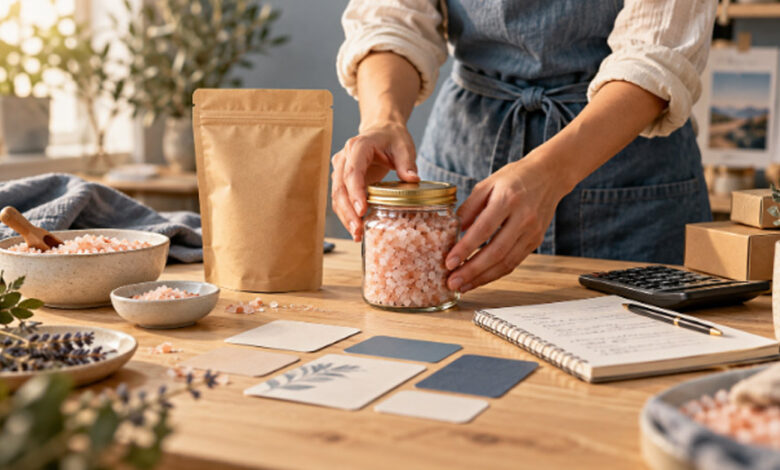
If you are exploring a salt brand, a supplier such as Sobaan Salts provides a place to begin discussing product and packaging options. Bring a clear brief to that conversation and request documentation and samples relevant to your intended market. Treat the supplier’s website as an introduction, then verify the details of your actual order.
Keep a record of what you approved. If you change a pack size or ingredient, revisit the costs, artwork, and other affected requirements before production moves ahead.
Work out what each sale leaves behind
The difference between a retail price and the product cost is not automatically profit. Packaging, fulfillment, sales fees, discounts, returns, and customer acquisition can all change the result.
Here is an illustrative example in PKR, not a quotation or market benchmark. Suppose you sell a pack for PKR 1,000. Product and retail packaging cost PKR 360, delivery and handling cost PKR 180, sales fees cost PKR 50, and you allow PKR 60 for promotions and expected returns. That leaves PKR 350 per sale before fixed costs and any other applicable expenses.
If monthly fixed costs were PKR 70,000, you would need 200 sales at that contribution to cover them. Change the inputs to match your business, including any taxes or costs not already included. If your contribution falls to PKR 250, the same fixed costs require 280 sales.
Run a less comfortable version of the calculation too. What happens if delivery costs rise, some packs are damaged, or customers only buy during a discount? This is an exercise in understanding your assumptions before committing cash.
Check the market requirements before printing labels
Food requirements depend on the product, activity, and place of sale. FDA’s guidance for starting a US food business explains that federal, state, and local requirements can apply and that food labeling must be truthful and not misleading. Other markets have their own rules and authorities.
Identify the requirements for your actual launch market, including any relevant facility, safety, ingredient, labeling, and import obligations. Get appropriate specialist advice before finalizing packaging. A supplier offering private labeling does not remove the need to understand your responsibilities as the seller or importer.
Avoid adding a health or nutrition claim simply because it appears on another brand’s label. Confirm both the supporting evidence and the rules governing that claim. Correcting artwork before printing is much easier than dealing with unusable stock.
Test a finished pack through a realistic journey
A product sample and an empty packaging sample leave important questions unanswered. Ask for a representative filled pack and examine how the whole thing works.
Check that it opens as intended, reseals where needed, dispenses properly, and survives reasonable handling. Review the label at actual size. Think about storage, transport, and how customers will use the pack after opening. These practical checks complement, rather than replace, any necessary safety or shelf-life validation.
Sobaan Salts’ private-label packaging options include formats that can inform an early brief. Ask the supplier to confirm the current options, minimums, costs, and lead times for your chosen configuration. Do not plan a launch around an unconfirmed example on a web page.
Start with a launch you can learn from
A wide range creates more decisions before you know what customers will buy again. A smaller initial range can make it easier to understand which pack, price, and message work for your chosen audience.
Decide what you need to learn from the first batch. Track customer questions, damage, repeat purchases, complaints, and the time required to fulfill orders. Separate a successful social post from evidence that customers want to buy the product repeatedly.
Set a reorder point that considers sales pace, production time, transport, and the cash needed for the next order. Selling out can feel exciting, but a long gap in availability may frustrate customers you worked hard to acquire.
Prepare for the order after the first one
Keep supplier contacts, lot records, approved artwork, cost assumptions, and a simple complaint process organized from the beginning. Decide who handles a customer problem and how information gets back to the supplier.
Your first launch does not have to be large to be useful. It needs to tell you whether the product, costs, supply, and customer experience work together. Before placing the order, make those pieces concrete enough that you can check them when the stock arrives.