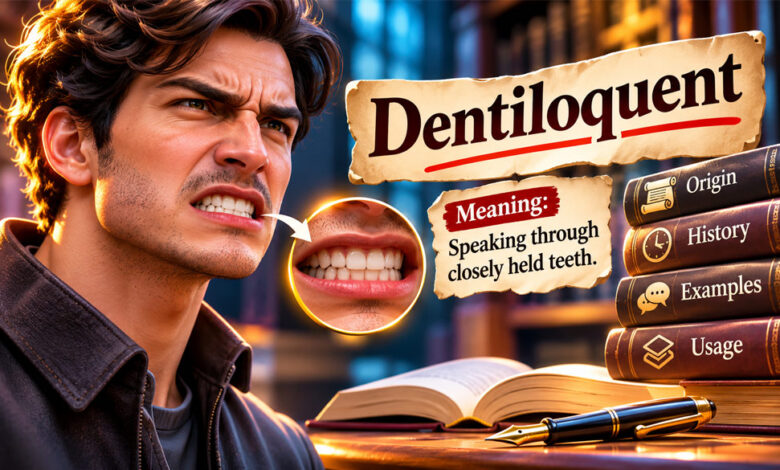

Dentiloquent is a rare English word that describes speaking through the teeth. It usually refers to speech made while the teeth stay close together and the jaw has limited movement.
People may come across this word in vocabulary lists, old dictionaries, word quizzes, or creative writing. It is not commonly used in everyday conversation.
This guide explains the meaning of Dentiloquent, its history and origin, how to pronounce it, what this type of speech sounds like, and how it differs from other forms of speech.
What Does Dentiloquent Mean?
Dentiloquent means speaking through one’s teeth. It is an adjective used to describe a particular way of speaking.
A person speaking this way keeps the teeth close together and does not open the jaw as much as they normally would. The words are produced through the small space between the teeth.
The term describes how someone speaks, not what they say. A Dentiloquent speaker could be saying something friendly, serious, angry, or neutral.
The word is also connected with dentiloquy, a noun referring to the act or practice of speaking through the teeth. Another related term is dentiloquist, which can refer to a person who speaks in this way.
Dentiloquent should not be used as another word for good speaking, unclear speech, anger, or persuasive communication. Its meaning is much more specific.
Is Dentiloquent a Real Word?
Yes, Dentiloquent is historically documented, but it is an extremely rare word.
One historical source places the word in Thomas Blount’s Glossographia, published in 1656. This shows that Dentiloquent is not simply a new term created by modern websites.
However, historical evidence does not mean the word was widely used. Some linguistic discussions have grouped unusual words of this kind with so-called “hothouse words.” These were learned or unusual terms that appeared in dictionaries but had little evidence of widespread everyday use.
Its modern dictionary status is also unusual. Collins currently presents Dentiloquent in its New Word Suggestion section and defines it as “talking through one’s teeth.” The entry is being monitored for evidence of usage rather than being presented like a normal mainstream dictionary word.
This does not mean Dentiloquent was recently invented. The historical evidence is much older. It simply shows that the word remains uncommon and is not widely used in modern English.
History of Dentiloquent
Dentiloquent has a longer history than its modern rarity might suggest.
The word has been reported in Thomas Blount’s 1656 Glossographia. Blount’s work included many unusual and learned words, some of which never became part of normal everyday English.
A related word, dentiloquy, also has a documented history. Etymonline dates dentiloquy to 1737 and gives its meaning as the act or practice of speaking through the teeth or with the teeth closed.
These records help explain the unusual position of Dentiloquent today. It has historical roots, but it never became a common word like talking, whispering, or mumbling.
Rare words can survive for centuries in dictionaries, books, language studies, and vocabulary collections even when people rarely use them in normal conversation.
For this reason, it is more accurate to describe Dentiloquent as a historically documented but extremely rare English word rather than a new or commonly used adjective.
Where Does Dentiloquent Come From?
The meaning of Dentiloquent becomes easier to understand when the word is divided into its main parts.
The beginning dent- or denti- is connected with teeth. It comes from the Latin dens, with the form dentis, meaning “tooth.”
The same root appears in familiar English words such as dental, dentist, dentition, and denture.
The other part of Dentiloquent belongs to a family of words connected with Latin loqui, meaning “to speak” or “to talk.”
This speech-related root also appears in words such as eloquent, loquacious, colloquy, and soliloquy.
A simple way to remember Dentiloquent is therefore:
teeth + speaking = speaking through the teeth
This word origin also helps explain why Dentiloquent should not be given a broader meaning involving confidence, body language, smiling, or public-speaking skills. Its basic idea is specifically connected with teeth and speech.
How Do You Pronounce Dentiloquent?
Dentiloquent is uncommon, so many people first encounter it in writing rather than hearing someone say it.
One published pronunciation gives an IPA form of approximately /dˈɛntɪ.lɑːkwənt/. A simple pronunciation guide is:
den-ti-lo-quent
Another easy approximation is “denti-lah-quuhnt.”
You may also see pronunciation guides that sound slightly different. This is not surprising because Dentiloquent is rarely used in normal spoken English.
The ending may be easier to remember by comparing it with words such as eloquent and grandiloquent.
You do not need to speak through clenched teeth when pronouncing Dentiloquent itself. Saying it normally will usually make the word clearer.
What Does Dentiloquent Speech Sound Like?
Dentiloquent speech does not have one exact sound. The main feature is the position of the teeth and jaw.
The teeth stay relatively close together, while the jaw opens less than it normally would during relaxed speech. This restricted movement can change the way the words sound.
Depending on the person and situation, the voice may sound tight, controlled, restrained, compressed, or tense. It may also become slightly harder to understand if the restricted jaw movement affects pronunciation.
However, Dentiloquent does not tell us how loud or quiet the person is speaking. It also does not define the pitch, speed, or clarity of the voice.
Someone could speak loudly through closely held teeth. Another person could speak very quietly in the same way.
The important point is the physical manner of speaking, not one particular sound.
Does Dentiloquent Always Mean Anger?
No. Dentiloquent does not automatically mean that someone is angry.
Speaking through clenched teeth is often connected with anger because people may tighten their jaws when they are frustrated or trying to control an emotional reaction. This is why the behavior often appears in tense scenes in books, films, and television.
But there are other possible reasons for speaking with closely held teeth. A person may do it because of nervous tension, discomfort, determination, emotional restraint, or an attempt to remain polite. An actor may also use this speaking style deliberately to create a particular voice.
Someone might even restrict their mouth movement because they are trying to speak discreetly.
The surrounding situation therefore matters. Dentiloquent tells us how the words are being spoken. It does not tell us exactly what the speaker is feeling.
If a writer wants readers to understand that a Dentiloquent character is angry, the surrounding dialogue, actions, or context should make that clear.
Dentiloquent vs. Mumbling and Muttering
Dentiloquent, mumbling, and muttering can all describe unusual ways of speaking, but they do not mean the same thing.
Mumbling usually refers to speech that is unclear, quiet, or difficult for another person to understand. Someone can mumble without keeping their teeth close together.
Muttering often means speaking in a low or indistinct voice. A person may mutter a complaint to themselves or speak quietly because they do not want everyone nearby to hear.
Dentiloquent is more physically specific. It refers to speech produced through or with closely held teeth.
A Dentiloquent speaker may still pronounce every word clearly. The person also does not need to speak quietly.
The behaviors can sometimes happen together. Someone could mutter while keeping their teeth clenched, for example. In that situation, both descriptions may apply, but they still describe different parts of the person’s speech.
Dentiloquent vs. Eloquent and Grandiloquent
Dentiloquent can be confused with words such as eloquent and grandiloquent because they look similar. However, their meanings are different.
Eloquent describes speech or writing that expresses ideas clearly, effectively, or persuasively. It tells us about the quality of someone’s expression.
Dentiloquent describes the physical way someone speaks. A person could be eloquent while also speaking through closely held teeth, so the two words are not opposites.
Grandiloquent usually describes language that sounds very formal, elaborate, lofty, or pompous. It is about the style of the language rather than the position of the teeth or jaw.
The easiest way to remember the difference is that Dentiloquent tells us how the mouth is being used, while eloquent and grandiloquent tell us more about the person’s language or style of expression.
Dentiloquent vs. Ventriloquism
Dentiloquent speech and ventriloquism can both involve limited mouth movement, but they are not the same thing.
Ventriloquism is a performance technique. A ventriloquist tries to make a voice appear to come from somewhere else, often from a puppet. The performer usually limits visible lip movement as part of the illusion.
Dentiloquent simply refers to speaking through or with closely held teeth. There is no requirement to create the illusion that another person or object is speaking.
The two may look somewhat similar from a distance, but their purpose is different.
Dentiloquent vs. Dental Articulation
Dentiloquent should also not be confused with dental articulation.
Dental articulation is a term used in phonetics. It describes speech sounds made when the tongue touches or comes close to the upper teeth.
The English “th” sounds in words such as think and this are familiar examples. The tongue and teeth naturally work together to produce these sounds.
There are also labiodental sounds, which involve the lower lip and upper teeth. The English sounds f and v are common examples.
Using the teeth normally to produce these sounds does not make a person Dentiloquent. Dentiloquent refers to the broader manner of speaking with the teeth held relatively close together.
How Teeth Affect Speech
Teeth are only one part of the speech process. Clear speech depends on several parts of the mouth working together.
The tongue changes position to form different sounds. The lips open, close, and change shape. The jaw controls how widely the mouth opens. The palate and teeth also help control airflow and articulation.
Small changes inside the mouth can affect pronunciation. This is why dental changes can sometimes temporarily change the way certain sounds are produced.
Research into dentures and speech, for example, has found that dental prostheses can affect some speech sounds while a person adjusts to changes inside the mouth.
This does not mean that dental changes cause Dentiloquent speech. It simply shows that the teeth and surrounding structures have a real role in normal speech production.
Is Dentiloquent a Medical or Speech Disorder?
Dentiloquent is not an established medical diagnosis or speech disorder.
It is a descriptive vocabulary term. It tells us that someone is speaking through or with closely held teeth. It does not explain why that person is speaking in this way.
Restricted jaw movement or unusual speech can have many possible causes. It may be deliberate, habitual, related to acting, or connected with dental, jaw, injury, or health issues.
The word Dentiloquent cannot be used to diagnose any of these causes.
If someone has ongoing difficulty opening the jaw, moving the mouth, speaking clearly, or eating normally, professional assessment may be appropriate. A healthcare professional can look for the actual cause rather than relying on a descriptive vocabulary term.
How to Use Dentiloquent in a Sentence
Dentiloquent is an adjective, so it can describe a person’s voice, reply, warning, remark, response, delivery, or speaking style.
For example:
“The detective gave a Dentiloquent reply, barely opening his jaw.”
“Her Dentiloquent warning made the tension in her voice clear.”
“The actor used a Dentiloquent delivery during the argument scene.”
“His Dentiloquent response came through tightly held teeth.”
“She gave a Dentiloquent reply while trying to remain calm.”
Context is especially useful with this word because many readers will not recognize it immediately. Mentioning the teeth, jaw, or speaking style can make the meaning clear without requiring readers to look it up.
When Should Writers Use Dentiloquent?
Dentiloquent works best when its specific meaning adds something useful to the writing.
It can fit well in fiction when describing a character who speaks with a tight jaw. It may also appear in scripts, vocabulary articles, word games, language discussions, historical word research, and collections of unusual English words.
However, rare vocabulary is not always better vocabulary.
In normal conversation, business writing, instructions, or simple educational content, “speaking through clenched teeth” will usually be easier to understand.
Writers should consider their audience. If using Dentiloquent makes the sentence harder to understand without adding useful precision, simpler wording is normally the better choice.
Other Rare Words Related to Speech
Dentiloquent belongs to a wider group of English words connected with speaking. Some share similar Latin roots but have very different meanings.
Grandiloquent describes language that sounds lofty, elaborate, or pompous.
Melliloquent is a rare term associated with sweet or pleasant speech.
Somniloquent relates to speaking while asleep. The related noun somniloquy refers to sleep talking.
Fatiloquent is an archaic term connected with prophetic speech or speaking about fate.
Loquacious means very talkative or inclined to speak a lot.
These words are useful examples of how English combines different elements with roots related to speech. Their similar endings do not make them interchangeable.
Why Is Dentiloquent So Rare?
Dentiloquent gives a short name to a specific behavior, but English already has an easy way to describe the same idea: “speaking through clenched teeth.”
That familiar phrase creates an immediate picture for most readers. Dentiloquent often needs an explanation before readers understand it, which limits its usefulness in everyday communication.
Its history also helps explain its unusual status. Research into older dictionaries has discussed Dentiloquent among unusual learned words that appeared in reference works without necessarily becoming widely used in ordinary English.
This shows an important point about vocabulary. A word can have a long documented history without ever becoming common.
Today, Dentiloquent is more likely to appear in vocabulary discussions, unusual-word collections, language articles, or creative writing than in everyday speech.
Common Mistakes About Dentiloquent
One common mistake is assuming Dentiloquent simply means angry. Anger can lead someone to speak through clenched teeth, but the emotion comes from the situation rather than the definition of the word.
Another mistake is treating it as a synonym for mumbling, muttering, or whispering. These words mainly describe volume or clarity. Dentiloquent specifically focuses on speech through closely held teeth.
It should not be confused with eloquent or grandiloquent either. Those terms describe qualities or styles of expression rather than the physical position of the teeth.
Dentiloquent is also different from ventriloquism and normal dental articulation.
Most importantly, it should not be presented as a medical diagnosis. The word describes a manner of speaking. It does not identify a dental condition, jaw problem, speech disorder, or other health issue.
Writers should also avoid presenting Dentiloquent as a common modern word. Its rarity is an important part of understanding how and when to use it.
Bottom Line
Dentiloquent is a rare English adjective meaning speaking through one’s teeth. It describes speech made while the teeth stay close together and jaw movement is relatively limited.
The word has historical evidence going back centuries, even though it remains extremely uncommon today. Its roots connect the ideas of teeth and speaking, which also makes its meaning easier to remember.
Dentiloquent describes how someone speaks, not automatically why they speak that way. Anger and tension may be involved, but they are not required.
For everyday writing, “speaking through clenched teeth” is usually clearer. Dentiloquent is most useful when discussing unusual vocabulary or when a writer deliberately wants one precise word for this specific manner of speech.
Frequently Asked Questions
What does Dentiloquent mean?
Dentiloquent means speaking through one’s teeth, usually while the teeth remain close together and jaw movement is limited.
Is Dentiloquent a real English word?
Yes. Dentiloquent has historical documentation, but it is extremely rare. Collins currently lists it in its New Word Suggestion section rather than as a normal mainstream dictionary entry.
How old is the word Dentiloquent?
Historical research reports Dentiloquent in Thomas Blount’s Glossographia, published in 1656. This means the term has been documented for centuries.
How do you pronounce Dentiloquent?
A simple pronunciation is den-ti-lo-quent. One published pronunciation gives an approximation similar to “denti-lah-quuhnt.” Small differences may occur because the word is rarely spoken.
What is the noun form of Dentiloquent?
The related noun is dentiloquy. It refers to the act or practice of speaking through the teeth.
Does Dentiloquent mean angry?
No. Anger may cause someone to speak through clenched teeth, but Dentiloquent only describes the manner of speaking. The person’s emotion depends on the situation.
Is Dentiloquent the same as mumbling?
No. Mumbling usually means speaking unclearly or too quietly. Dentiloquent specifically refers to speaking through or with closely held teeth.
Is Dentiloquent a medical condition?
No. Dentiloquent is a descriptive vocabulary term, not an established medical condition or speech disorder.
Renteaza Meaning: Business, Money, and Everyday Uses
Pinaflux Complete Guide: Meaning, Uses, Security, and Common Questions