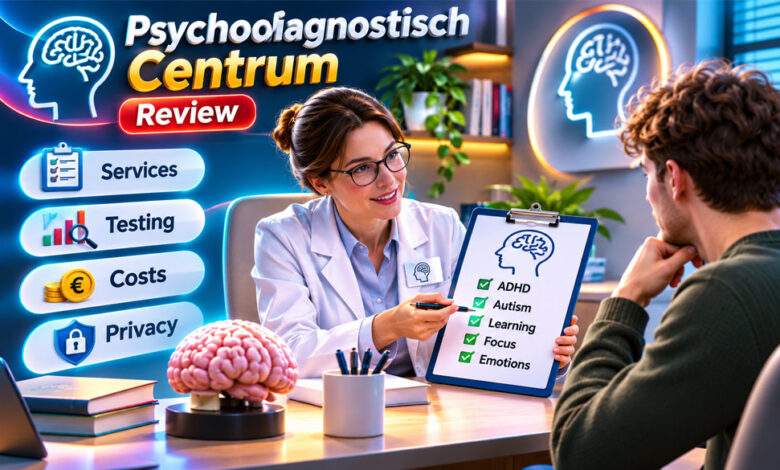

A Psychodiagnostisch Centrum is a center that helps understand mental health, learning, behavior, and thinking problems. The Dutch term roughly means psychodiagnostic center.
People may visit one when they have problems with focus, memory, learning, emotions, or behavior. Testing can also help when symptoms are unclear or earlier treatment has not helped enough.
These centers may use interviews, psychological tests, questionnaires, observations, and personal history. This guide explains how a Psychodiagnostisch Centrum works, what it can assess, costs, privacy, and what to expect during testing.
What Is a Psychodiagnostisch Centrum?
A Psychodiagnostisch Centrum provides psychological testing and assessment. Its main purpose is to understand why someone is having certain problems and what kind of help they may need.
This process is called psychodiagnostiek in Dutch.
A center may look at mental health, behavior, learning, memory, development, emotions, and other thinking skills.
A full assessment normally uses more than one test. A professional may use interviews, questionnaires, psychological tests, observations, and information about the person’s life.
The goal is not always to give someone a diagnosis. Sometimes testing shows that problems may be connected to stress, poor sleep, learning needs, life situations, or several things at the same time.
Testing may also show a person’s strengths. The results can help professionals decide what treatment, school support, further testing, or other care may be useful.
Is Psychodiagnostisch Centrum One Organization?
No. Psychodiagnostisch Centrum is not always the name of one company or healthcare group.
It is also a general term for a service that provides psychological testing and diagnosis. Hospitals, mental health organizations, and private practices may provide these services.
However, some healthcare providers use Psychodiagnostisch Centrum as the name of a specific service.
For example, MET ggz has a Psychodiagnostisch Centrum in Roermond and Maastricht in the Netherlands. Its published information describes testing for adults aged 18 to 65 whose problems are unclear or whose treatment has stopped making enough progress.
These rules are for that specific service. Other centers may have different age limits and entry rules.
Always check the rules of the center you plan to use.
Who May Need a Psychodiagnostic Assessment?
A psychodiagnostic assessment may be useful when someone has ongoing problems that are difficult to explain.
For example, a person may have trouble focusing, remembering things, planning tasks, learning, managing emotions, or dealing with relationships.
Parents may also seek testing when a child has ongoing problems at school or home. The child may struggle with learning, attention, communication, social skills, or following instructions.
Testing can be useful when several conditions could explain the same symptoms.
For example, poor concentration does not always mean ADHD. Stress, anxiety, depression, sleep problems, medication, and other health issues can also make it difficult to focus.
Some people already have a diagnosis but still have problems. If earlier treatment has not helped enough, another assessment may look for a different or additional cause.
Not every period of sadness, worry, or stress needs a full assessment. A general practitioner or mental health professional may sometimes be the best place to start.
Conditions and Problems That May Be Assessed
The conditions assessed depend on the center and its staff. Some centers focus on a few areas, while others provide several types of testing.
ADHD
ADHD can affect focus, planning, organization, and self-control.
An ADHD assessment should use more than one questionnaire. Professionals may look at symptoms, childhood history, daily life, and how the problems appear in different situations.
They should also consider other possible reasons for attention problems.
Autism
Some psychodiagnostic centers assess autism spectrum disorder.
Testing may look at social communication, behavior, development, and daily difficulties.
Childhood history can be important. Information from parents or other people who know the person well may also help when it is appropriate and permission has been given.
Learning and Cognitive Difficulties
Testing can help understand problems with learning, reasoning, memory, and thinking.
Children may be assessed if they have ongoing problems with reading, writing, mathematics, or other schoolwork.
Testing can also show areas where a person is doing well. This may help schools and professionals decide what support could be useful.
Anxiety, Depression, and Emotional Problems
Anxiety, depression, stress, and other emotional problems can affect sleep, concentration, motivation, relationships, and daily life.
A psychologist may use interviews and questionnaires to better understand these symptoms.
The professional may look at how long the symptoms have been present, how serious they are, and how much they affect everyday life.
Personality and Behavioral Concerns
Some centers also look at long-term patterns in behavior, emotions, relationships, and thinking.
Professionals do not judge personality from one action or one difficult period. They look at patterns over time and consider the person’s history and current situation.
How a Psychodiagnostisch Centrum Assessment Works
The exact process depends on the center and the reason for testing.
A good assessment starts by understanding the main problem. The professional then chooses tests that can help answer the main questions.
Referral, Screening, and Intake
The first step may be registration or a referral.
In the Netherlands, insured specialist mental healthcare usually needs a suitable referral. This often comes from a huisarts, or general practitioner.
The center may first check whether its services are suitable for the person’s needs.
During the intake meeting, the professional may ask about symptoms, medical history, medication, sleep, family life, education, work, earlier treatment, and daily activities.
The person can also explain what they hope to learn from the assessment.
Giving clear examples can help. Instead of only saying, “I think I have ADHD,” a person can explain how attention or organization problems affect work, school, or home life.
Personal Assessment Plan
After the intake, the professional decides which tests may be useful.
Not everyone needs the same tests.
A simple question may only need an interview and a small amount of testing. A more complex problem may require several appointments and different tests.
Testing may include questionnaires, interviews, thinking tasks, or observations.
In some cases, information from parents, teachers, partners, or previous healthcare professionals may also help. Permission should be obtained when needed.
Professionals should also consider the person’s age, language, culture, disability, and other needs when choosing tests.
More tests do not always mean a better assessment. Every test should have a clear purpose.
Interviews and Psychological Testing
Some parts of an assessment may feel like a normal conversation.
Other parts may ask the person to answer questions, remember information, solve problems, complete tasks, or focus on an activity.
The professional may also observe how the person completes certain tasks.
Test scores are only one part of the assessment. The professional also considers symptoms, personal history, development, and everyday life.
One high or low score should not be enough to make a diagnosis.
Results and Feedback
After testing, the professional reviews all the information.
A feedback meeting is usually held to explain the results. The findings should be explained in simple language.
The professional may explain whether the results support a diagnosis. They should also explain anything that remains unclear.
The person may receive a written report. It can include the reason for testing, tests used, results, conclusions, and recommended next steps.
Patients can ask questions if they do not understand something. They can also point out factual mistakes in their personal information.
Types of Tests Used at a Psychodiagnostisch Centrum
There is no single set of tests used for everyone. The tests depend on what the professional needs to understand.
Intelligence and Cognitive Tests
These tests look at different thinking skills.
They may measure reasoning, problem-solving, memory, and how someone processes information.
The WISC is commonly used for cognitive testing in children, while the WAIS is used with adults.
These tests can show both strengths and areas where a person may have difficulty.
Attention and Executive-Function Tests
These tests may look at concentration, planning, working memory, and control over attention.
They can be useful when someone struggles to stay focused, organize tasks, or finish work.
A poor score on an attention test does not automatically mean someone has ADHD. Other information is needed before making that decision.
Personality Assessments
Personality assessments look at longer-term patterns in thoughts, feelings, behavior, and relationships.
They may help professionals understand repeated emotional, behavioral, or relationship problems.
Symptom Questionnaires
Questionnaires can ask about anxiety, depression, trauma-related symptoms, attention problems, and other mental health concerns.
They give professionals useful information about the symptoms a person reports.
However, questionnaires should normally be used as part of a larger assessment. They should not replace professional judgment.
Developmental Information and Observations
Developmental history can be important when looking at conditions that may begin in childhood.
Professionals may ask about childhood behavior, school experiences, communication, social skills, and development.
For children, information from parents and teachers may help show how problems appear at home and school.
How Reliable Are Psychological Tests?
Psychological tests can provide useful information when they are chosen and used correctly.
A good test should be reliable and valid.
Reliability means that the test measures something in a consistent way. Validity means that the test actually measures what it is meant to measure.
Professionals also compare scores with suitable groups of people. Age and other important factors may be considered.
In the Netherlands, COTAN, a committee connected with the Nederlands Instituut van Psychologen, reviews psychological tests. It looks at areas such as reliability, validity, and test standards.
Even good tests have limits.
Stress, tiredness, health, language, culture, and the testing environment can affect results. This is one reason professional review is important.
Be careful with websites that promise a definite diagnosis from one quick online quiz. Online tests may help identify possible concerns, but they cannot replace a full professional assessment.
Professionals Working at a Psychodiagnostisch Centrum
Different centers may have different professional teams.
Psychologists often carry out much of the assessment. They may interview patients, choose tests, study the results, prepare reports, and explain the findings.
In the Netherlands, a GZ-psycholoog is a regulated healthcare profession. Some centers may have GZ-psychologists carrying out or supervising assessments.
An orthopedagoog may work with learning, education, development, and behavioral problems. This role is often connected with children and young people.
Testing assistants may help give certain tests and record results under professional supervision.
A psychiatrist may become involved when medical mental health care or medication needs to be considered. Psychiatrists are medical doctors and can prescribe medication.
Not every center has all these professionals. Check who will carry out and supervise the assessment before booking.
Psychodiagnostic Center vs. Psychologist vs. Psychiatrist
These services are connected, but they are not exactly the same.
A psychodiagnostic center mainly focuses on detailed testing and assessment. Some centers only provide testing and then send the person to another provider for treatment.
A psychologist may provide testing, therapy, or both. This depends on their training and professional role.
A psychiatrist is a medical doctor who specializes in mental health. A psychiatrist can assess mental health conditions and prescribe medication when needed.
A general practitioner, or GP, can also be a good first contact. A GP can discuss symptoms, check physical health, provide basic care, and make referrals.
The right choice depends on the person’s needs.
How to Check if a Center Is Trustworthy
Before choosing a Psychodiagnostisch Centrum, check who will carry out the testing and whether they have suitable qualifications.
A reliable center should clearly explain its services, staff, testing process, and reports.
In the Netherlands, some regulated healthcare professionals can be checked through the BIG-register. This includes GZ-psychologists and psychiatrists.
In Belgium, clinical psychologists need professional recognition and federal authorization known as a visum.
Before booking, check:
- What age groups the center accepts.
- What conditions it assesses.
- Who will carry out the tests.
- Who will review and sign the report.
- Whether the tests are suitable for your language and needs.
- Whether you will receive a written report.
- How the results will be explained.
- What happens if the results are unclear.
A good assessment does not always end with a diagnosis. A professional should be willing to explain when there is not enough evidence for a clear answer.
How Long Does an Assessment Take?
There is no fixed time for a psychodiagnostic assessment.
A smaller assessment may only need a few appointments. More detailed ADHD, autism, personality, learning, or cognitive testing may require several visits.
Some testing sessions may last around an hour, while others may take longer. Breaks may be provided during long sessions.
After testing, the psychologist needs time to review the information and prepare the results or report.
Waiting lists can also increase the total time.
Ask the center how many visits you may need and when you can expect to receive your results.
Psychodiagnostisch Centrum Costs
There is no fixed price for a Psychodiagnostisch Centrum.
The cost depends on the type of testing, number of appointments, tests used, report, provider, and insurance.
A smaller assessment may cost less than a detailed assessment involving several tests.
Costs in the Netherlands
Some assessments in the Netherlands may be covered when they are part of insured mental healthcare.
Insured specialist mental healthcare normally requires a suitable referral, often from a GP.
Coverage can depend on the healthcare provider and the person’s insurance plan. Patients should check whether their insurer has a contract with the provider and whether a deductible applies.
The information collected for this article reports a standard adult deductible of €385 for 2026. Patients should check the current amount with their insurer or an official Dutch healthcare source because rules can change.
Private testing that is not covered by insurance may need to be paid for by the patient.
Costs in Belgium
There is no standard price for psychodiagnostic testing in Belgium either.
The information collected for this article reports that private assessments may cost several hundred euros. More detailed testing may sometimes cost over €1,000. These are general reported amounts, not fixed national prices.
Belgium’s RIZIV/INAMI supports some types of psychological care. However, this does not mean every full psychodiagnostic assessment is covered.
Ask the center for a full price before starting. Check whether the price includes the intake, tests, report, and feedback meeting.
Insurance and Referral Rules
Insurance and referral rules depend on the country and provider.
In the Netherlands, insured specialist mental healthcare generally needs a suitable referral. A GP is often involved.
A referral does not mean every cost will automatically be covered. The provider, insurance plan, and type of assessment can affect coverage.
In Belgium, some psychological services can be used directly under certain programs. This does not mean every specialist diagnostic assessment is covered or available without a referral.
Before booking, ask about all possible costs, including testing, intake, reports, feedback, and cancellation fees.
It is also a good idea to check coverage directly with the insurer.
Privacy, Consent, and Psychological Reports
Psychological testing can involve very private information.
A center may collect information about mental health, childhood, relationships, education, work, medical history, medication, and previous treatment.
Test results and professional findings may also become part of the patient’s record.
The center should explain how this information is stored, who can see it, and when it may be shared.
Consent is important when information is shared with other people or organizations.
Extra care may be needed when an assessment is requested by a school, employer, insurer, or legal representative.
Ask who will receive the results and whether they will receive the full report.
In some cases, a shorter summary may provide the needed information without sharing every private detail.
Patients should also have a chance to understand what their results mean.
What Happens if the Results Are Unclear?
Not every assessment gives one clear diagnosis.
Different conditions can cause similar symptoms. Stress, poor sleep, health problems, medication, and difficult life situations can also affect behavior, emotions, and thinking.
An assessment may therefore find real difficulties without finding one clear disorder.
This does not make the assessment useless.
The results may still show what should happen next. A professional may suggest treating another problem first, improving sleep, reducing stress, getting medical tests, finding old school records, or completing more testing.
The issue may also be reviewed again later.
A second opinion can be useful if important information appears to have been missed or the findings do not seem to match the evidence.
What Happens After the Assessment?
A feedback meeting is usually held after testing.
The professional explains the main results and what they mean. The patient can ask questions.
A written report may also be provided. It may include the reason for testing, tests used, results, conclusions, possible diagnosis, and next steps.
The next step depends on the findings.
Some people may need therapy. Children may need extra help at school. Other people may need support at work or with daily activities.
Further medical or psychological testing may sometimes be recommended.
Some psychodiagnostic centers only provide testing. In that case, the patient may be sent to another healthcare provider for treatment.
How to Prepare for Your First Appointment
You do not need to study for psychological testing.
Instead, prepare information that can help the professional understand your situation.
You may want to bring details about previous diagnoses, current medication, earlier treatment, and past assessments.
School reports or older medical information may also help if the center asks for them.
Think of a few clear examples of how your problems affect daily life. These could involve school, work, home, or relationships.
Also mention your strengths.
Tell the professional if your symptoms change because of sleep, stress, medication, substances, or other factors.
Do not try to get a certain score or diagnosis. The goal is to give the professional an accurate picture.
Tell the examiner if you do not understand the instructions, have trouble with the language, or become too tired during testing.
Psychodiagnostisch Centrum in the Netherlands and Belgium
Psychodiagnostic services are available through different healthcare organizations and private providers in both the Netherlands and Belgium.
They do not all belong to one organization.
Each provider may have different age limits, services, prices, waiting times, and referral rules.
One example is MET ggz, which has a Psychodiagnostisch Centrum in Roermond and Maastricht. Its published information describes specialist assessment for adults aged 18 to 65 with unclear problems or treatment that has stopped making enough progress.
The collected information also mentions Brijder in the Netherlands in connection with psychological testing for people receiving addiction care.
In Belgium, IPO is reported to provide assessments in areas such as ADHD, autism, intelligence, and personality. Feinbrein is also reported to offer ADHD and autism assessment.
These are separate providers. Their services and rules can change, so check their current information before booking.
Benefits and Limitations of Psychodiagnostic Assessment
Psychological testing can be useful, but it also has limits.
Benefits
A detailed assessment can help explain symptoms that are difficult to understand.
It can compare different possible causes instead of assuming that one condition is responsible.
Testing can also show a person’s strengths and areas where they may need help.
The results may guide therapy, school support, workplace help, further healthcare, or additional testing.
It can also be useful when someone already has a diagnosis but still has problems that the earlier diagnosis does not fully explain.
A full assessment uses different types of information. This can provide a better picture than one questionnaire alone.
Limitations
Testing does not guarantee a diagnosis.
Some symptoms can have several possible causes, and the evidence may not always give one clear answer.
Testing can also take several appointments. Waiting lists may make the process longer.
Private testing can be expensive, especially when insurance does not cover it.
Results may also be affected by stress, tiredness, language, culture, health, and other factors.
Some centers only provide testing. Patients may need to go somewhere else for treatment.
When a Psychodiagnostisch Centrum Is Not the Right Choice
A Psychodiagnostisch Centrum mainly provides assessment and testing. It is not the right service for every situation.
Someone with mild or short-term concerns may first speak with a GP or another mental health professional.
Routine psychological testing is also not the right choice during an immediate mental health emergency.
Someone in immediate danger, experiencing a serious mental health crisis, or at risk of suicide needs urgent medical or emergency help rather than waiting for a normal testing appointment.
A Psychodiagnostisch Centrum is most useful when there is a clear problem or question that needs detailed assessment.
Bottom Line
A Psychodiagnostisch Centrum helps understand mental health, behavior, learning, development, emotions, and thinking problems.
It is mainly a type of psychological assessment service, not one single company. Different centers have different services, age limits, prices, referral rules, and treatment options.
An assessment may include interviews, tests, questionnaires, observations, and personal history. Professionals look at all this information together instead of making a diagnosis from one test.
Before choosing a center, check the staff’s qualifications, costs, insurance coverage, referral rules, privacy policy, and what happens after testing.
The main goal is to better understand the person’s difficulties and decide what support or treatment may help.
Frequently Asked Questions
What is a Psychodiagnostisch Centrum?
It is a center or service that uses professional testing to understand psychological, behavioral, learning, developmental, and thinking problems.
What conditions can a Psychodiagnostisch Centrum assess?
Depending on the center, it may assess ADHD, autism, learning problems, attention, memory, emotional difficulties, personality, and other mental health concerns.
Can a Psychodiagnostisch Centrum diagnose ADHD or autism?
Yes, some qualified centers assess ADHD and autism. A full assessment should use several sources of information rather than one questionnaire.
Do I need a referral?
It depends on the provider and country. Insured specialist mental healthcare in the Netherlands usually requires a suitable referral.
How long does psychodiagnostic testing take?
It depends on the assessment. Some need only a few visits, while more detailed testing can require several appointments plus time to prepare the results.
How much does a Psychodiagnostisch Centrum cost?
There is no fixed price. The cost depends on the center, type of testing, number of appointments, insurance, and country.
Is psychodiagnostic testing covered by insurance?
Sometimes. Coverage depends on the type of assessment, referral, provider, insurance plan, and local healthcare rules.
What happens after psychodiagnostic testing?
The professional normally explains the results and may provide a written report. The next step could include therapy, school support, medical care, more testing, or referral to another specialist.
Crackstube Review: What It Offers and Is It Safe to Use?
MathPlayZone Complete Guide: Math Games, Features, Safety, and Benefits