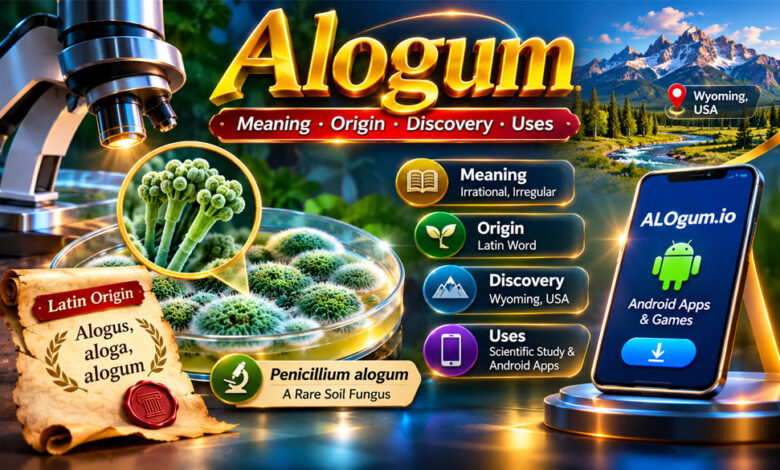

Alogum is an uncommon word with different meanings. It comes from a Latin word that means irrational or irregular. It is also part of the scientific name of a soil fungus called Penicillium alogum.
People searching for Alogum may also find ALOgum.io, a website that offers Android apps and games.
In this guide, we will explain the meaning of Alogum, its origin, the discovery of the fungus, its features, and its use in technology.
What Is Alogum?
Alogum is a rare Latin word that has different uses. Its meaning depends on where you see it.
In Latin, Alogum means something irrational, irregular, or lacking reason. In science, it is part of the name Penicillium alogum, a type of fungus found in soil.
ALOgum.io is also the name of a website reported to offer Android apps and games.
The Latin word and the fungal species are connected. However, there is no confirmed connection between the fungus and the Android website.
The Latin Meaning and Origin of Alogum
Alogum comes from the Latin adjective alogus, aloga, alogum. It is also connected to the Greek word alogos, which means something that lacks reason or logical order.
The Lewis and Short Latin dictionary lists several meanings of this word, including irrational and irregular.
It is a rare word found in later forms of Latin. Although Alogum may sound like a modern name, the word existed long before the internet.
Historical Uses of Alogum
The word had different meanings depending on how it was used.
| Context | Meaning |
|---|---|
| General language | Something irrational or lacking reason |
| Mathematics | Something that does not match another line or quantity |
| Poetry | A part of a verse that does not follow the usual pattern |
All these meanings are connected to the idea of something that does not follow a normal order.
Is Alogum an English Word?
Alogum is not a common English word. It mainly appears in articles about Latin words, fungal species, or Android apps.
There is no established English definition that describes Alogum as an AI platform, business tool, or new technology.
What Is Penicillium Alogum?
Penicillium alogum is a type of tiny fungus that scientists officially described in 2016. It belongs to Penicillium, a large group of molds.
Different Penicillium species can grow in soil, plants, food, dust, and other places. Each species has its own appearance, genes, growth patterns, and chemical properties.
Scientists identified P. alogum by studying soil samples from Wyoming, United States.
The fungus is mainly known for its role in scientific research. No medical or commercial use has been confirmed for it.
The Discovery and History of Alogum
The original fungal samples came from the Wind River Range in Wyoming. Some samples were collected in 1998. Researcher M. Christensen collected the main sample in June 2001.
Scientists later studied these samples in laboratories. They examined how the fungus grew, what it looked like, its DNA, and the chemicals it produced.
The results showed that the fungus was different from other known Penicillium species.
In 2016, scientists officially described it in a research paper called Fifteen New Species of Penicillium. The paper was published in the scientific journal Persoonia.
Cobus M. Visagie, Jens C. Frisvad, and Keith A. Seifert were responsible for naming the species.
The study introduced 15 new Penicillium species from different locations and natural environments.
Scientific Classification of Alogum
Scientists place living things into groups based on their shared features and genetic information. This makes it easier to study and compare different species.
The scientific classification of Penicillium alogum is given below.
| Classification | Scientific Name |
|---|---|
| Kingdom | Fungi |
| Phylum | Ascomycota |
| Class | Eurotiomycetes |
| Order | Eurotiales |
| Family | Aspergillaceae |
| Genus | Penicillium |
| Subgenus | Aspergilloides |
| Section | Stolkia |
| Species | Penicillium alogum |
Its full scientific name, including the scientists who named it, is Penicillium alogum Visagie, Frisvad & Seifert.
The original research places the fungus in section Stolkia. Some online articles place it in section Lanata-Divaricata, but this does not match the original study.
Scientific Reference Records
The fungus has several scientific reference numbers.
| Reference | Identification Number |
|---|---|
| Type specimen | DAOM 695759 |
| Living reference culture | DAOMC 250543 |
| MycoBank number | MB815772 |
A type specimen is the main reference sample used to identify a species.
A living reference culture allows scientists to grow and study the fungus again. MycoBank is a scientific database that stores information about fungal names and species.
Why Was the Fungus Named Alogum?
Scientists named the fungus Alogum because of its uneven branching pattern.
The fungus has tiny structures called conidiophores. These structures hold the cells that produce spores.
In P. alogum, some of these structures have simple branches, while others divide into uneven branches.
Scientists chose the Latin word alogum because it means irregular, irrational, or nonsensical.
The name describes the shape of the fungus. It does not describe its effects on human health.
The correct scientific name is written as Penicillium alogum. It can also be shortened to P. alogum after the first mention.
Where Is Alogum Found?
The original samples of Penicillium alogum came from tundra wetland soil in the Wind River Range of Wyoming, United States.
The main sample was collected from Middle Mountain in June 2001.
This mountain area has cold weather and moist soil. Wetland soil often contains water and dead plant material, which can support fungal growth.
However, scientists do not know all the places where Alogum grows naturally.
The original samples came from Wyoming, but this does not mean the fungus is only found there. It may also grow in other areas that scientists have not studied.
There are few scientific records of this species, but its actual numbers in nature remain unknown.
What Does Alogum Look Like?
Penicillium alogum forms small colonies when scientists grow it in laboratories. A colony is a group of fungal cells growing together.
Its size, color, and texture depend on the material and conditions in which it grows.
Colony Appearance
The thin fungal threads, called mycelium, are mostly white. Its spores may appear grey-green, dull green, or dark green.
Some colonies have a soft, woolly surface. Others have a smooth surface that looks like velvet.
Small grooves or raised areas may also appear on the colonies.
The underside can have pale yellow, orange, grey, or grey-green colors. Small red droplets may appear after about two weeks under certain laboratory conditions.
Many other Penicillium species have similar colors and shapes. This makes it difficult to identify Alogum by appearance alone.
Microscopic Features
Scientists use microscopes to study the tiny parts of the fungus.
| Feature | Description |
|---|---|
| Conidiophores | Uneven spore-bearing branches |
| Stalk length | About 10–43 micrometers |
| Stalk color | Sometimes light greenish-brown |
| Phialides | Spore-producing cells in groups of three to five |
| Spore shape | Round |
| Spore size | About 2.5–3 micrometers |
| Spore walls | Thick and slightly rough |
A micrometer is one-thousandth of a millimeter.
The uneven branches and small round spores help scientists recognize this species. However, other tests are usually needed to confirm its identity.
How Does Alogum Grow in Laboratories?
Scientists grow fungi on special materials called culture media. These materials contain nutrients that support fungal growth.
The original study used several types of culture media.
| Culture Medium | Full Name |
|---|---|
| CYA | Czapek Yeast Autolysate Agar |
| MEA | Malt Extract Agar |
| YES | Yeast Extract Sucrose Agar |
| OA | Oatmeal Agar |
| CREA | Creatine Sucrose Agar |
Scientists used these materials to compare the fungus’s growth, size, color, and texture.
Laboratory Growth Results
The original study recorded the following results.
| Test Condition | Result |
|---|---|
| CYA at 25°C for seven days | 19–22 mm |
| MEA at 25°C for seven days | 31–35 mm |
| CYA at 37°C for seven days | No growth |
| CREA | Weak growth |
| Acid production test | No acid detected |
The fungus grew larger on malt extract agar than on CYA during the seven-day test.
It did not grow on CYA at 37°C during the reported test.
These results help scientists compare Alogum with other fungi. However, they do not prove that the fungus is harmless to humans.
How Do Scientists Identify Alogum?
Many fungi look similar. Scientists cannot confirm the identity of Alogum by checking its color or shape alone.
The researchers used a method called the polyphasic approach. This means using several types of tests together to identify a species.
Physical and Microscopic Examination
Scientists examined the size, color, texture, and growth of the fungal colonies.
They also used microscopes to study the spores, stalks, spore walls, and branching patterns.
These tests helped them find differences between Alogum and other related fungi.
DNA Analysis
DNA testing helps scientists compare the genetic information of different species.
The original study used three DNA markers to identify Penicillium alogum.
| DNA Marker | Reference Number |
|---|---|
| ITS | KT887869 |
| Beta-tubulin (BenA) | KT887830 |
| Calmodulin (CaM) | KT887791 |
These records allow other scientists to compare newly collected fungal samples with Alogum.
Using several DNA markers helps researchers tell closely related species apart.
Chemical Analysis
Scientists also studied the chemicals produced by the fungus as it grew.
Some of these chemicals are called extrolites.
Different fungal species can produce different chemicals. Studying them gives scientists another way to identify and compare fungi.
Alogum and Its Close Relatives
Penicillium alogum belongs to section Stolkia, which includes several related fungal species.
These fungi share some features, but they also have differences in their spores, branches, and growth patterns.
| Related Species | Main Differences |
|---|---|
| P. stolkiae | Longer spore-producing cells and slightly larger spores |
| P. subarcticum | Larger spores measuring about 3–4 micrometers |
| P. pullum | Larger, rough spores that become darker with age |
| P. boreae | More divided branches |
| P. canariense | More divided branches |
Most of these differences are too small to see without a microscope.
Penicillium Alogum vs. Penicillium Stolkiae
Penicillium stolkiae looks very similar to Alogum. Both species can have similar colony colors and branching patterns.
However, their spores and spore-producing cells are slightly different.
The spores of P. alogum measure about 2.5–3 micrometers. The spores of P. stolkiae measure around 2.8–3.5 micrometers.
P. stolkiae also has longer spore-producing cells, measuring about 7–10 micrometers.
Scientists use these small differences and DNA tests to identify each species correctly.
Chemical Properties of Alogum
Like many fungi, Penicillium alogum produces chemicals as it grows.
During the 2016 study, scientists found an unknown chemical compound with the molecular formula C₂₁H₂₈O₈.
However, they did not fully identify its chemical structure or understand its effects.
It is not known whether this compound has useful or harmful properties.
No medical, farming, or industrial use has been confirmed for this compound. More research is needed to understand it.
Does Alogum Produce Penicillin?
Many people connect Penicillium with penicillin, an antibiotic used to treat certain bacterial infections.
However, not every Penicillium species produces penicillin. Different species can produce different chemicals.
There is no confirmed evidence that Penicillium alogum produces medically useful penicillin.
It should not be used as a medicine, antibiotic, or natural treatment.
Is Alogum Harmful to Humans?
Scientists do not know much about the effects of Penicillium alogum on human health.
The original study focused on identifying and naming the fungus. It did not study its health effects in detail.
Alogum has not been established as a common cause of human infections or a known source of dangerous toxins.
However, this does not mean it is completely safe.
Mold spores can cause breathing problems, irritation, and allergic reactions in some people. Unknown fungi should not be eaten or used in home experiments.
Can You Identify Alogum at Home?
You cannot reliably identify Alogum just by looking at a mold patch.
Many Penicillium species have similar green or grey colors. Scientists often need microscopes, laboratory tests, and DNA testing to identify them.
If you find mold in your home, focus on fixing moisture problems and removing the mold safely instead of trying to identify its exact species.
Why Is Alogum Important to Science?
The discovery of Penicillium alogum helps scientists learn more about fungi and the different species living in soil.
Some fungi look almost the same but have different genes and chemical properties. Studying these differences helps scientists identify and classify them correctly.
The reference samples, living cultures, and DNA records also help researchers compare new fungal samples with known species.
The unknown chemical compound found in Alogum may also be useful for future scientific studies.
Its discovery shows how scientists use several methods together to identify new forms of life.
What Is Still Unknown About Alogum?
Scientists have learned several things about Alogum, but much about the fungus remains unknown.
| Research Area | Current Information |
|---|---|
| Natural distribution | Not fully known |
| Population size | Unknown |
| Role in soil | Not fully understood |
| Human health effects | Limited research |
| Toxicity | Unknown |
| Complete chemical properties | Not fully studied |
| Medical uses | None confirmed |
| Agricultural uses | None confirmed |
| Industrial uses | None confirmed |
| Antibiotic production | Not confirmed |
| Conservation status | Not established |
Future soil studies, DNA tests, and chemical research may help answer these questions.
What Is ALOgum.io?
ALOgum.io is a separate use of the name Alogum. It is described as a third-party website that offers Android apps and games.
According to information from August 2026, the website offered both original and modified APK files.
Its reported content includes:
- Android apps.
- Mobile games.
- Utility apps.
- Entertainment apps.
- Original APK files.
- Modified APK files.
- Android and technology information.
The website reportedly claims to offer fast, easy, and safe downloads. However, these claims have not been independently checked.
Its owner, founder, launch date, pricing, and subscription plans are not clearly known. Its current availability has also not been verified.
What Is an APK File?
An APK is a file used to install an Android app.
When you download an app from Google Play, the installation usually happens automatically. APK files allow you to install compatible apps from other sources.
Installing apps from outside an official app store is called sideloading.
An APK file may not work on every Android device. Its compatibility depends on the Android version, device hardware, and app requirements.
APK files cannot be installed directly as normal apps on iPhones or iPads.
Original APK vs. MOD APK
ALOgum.io reportedly offers original and modified APK files.
An original APK is meant to contain the app as released by its developer. A MOD APK is a changed version of that app.
These changes may affect the app’s features, advertisements, permissions, or other functions.
| Feature | Original APK | MOD APK |
|---|---|---|
| App code | Meant to be unchanged | Changed |
| Features | Standard features | May have changed features |
| Updates | May follow official updates | May miss official updates |
| Security | Depends on the file source | May have extra risks |
| Compatibility | Depends on the device | May have extra problems |
| Licensing | Depends on distribution rights | May raise copyright issues |
A file labeled as an original APK is not always genuine. You should still check its source before installing it.
Is ALOgum.io Safe and Legal?
There is not enough verified information to confirm that ALOgum.io or every file on the website is safe.
Its reported terms explain that some files come from third parties and that users accept the risks of downloading modified APK files.
Downloading apps from unofficial sources may involve risks such as:
- Harmful software.
- Unnecessary app permissions.
- Theft of personal information.
- Missing security updates.
- App crashes.
- Device compatibility problems.
- Account restrictions.
These are general risks of unofficial APK downloads. They are not confirmed problems involving ALOgum.io.
There is also limited information about the website’s privacy practices, security checks, malware scanning, and handling of user data.
Downloading apps outside Google Play is not automatically illegal. However, sharing or changing apps without permission may break copyright laws, software licenses, or developer rules.
The legal status depends on the app, its distribution rights, and the laws of your country.
Tips for Downloading Android Apps Safely
Follow these simple safety tips when downloading Android apps:
- Use Google Play or official developer websites when possible.
- Check the app developer and download source.
- Review the permissions requested by the app.
- Keep Google Play Protect enabled.
- Pay attention to Android security warnings.
- Keep your apps and Android system updated.
- Avoid sharing personal information with unknown apps.
F-Droid is another option for downloading free and open-source Android apps. APKMirror is a third-party website that offers different versions of Android apps.
Always check the source and compatibility of an APK file before installing it.
Is ALOgum.io Connected to the Latin Word or Fungus?
There is no confirmed connection between ALOgum.io and Penicillium alogum.
The Latin word existed long before the internet, while scientists officially described the fungus in 2016.
The reason why the website uses the name ALOgum is unknown.
Having the same spelling does not mean that the website is connected to the Latin word or the fungus.
Alogum vs. Algum and Almug
Alogum is sometimes confused with Algum and Almug because these words have similar spellings.
However, they have different meanings.
| Term | Meaning |
|---|---|
| Alogum | A Latin word meaning irrational or irregular |
| Penicillium alogum | A species of soil fungus |
| ALOgum.io | An Android APK download website |
| Algum | A biblical word referring to valuable wood |
| Almug | Another biblical word referring to valuable wood |
Algum and Almug appear in biblical stories about King Solomon, including passages in 1 Kings and 2 Chronicles.
Some historical sources connect this wood with sandalwood. However, its exact tree species remains unknown.
Alogum has a different origin and should not be confused with these biblical words.
How to Identify the Correct Meaning of Alogum
The easiest way to understand Alogum is to check the words around it.
The same term can appear in search results about language, fungi, Android apps, and biblical history.
| Related Words | Likely Meaning |
|---|---|
| Latin, Greek, irrational | Latin word |
| Mathematics, poetry, verse | Historical language |
| Fungi, mold, spores | Scientific species |
| Wyoming, soil, DNA | Fungal research |
| Android, APK, apps, games | ALOgum.io |
| Solomon, Bible, wood | Algum or Almug |
Some online articles may describe Alogum as an AI platform, business tool, or digital service. However, there is no reliable evidence supporting these meanings in the available sources.
Checking historical dictionaries, original scientific papers, and official website information can help you find the correct meaning.
Bottom Line
Alogum is an uncommon term with different meanings. Its Latin origin refers to something irrational, irregular, or lacking reason.
Penicillium alogum is a soil fungus that scientists officially described in 2016. Its original samples came from Wyoming, United States. Scientists named it after its uneven spore-bearing branches.
ALOgum.io is a separate website reported to offer Android apps, games, and modified APK files. Its current services and safety claims have not been independently verified.
The meaning of Alogum depends on where and how the word is used.
Frequently Asked Questions
What is Alogum?
Alogum is a rare Latin word that also appears in the name of a soil fungus and an Android APK website.
What does Alogum mean in Latin?
It means irrational, irregular, unreasonable, or lacking reason.
What is Penicillium alogum?
Penicillium alogum is a type of soil fungus officially described by scientists in 2016.
Where was Alogum discovered?
The original fungal samples came from wetland soil in the Wind River Range of Wyoming, United States.
Is Alogum harmful to humans?
Its effects on human health are not well studied. It has not been established as a known cause of human infections.
Does Alogum produce penicillin?
There is no confirmed evidence that Penicillium alogum produces medically useful penicillin.
What is ALOgum.io, and is it safe?
ALOgum.io is a reported Android APK download website. Its safety claims have not been independently verified.
Are Alogum and Algum the same thing?
No. Alogum is a Latin word, while Algum is a biblical term referring to valuable wood.
Yonopress Review: Content, Categories, Benefits, and Limitations
Quad Equalizer: Features, Frequency Bands, Benefits, and Limitations