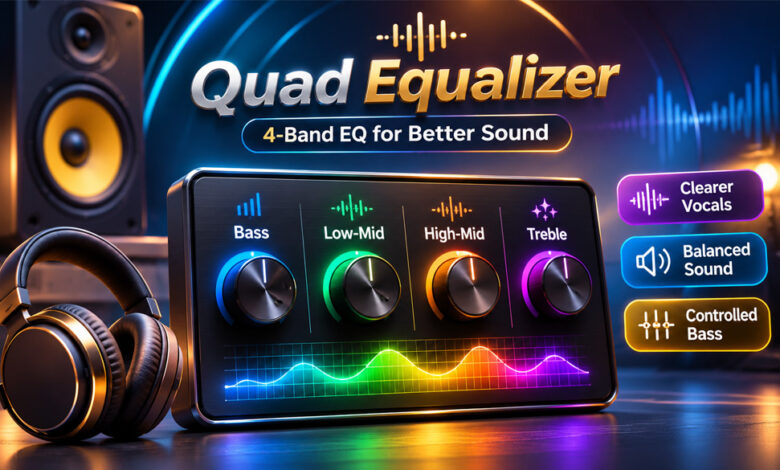

A Quad Equalizer is an audio tool that helps you change different parts of a sound. In most cases, it is a four-band equalizer with controls for bass, low-mid, high-mid, and treble.
People use a Quad Equalizer to reduce heavy bass, make voices clearer, control sharp sounds, and improve overall sound balance. This guide explains how it works, its main features, frequency bands, settings, benefits, and limits.
What Is a Quad Equalizer?
A Quad Equalizer usually means an equalizer with four main sound bands. These are bass, low-mid, high-mid, and treble. You can adjust each band to change a different part of the sound.
It gives you more control than simple bass and treble settings. A three-band EQ usually has bass, mid, and treble. A four-band EQ splits the middle frequencies into low-mid and high-mid.
This makes it easier to fix certain sound problems. For example, reducing low-mid frequencies may make muddy music clearer. Changing the high-mid band can help voices stand out.
However, Quad Equalizer is not one specific app, product, or company. The word “quad” can have different meanings.
A four-band equalizer controls four frequency areas. A four-channel equalizer works with four separate audio signals. Older quadraphonic audio systems can also use equalizers for four speaker channels.
The term is also used in some electronic systems. In this case, a quad signal equalizer can work with four data channels instead of normal audio.
You can usually understand the type by looking at the controls. Four frequency controls normally mean a four-band EQ. Four controls marked as separate channels usually mean a four-channel system.
How Does a Quad Equalizer Work?
A Quad Equalizer changes selected sound frequencies. It does not simply make the whole sound louder or quieter.
Sound frequencies are measured in Hertz (Hz). Low frequencies produce deep sounds such as bass. Higher frequencies create brighter sounds and fine details.
EQ changes are usually measured in decibels (dB). A positive number boosts a frequency. A negative number reduces it. At 0 dB, the frequency is not boosted or reduced.
For example, strong bass can sometimes cover a singer’s voice. Reducing the bass or low-mid band may make the voice clearer.
Some equalizers have fixed frequency bands. More advanced models let you choose the exact frequency you want to change. They may also include a Q control, which changes how wide or narrow the adjustment is.
Digital equalizers use digital signal processing, also called DSP. Hardware equalizers can use electronic circuits to make similar sound changes.
Small changes are usually enough. You often do not need large boosts or cuts to hear a difference.
Understanding the Four Frequency Bands
A four-band equalizer divides sound into four main areas. The exact frequency ranges can be different depending on the device.
Bass or Low Frequencies
Bass commonly covers around 20 Hz to 250 Hz.
This area includes deep sounds such as bass guitar, kick drums, low notes, and rumble. Increasing bass can make music feel fuller and stronger.
Too much bass can make music sound boomy. It can also cover voices and other instruments.
Small speakers may not be able to produce very deep bass. Boosting the bass too much can cause distortion instead of improving the sound.
Low-Mid Frequencies
Low-mid frequencies are often around 250 Hz to 2 kHz.
This area gives warmth and body to voices, guitars, piano, and other instruments.
Too much low-mid sound can make audio muddy, thick, or boxy. A small reduction may make voices and instruments easier to hear.
However, cutting too much can make the sound thin.
High-Mid Frequencies
High-mid frequencies are often around 2 kHz to 6 kHz.
This area affects vocal clarity, instrument detail, and presence. A small boost can make speech and vocals easier to hear.
Too much high-mid sound can make audio harsh, sharp, or tiring. A small reduction may help if voices or guitars sound too aggressive.
Treble or High Frequencies
Treble usually covers around 6 kHz to 20 kHz.
It controls brightness, cymbals, high notes, hiss, and small sound details.
A small treble boost can make dull audio sound clearer. Too much treble can make music sharp or uncomfortable.
These frequency ranges are only general examples. The exact ranges can change from one equalizer to another.
Types of Quad Equalizers
There are different types of four-band equalizers. The main types are graphic, parametric, and semi-parametric.
Graphic Equalizer
A graphic equalizer uses fixed frequency bands. Each band usually has a slider, knob, or digital control.
You can raise or lower each band, but you normally cannot change its main frequency.
Graphic EQs are simple to use. They work well for basic sound changes and everyday listening.
Parametric Equalizer
A parametric equalizer gives you more control.
It can let you change frequency, gain, and Q. Frequency chooses the sound area. Gain decides how much it is boosted or reduced. Q controls how wide or narrow the change is.
A high Q affects a smaller frequency area. A low Q affects a wider area.
This makes parametric EQ useful for fixing more specific sound problems.
Semi-Parametric Equalizer
A semi-parametric equalizer offers some of the controls of a parametric EQ.
For example, it may let you change frequency and gain while keeping Q fixed.
This type of EQ is found on some mixers and instrument amplifiers. It offers more control than a basic graphic EQ without making the settings too complicated.
Main Features and Controls
A Quad Equalizer can have different features depending on the hardware or software.
Frequency Control
Frequency control lets you choose which part of the sound you want to change.
For example, a setting near 100 Hz mainly affects bass. Frequencies around a few kilohertz can strongly affect voices and other details.
Fixed-band EQs may not let you choose the exact frequency. Parametric EQs usually offer more control.
Gain Control
Gain controls how much a frequency is increased or reduced.
Positive dB values boost the sound. Negative values reduce it.
Small changes are usually enough. Large boosts can make the sound less natural and may cause distortion.
Q or Bandwidth
Q controls how wide the EQ change is.
A low Q changes a wider frequency area. A high Q changes a smaller area.
This can help when you want to fix one specific sound without changing too much around it.
Not every four-band EQ has a Q control.
Output or Preamp Control
Some equalizers include an output or preamp setting.
Boosting several bands can make the signal too strong. Lowering the output or preamp can help prevent clipping and distortion.
EQ Bypass
A bypass button temporarily turns off the EQ.
This lets you compare the changed sound with the original sound without deleting your settings.
Try to compare both at a similar volume. Louder audio can sometimes seem better even when it is not actually clearer.
Filters
Some advanced equalizers include different filters.
Bell filters change sound around a selected frequency. Shelf filters change a wider low or high frequency area. High-pass and low-pass filters can remove frequencies outside a chosen range.
These filters are not available on every Quad Equalizer.
Presets and Device Profiles
Some software equalizers let you save your settings as presets.
You may also be able to create different profiles for headphones, speakers, or other devices.
This is useful because one EQ setting may sound good on headphones but poor on speakers.
Channel Linking
Channel linking is mainly used with four-channel equalizers.
It lets two or more channels use matching settings. This can be useful when left and right speakers need the same adjustments.
Real-Time Spectrum Analysis
Some digital equalizers show the sound frequencies on a live graph.
This can help you notice strong frequencies or possible sound problems. However, the graph should only be used as a guide.
Your speakers, room, microphone position, and other factors can affect the results. Listening is still important.
Where Is a Quad Equalizer Used?
A Quad Equalizer can be useful in many audio setups.
For music listening, it can reduce heavy bass, control sharp treble, or make voices clearer.
In music production and recording, it can change the sound of vocals, guitars, drums, bass, keyboards, and other instruments. It can also help when two instruments are using similar frequencies and are difficult to hear separately.
In car audio, EQ can help control heavy bass, unclear voices, and sharp high sounds. Every car sounds different because speaker position, seats, windows, and cabin size can affect the audio.
Guitar and bass amplifiers can also have four EQ controls. These help musicians change the body, bass, presence, and brightness of their instruments.
For podcasts, dialogue, and video calls, reducing unwanted low frequencies and making small midrange changes can help voices sound clearer.
A Quad Equalizer can also help with gaming. Heavy bass may hide smaller sounds such as footsteps or reload sounds. Reducing some bass and carefully changing the high-mid area may make these details easier to hear.
EQ can also be used with headphones, earbuds, home speakers, soundbars, and live sound systems.
Best Quad Equalizer Settings
There is no single best setting that works for everyone.
The best settings depend on your speakers, headphones, music, room, car, and personal preference.
Start with all four bands at 0 dB. Listen to audio you know well and decide what needs to change.
| Sound Problem | Band to Adjust | Starting Change |
|---|---|---|
| Too much bass | Bass | -1 to -3 dB |
| Muddy sound | Low-mid | -2 to -3 dB |
| Unclear vocals | High-mid | +1 to +2 dB |
| Harsh vocals | High-mid | -1 to -3 dB |
| Dull sound | Treble | +1 to +2 dB |
| Too much brightness | Treble | -1 to -2 dB |
| Distorted audio | Output/multiple bands | Reduce boosts and output |
Change only one band at a time. Listen again after every change.
Try reducing an unwanted frequency before making a large boost somewhere else. For example, reducing heavy bass may make vocals clearer without needing a large high-mid boost.
Keep the volume similar when comparing settings. Louder audio can sometimes seem better only because it is louder.
Quad Equalizer Settings for Different Uses
Different uses may need different settings.
For dialogue and podcasts, reducing a little bass or low-mid sound can help remove boom. A small high-mid boost may make words clearer.
For music, start at 0 dB and change only what needs improvement. Music that already has strong bass may not need any extra bass.
For competitive gaming, too much bass may hide smaller sounds. Reducing bass slightly and making a small high-mid change may help some game sounds stand out.
For car audio, listen for bass that sounds too heavy or high sounds that feel too sharp. Reduce the problem area instead of boosting every other band.
For bright headphones, a small high-mid or treble reduction may make the sound more comfortable.
For guitar and bass, settings depend on the instrument, amplifier, music style, and other instruments being played.
If possible, save separate EQ profiles for different devices. Your headphone settings may not work well with car speakers.
Benefits of a Quad Equalizer
A Quad Equalizer gives you useful sound control without too many settings.
It can improve vocal clarity by reducing frequencies that cover the voice. It can also reduce muddy or boomy sound.
The separate low-mid and high-mid controls are useful because they let you adjust warmth and vocal presence separately.
A four-band EQ is also fairly easy to learn. It gives more control than simple bass and treble settings but has fewer controls than larger equalizers.
It can be used with many types of equipment, including music software, car audio, amplifiers, mixers, speakers, and headphones.
Musicians and producers can also use it to help instruments sound clearer when they are playing together.
Limitations of a Quad Equalizer
A Quad Equalizer cannot fix every sound problem.
Four bands may not be enough when you need very detailed changes. A fixed four-band EQ may also have trouble fixing a problem that affects a very small frequency range.
A parametric EQ gives more control, but it still has only four bands. Professional mixing, mastering, or speaker tuning may need more bands.
EQ also cannot repair damaged speakers or headphones. It cannot restore sound details that were lost in a poor recording.
It cannot make a small speaker produce very deep bass if the speaker is not built for it. A large bass boost may simply cause distortion.
EQ is also not a complete noise-removal tool. It may help with some fixed hum, hiss, or rumble, but it cannot remove every background sound.
Speaker placement, microphone position, headphone fit, and room acoustics also affect sound quality. EQ cannot completely fix poor setup.
Compression, noise cancellation, spatial audio, virtual surround, and limiting are separate audio tools. They are not normal Quad Equalizer functions.
Quad Equalizer vs. Other Equalizers
Different equalizers offer different numbers of bands.
| Equalizer | Typical Controls | Common Use |
|---|---|---|
| 3-band EQ | Bass, mid, treble | Simple sound changes |
| 4-band EQ | Bass, low-mid, high-mid, treble | Music, amps, car audio |
| 5-band EQ | Five frequency areas | More detailed control |
| 10-band EQ | Ten frequency areas | More precise sound changes |
A 3-band EQ is simple, but it normally gives you only one midrange control.
A 4-band EQ separates the middle frequencies into low-mid and high-mid. This gives you more control over warmth and vocal clarity.
A 5-band EQ gives you another area to adjust.
A 10-band EQ divides the sound into even smaller sections. This can be useful when you need more detailed changes.
More bands do not always mean better sound. A four-band parametric EQ with good frequency and Q controls can still offer very useful control.
For normal music listening, car audio, and simple instrument changes, four bands may be enough. More bands are useful when you need to fix several specific frequency problems.
Common Quad Equalizer Problems and Fixes
Muddy Sound
Too much bass or low-mid sound can make audio muddy.
Try reducing the low-mid band slightly. If the bass is also too strong, reduce the bass a little.
Boomy Bass
Boomy bass can come from strong low frequencies. Speaker position and room or car acoustics can also cause it.
Reduce the bass slightly. Changing speaker position may also help.
Weak Bass
Do not immediately use a large bass boost.
First check your speakers, headphones, connections, and placement. Small speakers may not be able to produce very deep bass.
If your equipment can handle it, try a small bass boost.
Harsh Vocals
Too much high-mid sound can make voices sharp.
Try reducing the high-mid band slightly. If the sharpness is mainly in very high sounds, reduce the treble a little too.
Dull Audio
A small treble boost may make dull audio sound clearer.
A small high-mid change may also help. Avoid large boosts because they can make hiss more noticeable.
Sharp or Tiring Treble
Reduce the treble slightly if headphones or speakers sound too bright.
If voices or guitars are causing the problem, also check the high-mid band.
Distorted Sound
Large EQ boosts can make the audio signal too strong and cause clipping or distortion.
Reduce the boosted bands. You can also lower the output or preamp level if your equalizer has this control.
Several EQs Are Active
Sometimes several apps or devices are changing the sound at the same time.
For example, your phone, music app, headphone app, and Bluetooth speaker may all have their own EQ settings.
Turn off the extra EQ settings and use one equalizer first. This makes it easier to find the cause of a sound problem.
Tips for Getting Better Sound
- Start with all bands at 0 dB.
- Use music you already know well.
- Fix one sound problem at a time.
- Change one band at a time.
- Start with small changes of around 1–3 dB.
- Try reducing bad frequencies before making large boosts.
- Keep the volume similar when testing settings.
- Use EQ bypass to compare the original sound.
- Test your settings with more than one song.
- Do not copy another person’s settings without testing them.
- Save different settings for different devices.
- Check if other apps are also using EQ.
- Stop adjusting when the sound is clear and balanced.
A large EQ curve is not always better. If your equipment already sounds balanced, a nearly flat EQ may give the best result.
Bottom Line
A Quad Equalizer usually controls four sound areas: bass, low-mid, high-mid, and treble. It gives you more control than a basic bass and treble system while still being easy to use.
It can help make voices clearer, reduce muddy bass, soften sharp sounds, and improve overall sound balance.
However, EQ cannot fix damaged equipment or every recording problem. It also cannot make speakers produce frequencies they are not built to handle.
Start at 0 dB and make small changes. Adjust only what needs to be fixed. The best Quad Equalizer settings depend on your equipment, audio, and listening space.
Frequently Asked Questions
What is a Quad Equalizer used for?
It is used to adjust different sound frequencies. It can control bass, improve vocal clarity, reduce muddy sound, and change treble.
What are the four bands of a Quad Equalizer?
The four bands are usually bass, low-mid, high-mid, and treble. The exact frequency ranges can vary by device.
Does “quad” always mean four frequency bands?
No. It often means four frequency bands, but it can also mean four separate audio channels.
What are the best Quad Equalizer settings?
Start with all four bands at 0 dB. Then make small changes based on your speakers, headphones, music, and room.
Can a Quad Equalizer improve vocal clarity?
Yes. Reducing too much bass or low-mid sound and carefully adjusting the high-mid band can make voices clearer.
Is a Quad Equalizer better than a 10-band EQ?
Not always. A four-band EQ is simpler to use. A 10-band EQ gives you more detailed control over sound frequencies.
Can a Quad Equalizer improve car audio?
Yes. It can help control heavy bass, make vocals clearer, and reduce sharp high sounds. Speaker placement and the car interior also affect the sound.
Can EQ settings damage speakers?
Very large boosts at high volume can cause clipping or put too much stress on speakers. Small EQ changes and safe volume levels are better.
Nemin.io Guide: What It Is, How It Works, and Its Main Tools
Messonde Complete Review: Meaning, Uses, Types, and Maintenance