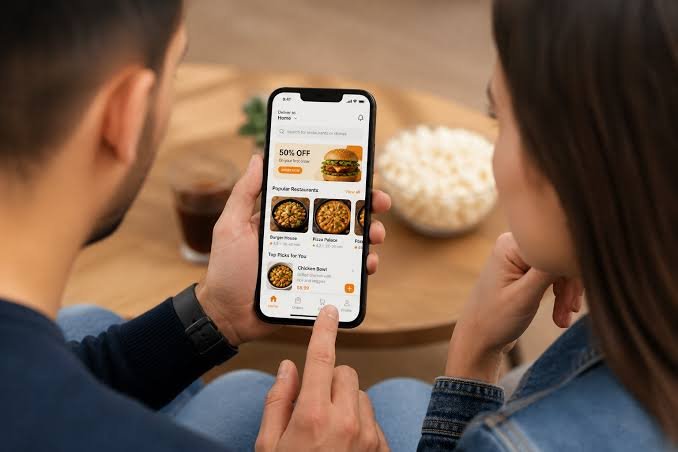

The food delivery industry has transformed the way customers discover restaurants, order meals, and receive food at their doorstep. With smartphones and digital payments becoming part of everyday life, businesses are increasingly investing in reliable food delivery platforms to meet changing customer expectations.
However, launching a successful delivery platform involves more than creating an attractive mobile application. Businesses need a solution that connects customers, restaurants, delivery partners, and administrators while managing orders, payments, logistics, and real-time tracking.
This is where food delivery app development becomes an important investment for startups, restaurants, and established businesses looking to build or expand their digital presence.
What Is Meant By Food Delivery App Development?
Food delivery app development refers to the process of designing and building a digital platform that allows customers to browse restaurants, select meals, place orders, make payments, and track deliveries. A complete solution generally consists of several connected components:
- Customer app: Used to search restaurants, browse menus, order food, pay, and track deliveries.
- Restaurant panel: Allows restaurants to manage menus, accept orders, update preparation status, and monitor sales.
- Delivery partner app: Helps riders receive delivery requests, navigate routes, update order status, and manage earnings.
- Admin dashboard: Gives the business control over users, restaurants, orders, payments, commissions, promotions, and analytics.
This multi-sided structure makes a delivery platform more efficient while providing every participant with tools relevant to their role.
Why Invest in a Food Delivery App?
The demand for convenient food ordering continues to create opportunities for businesses. A dedicated application can help companies establish a direct relationship with customers instead of depending entirely on third-party platforms.
One major benefit is convenience. Customers can order from anywhere without calling restaurants or waiting in queues. Businesses can also automate several manual processes, including order management, notifications, payment confirmation, and delivery assignment.
A well-designed application can also provide valuable customer data. Businesses can understand ordering patterns, popular dishes, preferred delivery times, and customer preferences. These insights can support personalized promotions and better operational decisions.
For companies involved in transportation and logistics, integrating delivery operations with solutions such as custom transportation software development can also help create a more connected approach to fleet, route, and delivery management.
Essential Features of a Food Delivery App
A delivery platform’s success depends heavily on its functionality. While features may vary by business requirements, several capabilities are essential.
1. User Registration and Profiles
Customers should be able to create accounts using email, phone numbers, or social sign-ins. Profiles can store addresses, order history, payment preferences, and other relevant information.
2. Restaurant and Menu Search
Search and filtering allow users to quickly find restaurants based on cuisine, location, ratings, price, delivery time, or special offers. Clear menus with images, descriptions, prices, and customization options can make ordering easier.
3. Shopping Cart and Order Management
Customers should be able to add or remove items, customize meals, apply promotional codes, review their order, and confirm delivery details before checkout.
4. Multiple Payment Options
A platform should support convenient and secure payment methods. Depending on the target market, these may include debit and credit cards, digital wallets, bank transfers, and cash on delivery.
5. Real-Time Order Tracking
Tracking gives customers visibility into the progress of their order. Status updates can show whether an order has been accepted, prepared, picked up, or delivered.
6. Push Notifications
Notifications can keep users informed about order confirmations, preparation progress, delivery status, promotions, and special offers.
7. Ratings and Reviews
Customers can rate restaurants and delivery experiences, helping businesses monitor service quality while giving future customers useful information.
8. Restaurant Management
Restaurant partners need tools to update menus, manage inventory, accept or reject orders, adjust preparation times, and review performance.
9. Delivery Management
Delivery partners should be able to view assigned orders, access navigation, update delivery status, and monitor completed deliveries and earnings.
10. Analytics and Reporting
An administrative dashboard can provide insights into sales, customer activity, restaurant performance, delivery times, revenue, and other key metrics.
The Food Delivery App Development Process
Building a delivery platform requires a structured development approach. Starting with a clear strategy can reduce unnecessary costs and prevent functionality gaps later.
Step 1: Define Business Requirements
The first stage is identifying the target audience, business model, service area, monetization strategy, and required functionality. Businesses should determine whether they are building a restaurant-specific platform, a marketplace, or a multi-restaurant delivery service.
Step 2: Choose the Platform
Depending on the target audience and budget, businesses can develop applications for iOS, Android, or both. A web-based administration and restaurant interface is also commonly required.
Step 3: Design the User Experience
The interface should make browsing, ordering, payment, and tracking straightforward. Simple navigation and a fast checkout experience can have a significant effect on customer satisfaction.
Step 4: Develop the Application
Developers then build the front end, backend, database, APIs, payment integrations, maps, notification systems, and administrative tools. The architecture should be designed for scalability so the application can handle increasing numbers of users and orders.
Step 5: Testing
Testing should cover functionality, security, performance, payment processing, location services, notifications, and compatibility across supported devices. Test real-world scenarios to identify problems before launch.
Step 6: Launch and Maintenance
After deployment, the application requires continuous monitoring and maintenance. Updates may include security improvements, performance optimization, new integrations, bug fixes, and features based on customer feedback.
How Much Does Food Delivery App Development Cost?
The cost of food delivery app development always varies considerably. There is no single fixed price because development requirements differ between businesses.
Factors that influence cost include:
- Number of applications and dashboards
- UI/UX complexity
- Number of features
- Payment and third-party integrations
- GPS and real-time tracking requirements
- Backend architecture
- Development team location and expertise
- Security requirements
- Testing and quality assurance
- Post-launch maintenance
A basic MVP with core ordering functionality generally costs less than a large marketplace featuring advanced analytics, dynamic delivery pricing, sophisticated logistics, loyalty programs, and extensive integrations.
For this reason, businesses should prioritize essential features first and gradually introduce advanced capabilities as their user base grows.
Conclusion
A modern food delivery platform brings together customers, restaurants, delivery partners, and administrators within a single digital ecosystem. From restaurant discovery and online payments to real-time tracking and analytics, every component contributes to the overall customer experience.
Successful food delivery app development starts with clear business objectives and continues through thoughtful design, scalable technology, comprehensive testing, and ongoing optimization. Businesses should focus on building a reliable core product first, then introduce advanced features as customer demand and operational requirements evolve.
With the right strategy, technology, and development partner, a food delivery application can serve as a scalable digital platform to improve customer engagement, streamline delivery operations, and create new opportunities for business growth.