
One product listing calls it a pendant, the next calls the same piece a charm, and a third simply says necklace. If you’ve ever hesitated before buying because the terms seemed to blur together, you’re not alone. The differences are small, but they change how a piece hangs, how it’s sold and what you need to wear it.
So, what is a pendant? This guide answers that in plain terms, then compares it side by side with charms, lockets and full necklaces. You’ll also see the common pendant types, which materials hold up best and how symbolic forms add meaning to the piece you choose.
What Is a Pendant, Exactly?
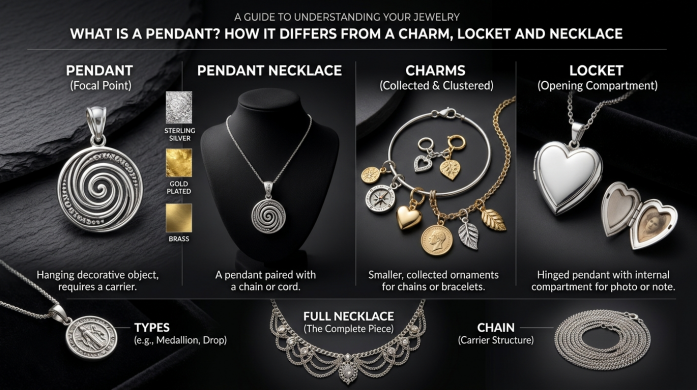
A pendant is a decorative object designed to hang from a chain, cord or wire. It’s the focal point of the piece, while the chain simply carries it. Understanding its three working parts makes the comparisons below easier.
The Three Parts of a Pendant Necklace
- The pendant:The hanging ornament itself, from a simple engraved disc to a sculptural, three-dimensional form.
- The bail:The small loop or fitting at the top that the chain threads through. When present, the 925 stamp on a sterling silver pendant is often found here, although very small pieces may not carry one.
- The chain or cord:The structure that carries the pendant around your neck. It may come attached or be sold separately, depending on the piece.
Put together, these parts answer another common question: what is a pendant necklace? It’s simply a pendant paired with a chain, sold either as one finished piece or as separate components.
Why Buying the Parts Separately Can Help
Buying a pendant on its own lets you choose a chain length and gauge that suit both its weight and your neckline. Before you commit, check that the chain passes cleanly through the bail so the pendant hangs straight. For a deeper look at how each variable affects fit and drape, this guide to choosing chain length and pendant weight walks through the details.
Pendant vs Charm vs Locket vs Necklace
These four terms overlap, but each describes something slightly different. Comparing them in pairs is the quickest way to see where the lines fall.
Pendant vs Charm
Pendant: Usually medium to large and designed to stand alone as the focal point. It hangs from a bail and often carries the full visual weight of the look.
Charm: Smaller and typically attached with a jump ring or a tiny clasp. Charms are often collected and grouped several to a bracelet or chain, so each one plays a supporting role.
Pendant vs Locket
Pendant: Most pendants are solid forms with nothing to open, valued for their shape and surface alone.
Locket: A specific type of pendant with a hinged front that opens to a small compartment, traditionally used for a photo or a folded note. Lockets sit inside the pendant family, while most pendants don’t open.
Pendant vs Necklace
Necklace: The complete piece worn around the neck, whether a plain chain, a rigid collar or a chain carrying an ornament.
Pendant: Only the hanging component, which needs a chain, cord or wire before it can be worn. That’s why a chain can be a necklace on its own, but a pendant can’t.
Common Types of Pendants
Most types of pendants fall into a few recognizable formats, each with its own silhouette on the body:
- Medallion:A flat, coin-like disc, often engraved on one or both sides. It sits close to the chest and reads cleanly under open collars.
- Drop:An elongated form that hangs vertically. It visually lengthens the neckline and pairs well with V-necks.
- Symbol:A shape such as a spiral, serpent, moon or cross. The form itself carries the meaning.
- Single-stone:One set stone acts as the focal point. Its color and cut lead the design, with the metal framing it.
- Locket:An opening pendant with a hinged compartment. It’s usually a little heavier than a solid piece of similar size.
Choosing a Pendant Material That Lasts
Material decides how a pendant ages, how it feels on the skin and how much care it needs. Three options cover most everyday pendants:
- 925 sterling silver:An alloy of 92.5% fine silver and 7.5% other metals, primarily copper, which adds strength. It’s widely considered hypoallergenic and can maintain its appearance with proper care, though it may tarnish over time.
- 22K gold plated over 925 sterling silver:A gold surface layered over a sterling silver base. It brings a warm tone while keeping the hypoallergenic qualities of the silver underneath.
- Brass:A warm, golden alloy with a slightly vintage feel. Look for pieces labeled nickel-free and lead-free, and expect a natural patina to develop with wear.
If you plan to wear a pendant daily, browsing 925 sterling silver jewelry is a practical way to compare finishes such as polished, matte and oxidized surfaces before you decide.
What a Pendant Can Mean
Pendants are one of the earliest forms of personal adornment found across many cultures. Beyond decoration, they have long signaled status, belonging or belief, and forms such as the serpent, the circle and the threshold appear again and again. Read this way, a pendant is a small artifact that holds an idea, and its meaning usually comes from the wearer’s own reasons for choosing it.
Pendant, Charm or Locket: The Quick Answer
A pendant is the hanging focal piece, a charm is its smaller and often collected cousin, a locket is a pendant that opens, and a necklace is the complete piece you wear. Once you know what is a pendant and how it connects to its chain, choosing the right one becomes far simpler. Start with form, then material, then the meaning you want it to carry.
Do you reach for a single statement pendant, or do you prefer a chain full of small charms? Share which camp you’re in, and why, in the comments below.