
Traditional floor tape, convex mirrors, and static blind-spot signs have reached their operational limits across high-throughput industrial facilities. High-velocity manufacturing plants and expansive distribution hubs generate constant acoustic noise and visual clutter that render passive visual markers ineffective during peak shift hours. When facilities experience rapid material turnover, standard visual cues fail to protect floor personnel navigating dynamic travel paths.
Site-wide Forklift Safety involves more than asking forklift operators to stay alert. A driver’s view is often restricted by the mast, loads, pallet racks, and nearby production areas. At the same time, work schedules can be demanding, making it difficult to notice every person who enters the vehicle’s path. A person can enter the vehicle’s path from behind a rack or work cell with little warning. Static signs and markings have a limited role in these situations, so additional ways to monitor vehicle and pedestrian movement are needed around these blind spots.
Moving from Passive Mitigation to Dynamic Proximity Detection
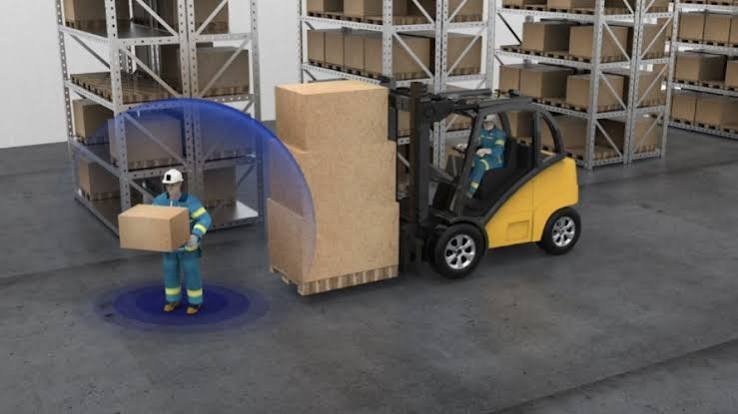
In a material handling area, fixed zones do not show where vehicles are heading as conditions change. Telemetry data gives a clearer picture by tracking details such as forklift speed, the distance between people and vehicles, and their travel direction. Having these details while movement is taking place gives safety teams a better view of situations that could lead to a collision. Facilities that depend only on audible warning beepers also have to deal with repeated alarms throughout the site. Workers can become used to hearing the same warning sound, particularly when alerts are triggered for routine movement. Proximity detection takes a more targeted approach by separating normal parallel traffic from situations where a forklift and pedestrian are moving toward the same area. This reduces unnecessary alerts and draws attention to situations that require a response. As a result, both operators and nearby floor workers receive clear, contextual alerts only when an actual hazard exists.
Overcoming Industrial Friction Points and Sensor Silos
Standalone collision prevention accessories often introduce unexpected maintenance overhead and fragmented floor management. Proprietary sensors that operate without enterprise connectivity create unintegrated sensor silos, leaving operations directors without centralized incident logs, heat maps, or route telemetry. Without unified telemetry, management cannot verify whether operators are adhering to designated travel rules across active staging areas.
This absence of centralized data prevents operations teams from identifying underlying structural bottlenecks before an OSHA recordable event occurs. Safety teams often have to look at past incident data rather than examine intersection layouts, rack placements, or staging practices that contribute to vehicle clustering. Bringing spatial sensor data into a centralized system makes it easier to review proximity events and identify patterns that can be considered when assessing site conditions.
Active Vehicle-Level Control and Edge Processing
Real-time positioning becomes more useful for vehicle control when it is connected to the forklift’s onboard systems. Spatial telemetry can be linked with CANbus controllers so that speed limits are applied automatically in areas such as pedestrian zones and blind intersections. This reduces the need for operators to manage every speed restriction themselves and keeps the same controls in place across different shifts, including periods when a driver may be tired.
Edge-based processing architectures ensure that safety-critical calculations occur within milliseconds directly on the mobile asset. Localized processing prevents latency delays and avoids dependence on continuous cloud connectivity, maintaining protective measures even when facilities experience transient wireless dropouts or structural RF interference. This localized execution guarantees reliable vehicle deceleration whenever personnel enter an active exclusion zone.
Leveraging Digital Twins for Spatial Risk Modeling
With continuous spatial tracking connected to a Digital Twin, plant engineers can look at more than individual proximity alerts. Location data can be displayed as heat maps, showing areas where near-misses happen frequently and highlighting staging bays or aisle layouts linked to repeated collision risks. This data-driven visibility eliminates the guesswork traditionally associated with material flow adjustments and facility layout planning.
This continuous spatial model bridges the long-standing divide between daily shop-floor execution and high-level administrative safety governance. Operations directors can review actual movement records to make changes to one-way routes, move frequently accessed inventory racks, or revise pedestrian crossing points instead of relying only on reports from workers. Looking at traffic patterns over time also gives teams a clearer basis for managing vehicle and pedestrian movement while keeping productivity in view.
A forklift safety setup does not have to depend on warning lights or people watching for hazards. An integrated forklift collision warning system combines location information, vehicle controls, and risk analysis in one setup. These functions provide more information about forklift and pedestrian movement and give the facility another way to respond when their paths come close. Safety measures can be built into the way material handling work is carried out without unnecessarily slowing the movement of goods.
Engineering Measurable Safety Outcomes
LocaXion is the world’s first pure-play RTLS & Digital Twin systems integrator. We engineer systems for your business outcomes-not just “tracking.”
That means less risk, less integration of guesswork, and faster time-to-value. And because we’re not locked to one technology stack, you get the freedom to scale with the right technology – not the technology we happen to sell.
RTLS tracks your assets. LocaXion transforms how your operation runs.
That’s the difference. And it’s not a small one.
Stop relying on passive alarms and unintegrated sensor silos and engineer your outcomes today at https://locaxion.com/