
Red, itchy, irritated skin is annoying enough on its own. But when you are not sure what is causing it, figuring out what to do next can be even more frustrating. Psoriasis and eczema are two skin conditions that are often confused because they can look pretty similar. So, what is the difference between psoriasis vs eczema? And if you are thinking about visiting a medical spa in Oshawa or trying something like microdermabrasion treatment in Oshawa, does it matter which one you have?
It does. While both conditions can cause redness, dryness, itching and inflammation, they have different causes and can behave quite differently. Knowing what you are dealing with is important, especially before putting new products or cosmetic treatments on already irritated skin.
What Is the Difference Between Eczema and Psoriasis?
The easiest way to think about the difference between eczema and psoriasis is to look at what is happening beneath the skin.
Eczema is closely linked to a weakened skin barrier. When that barrier is not working as well as it should, moisture escapes more easily and the skin becomes more sensitive to irritants, allergens and environmental changes.
Psoriasis works differently. It is an immune-mediated condition that causes skin cells to develop and build up much faster than normal. That is what leads to the thick, raised patches that psoriasis is known for.
They can both be uncomfortable, but there are some clues that can help you tell them apart.
| Eczema | Psoriasis |
| Often causes intense itching | May itch, burn or feel sore |
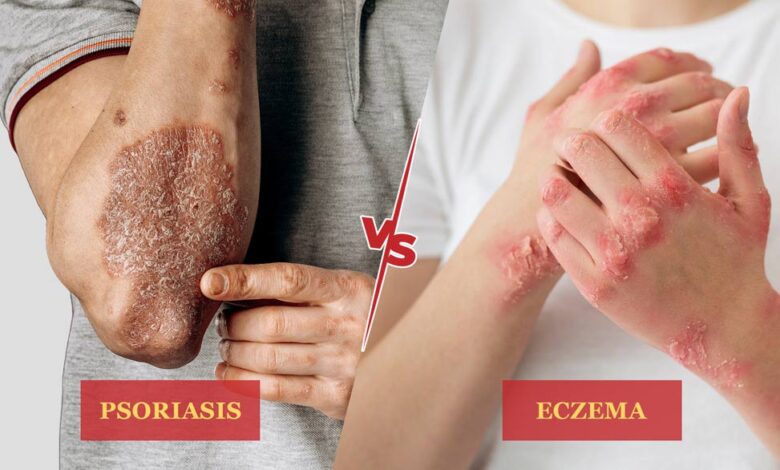
| Skin can become dry, cracked and irritated | Often produces thicker, raised plaques |
| Severe areas may ooze or crust | Usually has noticeable scaling |
| Common on the hands, face and skin folds | Common on the elbows, knees and scalp |
| Often linked to irritants or allergens | Can flare after stress, illness or skin injury |
And one important thing to clear up right away: neither eczema nor psoriasis is contagious.
How Eczema Usually Looks
Eczema can look different depending on the person, the type of eczema and how severe the flare-up is.
The skin may become red, dry, swollen, cracked or scaly. In some cases, small blisters can develop, and severe areas may ooze or crust.
The itching is often the part people notice most. It can be intense enough to make sleeping difficult, and scratching can make the skin even more irritated.
Common signs include:
- Very dry skin
- Persistent itching
- Red or inflamed patches
- Cracking or peeling
- Swelling
- Oozing or crusting
- Thickened skin from repeated scratching
For some people, eczema comes and goes. For others, certain triggers can keep causing flare-ups.
How Psoriasis Usually Looks
Psoriasis tends to have a different appearance.
The most common form, plaque psoriasis, causes raised patches of skin known as plaques. These areas are often clearly defined and covered with silvery or whitish scales.
Itching is possible, but psoriasis can also feel sore, tender or like it is burning.
Psoriasis commonly affects:
- Elbows
- Knees
- Scalp
- Lower back
- Palms and soles
- Fingernails and toenails
There are several types of psoriasis, so not everyone will have the classic thick, scaly patches people usually associate with the condition.
Psoriasis vs Eczema on the Hands
Hands are one of those areas where telling eczema and psoriasis apart can get tricky.
Hand eczema can leave the skin extremely dry, red and irritated. Deep cracks can develop, and things that normally seem harmless, such as washing your hands or using cleaning products, can become uncomfortable.
Psoriasis on the hands tends to produce thicker, more sharply defined areas. When it affects the palms, there can be considerable scaling, dryness and cracking.
The tricky part is that other skin problems can look similar too. Contact dermatitis, fungal infections and other forms of dermatitis can all cause changes to the hands.
If the same rash keeps coming back or basic skincare is not helping, it is worth having it checked rather than continuing to guess.
Scalp Eczema vs Psoriasis
Trying to figure out scalp eczema vs psoriasis can be especially frustrating. After all, both can leave you with an itchy, flaky scalp.
Scalp psoriasis often produces thicker patches with clearly defined edges. In some cases, the scaling extends past the hairline and onto the forehead or the back of the neck.
Eczema can cause redness, itching and flaking too. Seborrheic dermatitis is another common possibility, particularly when there is flaky skin around the scalp, eyebrows, ears or nose.
Some general clues:
Psoriasis tends to:
- Create thicker patches
- Have sharper borders
- Produce noticeable scale
- Extend beyond the hairline in some people
Eczema or seborrheic dermatitis may:
- Cause more widespread irritation
- Produce flaky skin
- Cause significant itching
- Affect the eyebrows, ears or area around the nose
These clues can be helpful, but they are not a diagnosis. Scalp conditions can overlap quite a bit.
Eye Psoriasis vs Eczema
Anything affecting the skin around your eyes deserves a little extra caution.
Both psoriasis and eczema can cause redness, dryness, scaling and irritation around the eyes. But they are not the only possibilities. Contact dermatitis, infections and other skin conditions can cause similar symptoms.
This is not an area where you want to start experimenting with strong skincare products.
Avoid using aggressive exfoliants, fragrances or other active ingredients close to the eyes unless you have been advised that they are appropriate.
If your eyelids become very swollen, painful or severely irritated, or you notice changes to the eye itself or your vision, get medical attention.
Early Eczema and Psoriasis on the Face
Facial skin can make the whole situation even more confusing.
Early eczema may show up as dry, itchy or irritated patches. Your skin might suddenly feel tight or become sensitive to products that you have used for years without a problem.
Facial psoriasis can appear as red, defined patches with scaling. It may affect areas around the eyebrows, ears or hairline.
But facial redness or flaking does not automatically mean eczema or psoriasis.
Rosacea, seborrheic dermatitis, contact dermatitis and several other conditions can look surprisingly similar.
That is why constantly changing your skincare routine may not solve the problem. If the irritation sticks around, getting the cause identified can save you a lot of trial and error.
Which Is Worse: Psoriasis or Eczema?
So, which is worse, psoriasis or eczema?
Honestly, there is no simple answer.
It depends on how severe the condition is, where it appears and how much it affects your day-to-day life.
Eczema can be incredibly itchy. A bad flare can make sleeping difficult, affect concentration and leave the skin cracked and painful.
Psoriasis can have a major impact too, especially when larger areas of the body are affected. Some people with psoriasis also develop psoriatic arthritis, which can cause joint pain, stiffness and swelling.
Rather than asking which condition is worse, it makes more sense to ask how severe your symptoms are and how much they are affecting your quality of life.
Are Psoriasis and Eczema Contagious?
No. Neither condition is contagious.
You cannot catch psoriasis or eczema from touching someone’s skin, hugging them, sharing a towel or sitting beside them.
Psoriasis is connected to immune-system activity and genetics. Eczema can involve skin-barrier problems, genetics, immune responses and environmental triggers.
That distinction is worth mentioning because visible skin conditions can sometimes lead to unnecessary embarrassment or stigma. There is no reason to avoid someone because they have psoriasis or eczema.
What Causes Psoriasis and Eczema?
Although both conditions involve inflammation, what drives that inflammation is different.
What Causes Eczema?
Eczema is often associated with a skin barrier that does not function properly.
Think of the skin barrier as a protective layer. When it is weakened, the skin can lose moisture more easily and become more vulnerable to things that would normally not bother it.
Common triggers can include:
- Fragrances
- Soaps and detergents
- Certain fabrics
- Cold or dry weather
- Heat and sweating
- Stress
- Allergens
- Frequent exposure to water or chemicals
The frustrating part is that everyone’s triggers can be different. What causes a flare for one person may not bother someone else at all.
What Causes Psoriasis?
Psoriasis is an immune-mediated disease. The immune system becomes overactive and speeds up the process through which skin cells are produced.
Normally, skin cells develop and shed gradually. With psoriasis, that process happens much faster, causing cells to build up on the surface of the skin.
A number of things can trigger or worsen a flare, including:
- Stress
- Infections
- Skin injuries
- Certain medications
- Smoking
- Alcohol
- Changes in weather
- Other personal triggers
Having a trigger does not mean the trigger caused psoriasis in the first place. It may simply be something that makes an existing condition more active.
Psoriasis vs Eczema Treatment
Treatment depends on what you actually have, how severe it is and where it is affecting your body.
There is no one-size-fits-all treatment. Eczema, psoriasis and other inflammatory skin conditions can look similar but respond very differently to treatment.
Depending on the situation, treatment may include:
- Regular moisturizing
- Prescription or non-prescription topical medications
- Corticosteroids when appropriate
- Other topical anti-inflammatory treatments
- Phototherapy
- Systemic medications
- Biologic medications for certain psoriasis patients
- Identifying and avoiding eczema triggers
This is why it is not a great idea to simply use someone else’s psoriasis cream on a rash that e.
Skincare Tips for Sensitive, Flare-Prone Skin
You do not need a bathroom shelf full of products to look after sensitive skin.
In fact, keeping things simple can sometimes be the better approach.
Choose Gentle Products
Look for products that are:
- Fragrance-free
- Gentle
- Made for sensitive skin
- Moisturizing
- Free from unnecessary irritants
If a product stings every time you apply it, that is probably your skin telling you something.
Moisturize Regularly
Moisturizer can help reduce dryness and support the skin barrier.
Applying it after bathing, while your skin is still slightly damp, can help lock in moisture.
This can be especially important during Canadian winters when cold outdoor air and dry indoor heating can leave already-sensitive skin feeling even drier.
Be Careful With Exfoliation
Exfoliation is not automatically bad, but timing matters.
Scrubs and strong exfoliating ingredients can irritate skin when its protective barrier is already compromised.
If you have active redness, cracking, scaling or inflammation, talk to a healthcare professional before adding an exfoliating treatment.
Pay Attention to Triggers
It can be surprisingly useful to pay attention to when your flare-ups happen.
Maybe your skin gets worse after using a particular product. Maybe cold weather sets it off. Or perhaps stress seems to make things worse.
You do not need to obsess over every little change. Just noticing patterns can sometimes help you and your healthcare provider figure out what is going on.
When Should You See a Professional?
Not every rash requires an urgent medical appointment. But if something keeps coming back, gets worse or simply does not look right, it is worth getting some professional advice.
Consider getting assessed if:
- Your rash keeps returning
- Symptoms are becoming more severe
- Itching is interfering with sleep
- Your skin is cracking or bleeding
- You notice possible signs of infection
- Over-the-counter products are not helping
- The rash is affecting your eyes or eyelids
- You develop joint pain, stiffness or swelling along with psoriasis-like skin changes
- You are not sure whether you have eczema, psoriasis or another skin condition
Getting the diagnosis right matters. Several different skin conditions can look almost identical, particularly in the early stages.
Psoriasis vs Eczema: The Bottom Line
When it comes to psoriasis vs eczema, the biggest thing to remember is that similar-looking skin does not necessarily mean the same condition.
Eczema often causes dry, itchy and irritated skin, while psoriasis commonly produces thicker, well-defined plaques with scaling. They also have different underlying causes, common triggers and treatment approaches.
If you have a rash that will not go away, try not to play detective with your skincare cabinet. A proper assessment can help figure out what is actually happening and what treatment makes sense for your skin.