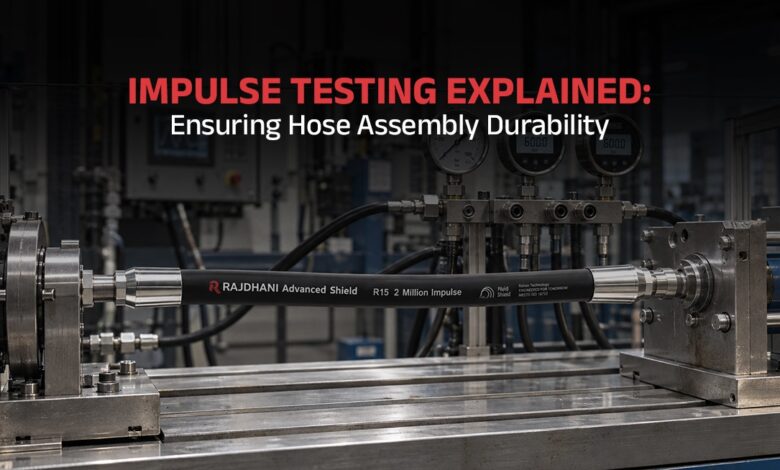

Hydraulic hose assemblies operate under repeated pressure, vibration, and machine movement. Over time, these conditions can create fatigue in the hose reinforcement, weaken the connection between the hose and fittings, and cause unexpected leakage or failure.
Impulse testing helps identify these weaknesses before a hose assembly reaches the field. It is a controlled durability test that repeatedly exposes an assembly to pressure cycles designed to represent real operating conditions.
For Hydraulic Hose manufacturers in India and Hydraulic assembly manufacturers in India, impulse testing is an important part of quality control and product validation.
What Is Impulse Testing?
Hydraulic impulse testing is an accelerated fatigue test for hose assemblies. During the test, the assembly is filled with hydraulic fluid and repeatedly pressurized between low and high pressure limits. The pressure cycles simulate surges, spikes, and pulsations that occur during actual machine operation.
Depending on the applicable hose specification, the test pressure may be higher than the hose’s rated working pressure. Industry test programmes commonly use impulse pressures around 120% to 133% of the maximum working pressure, although the exact value depends on the relevant standard and hose construction.
The objective is not simply to see whether a hose can withstand one pressure spike. It is to evaluate how the complete assembly performs after thousands of repeated pressure cycles.
How the Test Is Performed
The hose assembly is installed in a defined test configuration. It may be tested straight or positioned in a 90-degree or 180-degree bend, depending on the product specification.
Flexible testing is covered by ISO 6802, while ISO 6803 covers hydraulic pressure impulse testing without flexing.
The assembly is then connected to an impulse testing machine. The equipment controls:
- Internal pressure.
- Pressure rise and fall.
- Cycle frequency.
- Fluid temperature.
- Hose position and bend radius.
- Total number of cycles.
Many test programmes operate at approximately one cycle per second, although the frequency can vary. Depending on the hose type and standard, the assembly may be required to complete 150,000, 200,000, 500,000, or more cycles without leakage or other failure.
Some tests continue until the target cycle count is achieved, while others continue until the hose or fitting fails. The result helps manufacturers understand the fatigue life and performance limits of the assembly.
What Impulse Testing Evaluates
Hose reinforcement strength
Hydraulic hoses usually contain braided wire, spiral wire, or textile reinforcement layers. These layers carry the pressure load and protect the hose from expansion and rupture.
Repeated pressure cycles place continuous stress on the reinforcement. Impulse testing can reveal weak wires, poor bonding, construction defects, and fatigue damage that may not be visible during a normal visual inspection.
Fitting and crimp integrity
A hydraulic hose assembly is only as reliable as its connection. The fitting must remain securely attached to the hose while the assembly experiences pressure pulsations and movement.
Impulse testing checks whether the crimp, socket, ferrule, and hose body work together correctly. It can identify problems such as hose slippage, fitting separation, leakage around the crimp, or incorrect crimp dimensions.
Resistance to pressure pulsation
Hydraulic systems rarely operate at one constant pressure. Pumps, valves, cylinders, and motors can create rapid pressure changes during starting, stopping, loading, and reversing.
A hose that performs well under static pressure may still fail under repeated pulsation. Impulse testing provides a more realistic assessment of fatigue resistance than a single proof-pressure test.
Thermal and fluid performance
Some tests are performed at elevated fluid temperatures or under specific fluid conditions. This helps evaluate whether the hose tube, cover, reinforcement, and fitting materials remain compatible with the operating environment.
Temperature can soften, harden, or accelerate aging in hose materials. Testing under controlled conditions helps manufacturers select suitable materials for mobile equipment, industrial machinery, mining, oil and gas, and other demanding applications.
Important Standards
Impulse testing is governed by recognised international and industry standards. Two important references are:
ISO 6802:
Covers hydraulic impulse testing of rubber or plastic hose assemblies with flexing.
ISO 6803:
Covers hydraulic pressure impulse testing without flexing at high and low impulse pressures.
SAE J343:
Establishes test methods and performance evaluation procedures for SAE 100R hydraulic hoses and hose assemblies.
These standards help create consistent testing conditions. They define important factors such as pressure levels, test configuration, temperature, cycle requirements, and failure criteria.
Manufacturers should always confirm which standard applies to the specific hose type and application. A test result is meaningful only when the test method, pressure, temperature, and acceptance criteria are clearly documented.
Why Impulse Testing Matters
It improves product safety
Impulse testing helps detect manufacturing or assembly weaknesses before a product is supplied. This reduces the risk of hose bursts, oil injection injuries, and unexpected system failures in the field.It supports reliable machine operation
A failed hydraulic hose can stop an excavator, press, crane, agricultural machine, or production line. Testing helps manufacturers supply assemblies that can withstand repeated service conditions and support better equipment uptime.
It helps predict service performance
Impulse results provide useful information about the durability of a hose design. OEMs and equipment manufacturers can use this information when selecting hoses, defining maintenance intervals, and comparing alternative products.
However, impulse testing does not guarantee a fixed service life for every installation. Actual performance also depends on routing, bending, abrasion, fluid compatibility, temperature, contamination, and maintenance.It strengthens quality assurance
For Hydraulic Hose manufacturers in India, impulse testing demonstrates that products are evaluated beyond basic dimensional checks. It supports better process control, batch validation, and customer confidence.
For Hydraulic assembly manufacturers in India, it is especially valuable because the test evaluates the complete hose-and-fitting combination, not just the hose tube. A high-quality hose can still fail if the wrong fitting, crimp setting, or assembly method is used.
What Buyers Should Ask Manufacturers
When sourcing hydraulic hose assemblies, buyers should ask suppliers for clear technical information, including:
- Applicable testing standard.
- Maximum working pressure and impulse pressure.
- Number of completed cycles.
- Test temperature and hydraulic fluid used.
- Hose and fitting combination tested.
- Bend configuration and minimum bend radius.
- Failure criteria and inspection records.
- Traceability of the tested batch.
The test report should identify the product clearly and explain whether the assembly completed the required cycle count without leakage, fitting separation, cover damage, or other unacceptable failure.
Limitations of Impulse Testing
Impulse testing is an accelerated laboratory test, not a complete simulation of every field condition. It may not reproduce all forms of abrasion, contamination, incorrect installation, chemical exposure, or mechanical impact.
A hose assembly that passes the test can still fail if it is routed incorrectly, twisted during installation, exposed to excessive heat, or used above its rated pressure. For this reason, impulse testing must be combined with proper hose selection, installation, inspection, and maintenance.
Conclusion
Impulse testing is a critical method for evaluating the durability of hydraulic hose assemblies. By applying repeated pressure cycles under controlled conditions, it exposes weaknesses in the hose reinforcement, fitting connection, crimp, and overall assembly design.
For Hydraulic Hose manufacturers in India and Hydraulic assembly manufacturers in India, impulse testing supports safer products, improved quality assurance, and more reliable field performance. For buyers, a properly documented impulse test provides valuable evidence that the assembly has been tested against the repeated pressure and fatigue conditions found in real hydraulic systems.