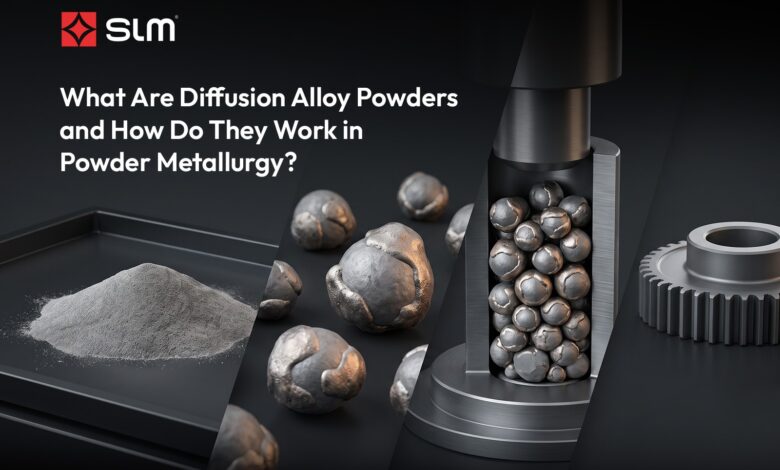

Diffusion alloy powders are iron-based powders in which alloying elements such as nickel, copper and molybdenum are thermally bonded to the surface of iron particles. Unlike pre-alloyed powders, the alloying elements do not initially form a completely uniform composition throughout each particle. This gives diffusion alloy powders an important advantage in powder metallurgy: they can retain much of the compressibility of the iron base powder while reducing the segregation associated with conventional powder mixes. During sintering, the alloying elements diffuse into the iron matrix and contribute to the final microstructure and properties.
What Are Diffusion Alloy Powders?
In conventional powder metallurgy, alloying elements can be introduced in several ways. They may be mixed with iron powder as separate elemental or ferroalloy particles, incorporated into the iron during atomisation to produce a pre-alloyed powder, or bonded to the iron particle through diffusion alloying.
Diffusion alloying sits between these approaches.
Fine alloying particles are brought into contact with iron powder and subjected to a controlled thermal treatment. The treatment promotes bonding between the alloying additions and the iron particles without fully dissolving the alloying elements throughout the iron particle.
The result is a powder in which the alloying additions are attached to the iron particles but remain chemically heterogeneous at the particle level.
The 2025 review Alloying Variants: A Special Feature of Powder Metallurgy describes this range as one of the distinctive features of PM, with fully pre-alloyed powders at the homogeneous end and powder mixes at the heterogeneous end. Diffusion-bonded powders occupy an intermediate position, with a more regular form of heterogeneity than a conventional mix.
How Does Diffusion Alloying Work?
The process can be understood in three stages.
- Start with an iron powder
The base iron powder provides the main particle structure. Its particle size, shape, apparent density and compressibility already influence how the powder behaves during pressing.
- Add the alloying elements
Elements such as nickel, copper and molybdenum are introduced as fine powders. They are distributed around the iron particles rather than being melted into the iron first.
- Apply controlled thermal treatment
The powder is heated to promote partial diffusion and bonding between the alloying particles and the iron surface. The temperature and treatment are controlled so that the additions become firmly attached without producing the same degree of solid-solution strengthening found in a fully pre-alloyed powder.
This distinction is important. A diffusion alloy powder is not simply a conventional premix that has been heated. The thermal treatment changes the relationship between the alloying particles and the iron base, reducing the tendency for the constituents to separate during subsequent handling.
Why Is Diffusion Alloying Used in Powder Metallurgy?
The main reason is to balance alloying flexibility, segregation control and compressibility.
A conventional powder mix gives manufacturers considerable flexibility because different alloying additions can be combined with an established iron powder grade. However, particles with different sizes, shapes and densities can segregate during handling, transportation or die filling.
Diffusion bonding reduces this problem by attaching the alloying additions to the iron particles.
Pre-alloying solves segregation at the particle level even more completely because the alloying elements are already incorporated into the molten metal before atomisation. However, those alloying elements strengthen the iron powder particles in solid solution. The resulting powder is harder to compact.
This is the central reason diffusion alloy powders remain useful.
Diffusion Alloy Powders vs Pre-Alloyed Powders
| Property | Diffusion Alloy Powders | Pre-Alloyed Powders |
| Alloying method | Alloying elements bonded to iron particles | Elements incorporated before atomisation |
| Particle chemistry | Heterogeneous | More chemically uniform |
| Segregation | Greatly reduced compared with loose mixes | Very low |
| Compressibility | Generally higher | Generally lower |
| Green density | Favourable where high density is required | Can require higher compaction pressure |
| Sintering | Alloying elements diffuse into iron | Alloy chemistry already established |
| Microstructure | Can retain controlled heterogeneity | More homogeneous |
| Flexibility | Alloy additions can be designed around base powder | Limited to available pre-alloyed grades |
The choice therefore depends on what the component needs from the powder. There is no universal advantage.
Why Compressibility Matters
Powder metallurgy starts with a deceptively simple operation: compacting loose powder into a shaped component.
The difficulty is that alloying can make this step harder.
Pre-alloyed iron powders contain alloying elements within the particle structure. This causes solid-solution strengthening, making the particles more resistant to deformation during pressing. A higher compaction pressure may therefore be required to achieve the desired green density.
Diffusion alloying largely preserves the softer iron-particle core. The alloying additions are concentrated towards the particle surface, so the powder can retain comparatively good compressibility.
Earlier comparative work on ferrous PM powders found that partially alloyed powders retained compressibility close to that of the iron base, while pre-alloyed powders showed reduced compressibility because of solid-solution strengthening.
That relationship remains important when producing high-density structural components.
What Happens During Sintering?
The powder’s chemistry does not remain frozen in the state in which it enters the press.
During sintering, the compact is heated below the melting point of its main constituent. The alloying elements begin to diffuse into the surrounding iron matrix. The extent and rate of homogenisation depend on temperature, time, alloying element and particle configuration.
Nickel, copper and molybdenum are common additions in diffusion-alloyed ferrous PM systems. Research comparing Fe-Ni-Mo-Cu materials has shown that diffusion alloying can provide good compressibility while producing high-strength PM steels after sintering and appropriate heat treatment.
The microstructure can nevertheless remain heterogeneous after conventional sintering. That is not necessarily a defect. In some PM steels, controlled heterogeneity contributes to the combination of strength, toughness and hardenability being targeted.
The 2025 literature review makes the same broader point: the sintering process can control how far a powder system moves towards chemical equilibrium, meaning the final microstructure is influenced by both the alloying route and the sintering schedule.
Where Are Diffusion Alloy Powders Used?
Diffusion alloy powders are particularly relevant to structural powder metallurgy components where high density, strength and hardenability are required.
Typical alloy systems include combinations of iron with nickel, copper and molybdenum. These are used in components such as gears, sprockets, hubs and other mechanically loaded parts.
The exact powder specification depends on the required density, strength, dimensional behaviour and heat-treatment route. A powder that works well for one component should not automatically be transferred to another application without considering the pressing and sintering conditions.
This is also why powder characteristics matter alongside chemistry. Apparent density, particle size distribution, morphology, flow and compressibility all influence the manufacturing process.
What Should a Powder Metallurgy Manufacturer Check?
For a powder metallurgy company evaluating diffusion alloy powders, chemical composition is only one part of the specification.
The powder should also be assessed for:
- Apparent density
- Particle size distribution
- Compressibility
- Green strength
- Flow behaviour
- Oxygen and impurity levels
- Alloy distribution
- Sintered density
- Dimensional change
- Final microstructure and mechanical properties
A consistent powder specification matters particularly when the material is being used across repeated production batches.
Current PM practice also increasingly relies on customised powder systems rather than treating every application as a standard grade. SLM Metal, for example, currently offers customised regular and bonded iron powder mixes according to customer recipes, including bonded mixes designed for high-carbon formulations.
That application-led approach is relevant because the best alloying route depends on the complete manufacturing sequence, from powder handling through pressing and sintering.
Why Diffusion Alloying Still Matters
Powder metallurgy gives manufacturers something conventional casting and wrought processing do not: several different ways to establish alloy chemistry before the final part is made.
Diffusion alloying is valuable because it uses that flexibility to address a specific manufacturing compromise. It reduces segregation without fully sacrificing the compressibility of an iron-based powder.
For high-density PM components, that can be a meaningful advantage. The powder can be designed to provide the required alloying response while retaining processing characteristics that make compaction practical.
The final decision should therefore consider the complete chain: powder properties → compaction → green density → sintering → microstructure → final performance.
Conclusion
Diffusion alloy powders are engineered to sit between conventional powder mixes and fully pre-alloyed powders. Alloying elements are thermally bonded to iron particles, reducing segregation during handling while preserving much of the base powder’s compressibility.
During sintering, those alloying elements diffuse into the iron matrix and contribute to the final microstructure.
For manufacturers, the value of diffusion alloying lies in this balance. It can provide alloyed PM materials without imposing the same compressibility penalty associated with fully pre-alloyed powders. The right choice, however, depends on the component, required density, alloy chemistry, sintering conditions and target properties.
FAQs
1. What are diffusion alloy powders?
Diffusion alloy powders are iron-based powders with alloying elements thermally bonded to the surface of the iron particles. The alloying elements subsequently diffuse into the iron during sintering.
2. How are diffusion alloy powders different from pre-alloyed powders?
In pre-alloyed powders, alloying elements are incorporated into the metal before atomisation. Diffusion alloy powders retain an iron-rich particle core with alloying elements bonded to the surface.
3. Why are diffusion alloy powders used?
They can reduce segregation while retaining relatively good compressibility. This makes them useful where manufacturers need alloyed PM materials and high green density.
4. Which elements are commonly used?
Nickel, copper and molybdenum are common alloying additions in diffusion-alloyed ferrous PM systems. The appropriate combination depends on the required properties and processing route.
5. Do diffusion alloy powders become homogeneous during sintering?
They can become more homogeneous as alloying elements diffuse into the iron matrix, but the extent depends on temperature, time, alloy chemistry and the powder’s initial configuration.
6. What should manufacturers consider when selecting a diffusion alloy powder?
Key factors include composition, particle size, apparent density, compressibility, green strength, flow, sintered density, dimensional change and the required final microstructure.