Why Four Campers Don’t Need Four Sets of Gear: How to Build a Shared Camping Kit That Actually Works

When four people go camping together, the problem is often not a lack of gear. It is that everyone assumes someone else might forget something, so each person packs a little extra.
By the time you reach the campsite, you may have duplicate cookware, lights, and folding chairs, while nobody remembered the trash bags, tent mallet, or enough camp lighting.
If the same friends or family members camp together regularly, it makes more sense to build a shared gear list than to start over with “who’s bringing what?” before every trip. Personal items stay personal, while the things everyone uses are assigned in advance. That frees up space in the car and cuts down on last-minute messages before departure.
Start by Deciding What Should Be Shared
Not every piece of camping gear belongs on a shared list.
Sleeping bags, pillows, clothing, and toiletries are shaped more by personal preferences and are usually easier to manage individually. Tents, tables, chairs, cookware, lighting, pumps, and basic tools are better suited to being planned for the group as a whole.
A simple place to start is the last trip. Look at what the group actually used and where unnecessary duplicates showed up.
If four people ended up using one table, there is little reason to bring a second one next time “just in case.” On the other hand, if people kept searching for a light after dark, the group may need a few smaller lights that can be used separately rather than another large piece of gear.
A useful shared camping list should reflect how the group really camps, not everything included on a generic online checklist.
Choose a Tent Based on How You Actually Camp Together
For group camping, the capacity listed on the tent is only part of the decision.
Two people who use a tent mainly for sleeping have different space needs from four people who also want room for backpacks, changing clothes, or getting out of the rain. When choosing inflatable tents or traditional tents, think about what the interior will actually be used for beyond sleeping.
If everyone spends most of the day away from camp, sleeping space and basic storage may be enough. If the group tends to spend more time at the campsite, extra room for walkways and shared space becomes more useful.
Headcount is only the starting point. The way the group actually camps should determine how much space it needs.
Shared Gear Should Be Usable by More Than One Person
One easy problem to overlook is that shared gear should not be something only its owner knows how to use.
If pitching the tent, setting up lights, connecting equipment, or packing everything away always depends on the same person, shared gear can quickly become one person’s responsibility.
A better approach is to have several people take part the first time the gear is used and divide the setup naturally. One person can handle the main structure, another can secure it, and someone else can organize the interior. That way, the whole process does not stall if the most experienced camper misses a trip.
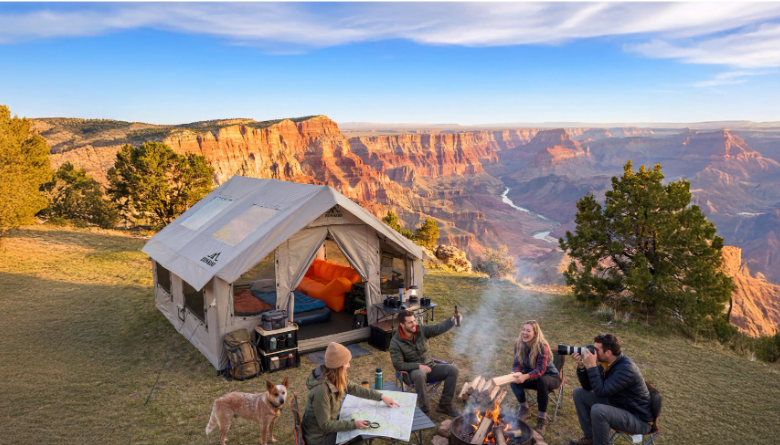
For example, inflatable camping tents such as the Zonkoo Orion use an integrated air-beam and single-valve inflation system, with a full setup time of about seven minutes. In a shared camping setup, inflation, securing, and interior organization can be split between different people so everyone knows which part they can take over.
Gear that is genuinely shared should not depend on one person always being there.
Shared Gear Also Needs a Plan After the Trip
It is easy to focus on who brings what before a trip and forget what happens after everyone gets home.
Who stores the tent? Was the cookware cleaned? Are any stakes missing? Will the lights be ready to use next time? If nobody checks, these small problems often go unnoticed until the group is packing for the next trip.
Shared gear works best when it has a regular storage place. There is no need for a complicated inventory system. After each trip, three checks are usually enough: is anything damaged, is anything missing, and does anything need to be replaced or restocked?
The person storing the gear does not also need to handle every inspection, repair, or replacement. Problems can simply be added to the shared list and reviewed together before the next trip.
If a frequently used tent, table, chair, or other shared item already needs replacing, black friday deals can be a useful opportunity to buy the replacement at a lower price. Larger items that the group uses repeatedly are easier to replace when everyone already knows what is needed, rather than rushing to sort it out just before the next camping trip.
That way, the shared list tracks more than who is bringing what. It also shows what needs attention and what may be ready for replacement.
A Good Shared Camping Kit Should Leave More Room in the Car
The point of sharing gear is not to combine everything four people might possibly want into one oversized collection.
A useful shared list should gradually mean less stuff. Everyone takes care of personal items, while tents, tables, chairs, lighting, and cookware are assigned in advance. What the group needs has someone responsible for bringing it, and unnecessary duplicates stay at home.
Four people going camping together do not need to fit four separate campsites into one car.