
Artificial intelligence has gone beyond the concept of simple automation. Businesses are now building autonomous agents that can successfully analyse data, make decisions and complete multiple business tasks. But building a modern AI agent is only half the way. The key part is deploying and scaling it reliably.
Many teams turn to AI development services when they move from pilot to production. Still, results are a function of the environment around the agent. That’s AI harness engineering. In this guide, we’ll show you how to build it, from architecture and monitoring to security and cost control.
What AI Harness Engineering Really Looks Like
The majority of teams put their energies into developing the business model. But AI harness engineering, however, turns that focus entirely onto the surrounding systems. It takes into account how an AI agent makes inferences over the data, tools, users, and different business processes throughout its complete lifecycle. That bigger picture is what turns a great demo into a reliable business system, and only reliable AI development services can make it happen.
The Foundation of Self-Directed Agents
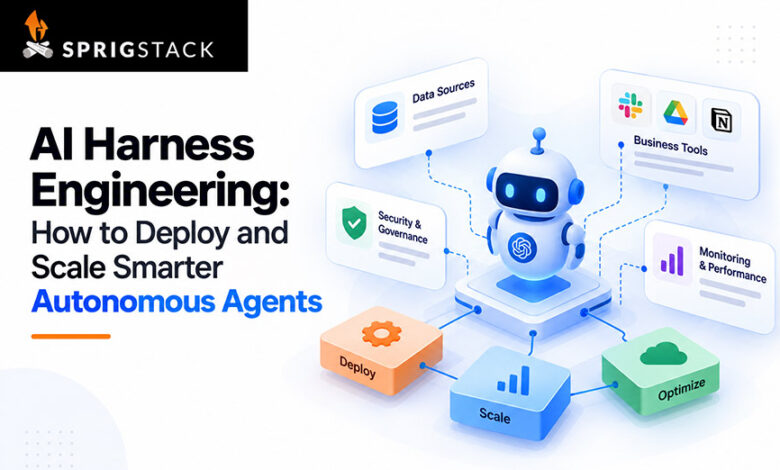
A well-built harness gives agents a structure to work from. Inside, an agent can:
- Only use approved data sources
- Connect to external systems over secure channels
- Follow the business rules relevant to its role
- Real-time performance metric reporting
- Meet security and compliance requirements
This architecture allows agents to behave consistently across use cases. Teams also have a clear understanding of what each agent is doing and why it made that particular choice.
Building Autonomous Agents for Real-World Environments
The choice of the language model is a minor detail for teams that want to adopt such techniques. Determining the domain of the application of the agent is an essential prerequisite to creating a worthwhile product. Understanding how various approaches of agents work is also of utmost importance, especially when choosing between proactive or reactive AI agents for specific applications. Teams that did not follow this advice often invested the resources creating an unnecessary product.
-
Define Clear Objectives
Artificial intelligence agents perform best within a narrow, well-defined set of responsibilities. Different things the teams should agree on before beginning development: everything from the outputs the agent actually has to create, to the boundaries around its decision-making, to the metrics that define success and the integrations it needs.
Limiting the scope reduces complexity and makes the whole job easier for the teams. That is because everyone knows what good performance looks like. The stakeholders are able to set their expectations right with clear objectives. The Leaders know what the AI Agent will do and not do before it is deployed.
-
Trusted Data Sources Link to
Even agents rely on good information, so data quality is always important. Outdated or incomplete records frequently lead directly to poor decisions. Teams should review access permissions, update frequency, and governance policies before connecting to any source.
Those sensitive records are actually protected by strict rules about who can see what. Consistent data access increases both accuracy and trust. Data audits on a regular basis will help to identify problems before they reach the agent.
-
Include Important Business Tools
Useful agents are rarely working alone. They pull relevant information from all the CRM platforms, ERP systems, knowledge bases and analytics dashboards. These tools are used to get timely updates with clear messaging and user-friendly email tools. Making an AI agent a productive team member versus a clever demo is about smooth integration.
Custom AI agent development is often relied on by companies that do not have any in-house expertise. This allows businesses to connect these artificial intelligence systems together securely. This reduces integration errors and reduces delivery time.
Scalable Agent Architecture Building
The best scalability is when you design for it from day one. Doing it later is usually expensive rework. A little design phase forethought saves months of effort down the road.
-
Principles of Modular Design
With modular architecture, teams can also successfully update one component without breaking the rest of the system. Most designs are four-module designs. The decision engine takes many inputs to make the right decisions. The tool layer makes it easy to integrate the AI agent with external applications and services. The memory layer stores context and previous interactions. The monitoring layer monitors the health and performance of the system.
You have more flexibility if you separate them. It also makes maintenance simpler, as engineers can test and repair each layer separately. Each module would also be able to scale independently, keeping infrastructure costs predictable.
-
Support for Multi-Agent Environment
Instead of a single general AI assistant, many companies now use a number of specialized agents. Specialised agents for customer service, sales support, research, and many operations. A clear, scalable system that works with an advanced AI agent can handle responsibilities.
For example, a knowledgeable research AI agent can pass on multiple findings to a sales agent without changing any customer records. Meanwhile, there are general rules that keep each agent within bounds. This setup scales well as new use cases are added. It also reduces the risk of damage when an agent fails.
The change is already measurable. The proportion of large US organisations using multiple AI agents across workflows doubled in a quarter, from 9% to 18%, according to KPMG’s Q2 2026 AI Pulse Survey.
Think growth early.
Performance, Security, and Cost Control
Even the most sophisticated bots require constant attention, and in this case, AI development services provided by experts can help. Performance. Safety. Spending. All three need to be managed deliberately.
-
Track Behaviour and Performance
First of all, measure the response accuracy, the task completion rate, the overall processing speed, and the user satisfaction accurately. Regular reviews show you where the agents are really struggling. As they do so, routine monitoring enables teams to identify inconsistent outputs and workflow failures, zeroing in on model drift early on.
Early detection also minimises the risks of small problems escalating into major incidents. Alerts must be delivered to the right people – and they must be delivered fast. At the same time, right feedback from users helps teams focus on the right prompts and fine-tune the decision logic.
-
Security and Governance
The importance of governance increases significantly for agents who have access rights to various business systems. Secondly they are designed following the least privilege principle, i.e., each agent is only granted the privileges required for performing various business tasks.
Make the activity logs detailed enough so that the auditors can track each and every workflow. Transparency makes for accountability; transparency makes for trust in business. All this can be done with effective AI development services.
-
Manage Costs as You Grow
As agents expand their systems and scale, usage costs can quickly escalate. Not all tasks require the most powerful model. Lightweight models are faster and a lot cheaper, and they are best for basic requests. You also need to monitor how you’re using the API and your infrastructure, and then adjust costs based on real data. And budget alerts warn teams when they go over budget.
This is where a lot of companies fall short. In the second quarter of 2026, KPMG’s AI Pulse Survey found that 66% of large U.S. organizations have monitoring dashboards in place, but only 26% have full, real-time visibility into the costs of running their artificial intelligence (AI) systems.
Some decisions still require a proper human review. That’s where an effective, hybrid approach combines the automation of routine work and the escalation of complex cases to humans. For example, refunds over a certain amount may need a manager’s approval.
Conclusion
Autonomous AI agents are successfully capable of changing multiple business processes, improving overall business efficiency, and creating new business opportunities. But it is not enough for any type of business success that the business models are strong. AI harness engineering provides the right structure that governance, scalability, security, and performance need to be successful.
Many companies are now looking for AI development services to create such brilliant ecosystems. Autonomous agents can perform well and be safe and adaptable with the right partner. Settling the objectives, building a modular harness, and controlling everything will make autonomous agents a constant source of valuable business.