
A hobby gets a digital companion
Pokémon collecting has always been part treasure hunt, part personal archive. People remember the card they pulled with a friend or the one they finally found after months of trading. But collections do not stay small forever. Modern sets, older printings, Japanese releases, and graded cards all bring more details to keep straight. In 2026, the appeal of a collection app is less about replacing that excitement and more about making the practical side of the hobby feel lighter.
Scanning is the feature that changes the routine
There is a big difference between planning to update a spreadsheet and actually doing it. A camera-based scanner can close that gap. With CardPrice’s iPhone app, collectors can point the phone at cards to identify them and add them to a digital collection. Its continuous-scan mode is built for moving through a stack; the app can save clear matches and ask users to confirm less certain ones. That is helpful for anyone who has promised themselves they will catalog their cards ‘one weekend’ and never quite managed it.
Why the little details matter
A card title alone rarely tells the whole story. Set numbers, special finishes, and language variants can change the relevant comparison. Apps that connect identification to a detailed card database have an advantage over a simple note-taking list because collectors can check the printing before saving it. This matters when trading with friends or sorting duplicates. It also reduces the chance of overvaluing a collection by accidentally selecting a rarer version of an ordinary card. Users still need to inspect their physical cards and confirm the match.
A collectible can be expensive without being interchangeable
Rayquaza VMAX #218/203 is a favorite among alternate-art collectors, but actual sales still differ. PriceCharting recorded a sale at $925 on October 14, 2026, and another at $1,275 on October 12. Condition and presentation can account for some variation, and a single sale should not be treated as a universal market clearing price. That is also why the wish-list experience matters: a collector can keep the desired printing in view without assuming every listing is a deal just because its asking price sits beneath a striking historical number. That card comes from the Sword & Shield Evolving Skies set, and collectors who would rather pull one themselves can still buy Evolving Skies booster packs from The Collector’s Club.
Market evidence: Completed-sale record 1
The practical lesson is to identify a printing before making a decision. For a closer look at the catalog and pricing tools, explore CardPrice.com. To scan cards and save them while sorting a collection, the CardPrice iPhone app provides the mobile workflow.
The collection view is becoming the real home screen
For many collectors, the headline feature is no longer the single-card price. It is the ability to see an entire collection in one place. CardPrice offers a portfolio-style view with tracked estimated values and price-history context. Its app also lists purchase-price recording, a profit-and-loss view, price alerts, and set completion tools. A collector can use those features to notice a change in a favorite card or plan which missing cards to look for next. Someone who never sells a card may find the organization just as valuable as the market data.
Exploring the collection through the Pokédex
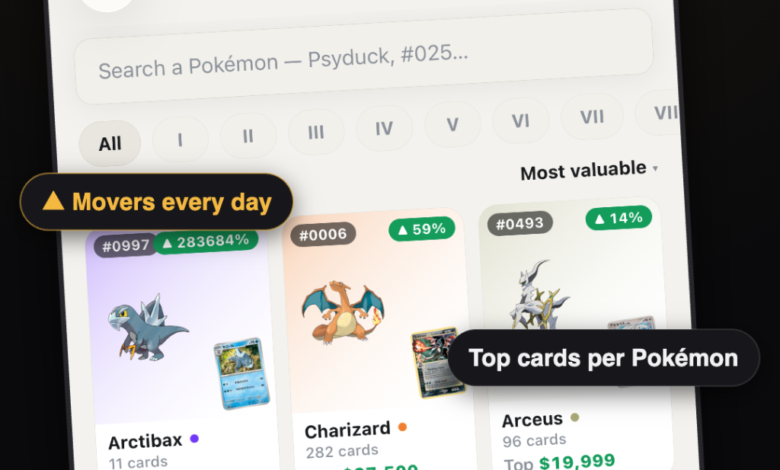
CardPrice’s Pokédex view places Pokémon characters into a searchable grid. The supplied screen includes Charizard, Arceus, Mew, Rayquaza, Umbreon and Mimikyu, with card counts and top-card values associated with each Pokémon. That can be useful when the collector starts with a favorite character instead of a set number. Someone collecting Umbreon cards may want to see which artwork they recognize, identify which set a card came from and then move into the exact card page. Broad character summaries are a starting point; they should not be confused with an appraisal for a particular physical copy.
Not every collectible needs to be treated like an investment
It is tempting to measure a collection by how much its estimated value has risen. But collecting rarely works so neatly. Condition varies, transactions have costs, and yesterday’s hot card may become tomorrow’s overlooked one. A tracking app should make the information easier to understand without pushing collectors toward constant buying and selling. The sensible approach is to use prices as reference points, keep accurate records, and continue collecting cards you actually like. That balance helps the hobby stay enjoyable.
The best workflow is the one you keep using
A practical collecting habit can be very small. Scan new cards when they enter your collection. Confirm the exact printing, save the quantity, and periodically check the cards you care most about. When a card leaves your collection, update the record. For larger collections, work through one binder section at a time instead of trying to finish in one night. A good app turns those small actions into a useful history without requiring a major data-entry project.
Choosing a tool you will actually use
A collection app should be evaluated on more than its feature list. Test identification accuracy on familiar cards first. Look for a clear way to correct an uncertain match, and check how easy it is to change quantities when you sell or trade. Consider whether the collection remains useful if you do not subscribe. Finally, check the privacy and account settings before adding personal information. The point of a digital system is to simplify recordkeeping, so a tool that adds friction every time you open a pack probably will not stick.
How to avoid catalog fatigue
Starting with the rarest and most expensive cards may sound logical, but it can make cataloging feel stressful because every identification requires extra checking. Try beginning with an ordinary binder page. Scan the cards, review the matches, and see which details the app captures. Once that routine is comfortable, move to more complicated variants and graded cards. You can also split the task into short sessions, adding a few pages whenever you have time. A collection tracker only works if it remains current, so sustainability matters more than speed on day one.
Trying the tools
CardPrice’s searchable website is at https://cardprice.com, and its iPhone app is listed at https://apps.apple.com/us/app/cardprice-tcg-card-scanner/id6814949740. The mobile listing currently describes a free scanning allowance and optional paid upgrades. Before choosing any app, try the scan accuracy with several card types and check whether the saved collection is easy to navigate. The technology should fit the way you enjoy collecting—not the other way around.
Why collectors want more than a number
The appetite for collecting apps is easy to understand when you watch someone open a binder full of cards. Their priorities are rarely identical. One person wants to finish a childhood-era set. Another wants to see the Japanese versions of favorite illustrations. Someone else has limited shelf space and needs a record of what is in storage. The common problem is memory: it is surprisingly hard to remember every printing once a collection starts to grow.
Scanning reduces the effort of creating that memory. The appeal is not merely novelty; it is the difference between saying “I think I have that one” and checking a saved collection. CardPrice supports card identification from an iPhone camera and provides a digital place to save the results. Price history and collection-value tracking then add context without requiring the owner to keep a manual spreadsheet up to date.
The strongest apps will also need to remain clear about uncertainty. Market values can change, collector tastes change and a software match can be wrong. Good collecting habits still include checking the card number, handling valuable items carefully and distinguishing estimated value from money in hand. Used that way, a collector app behaves more like an organized catalog than a machine telling anyone what to buy next.
What to check before acting on a number
Before buying from a wish list, verify the set and language from the listing photographs, compare multiple completed sales, and budget for taxes and shipping. A price alert points you toward a review; it should not make the decision for you.
For collectors who want to follow up rather than rely on a single price screenshot, these tools help keep research and ownership organized. For a closer look at the catalog and pricing tools, explore CardPrice.com. To scan cards and save them while sorting a collection, the CardPrice iPhone app provides the mobile workflow.