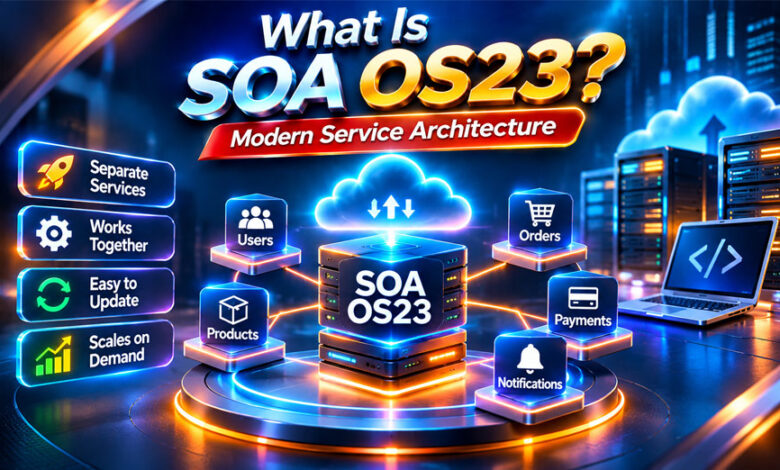

SOA OS23 is a term used online for a modern way of building software. The main idea is to divide a large software system into smaller services. Each service has its own job and can connect with other services.
SOA OS23 is often linked with APIs, microservices, cloud computing, containers, security, and monitoring. However, there is no clear proof that SOA OS23 is an official software standard.
This guide explains what SOA OS23 is, how it works, its main features, benefits, challenges, and common uses.
What Is SOA OS23?
SOA OS23 is a term used online for a modern type of Service-Oriented Architecture, also called SOA. It divides a large software system into smaller services. Each service handles a specific job.
For example, an online store may have one service for customer accounts, one for products, and another for orders. Other services may handle payments, stock, delivery, and customer notifications.
These services work together but do not need to be part of one large program. They can share information through APIs, messages, or events.
SOA OS23 is also linked with microservices, cloud computing, containers, API gateways, automation, security, and monitoring.
However, SOA OS23 appears to be an informal term used online. There is no clear proof that it is an official software standard.
What Does SOA OS23 Stand For?
Some online sources say SOA OS23 stands for Service-Oriented Architecture Open Standard 2023. Other sources use Service-Oriented Architecture Open Standard 23.
However, this meaning is not clearly confirmed by an official standards organization. There is also no confirmed information showing that an official SOA OS23 standard was launched in 2023.
It is safer to understand SOA OS23 as a term for modern service-based software design. SOA, APIs, microservices, containers, and cloud computing are real technologies and software concepts. The unclear part is whether SOA OS23 itself is an official standard.
How Does SOA OS23 Work?
SOA OS23 works by dividing software into separate services. Each service handles a clear task.
For example, when someone places an order online, the order service receives the order. A payment service handles the payment. An inventory service updates the stock. A notification service may then send an email to the customer.
These services need a way to communicate. APIs are often used to send and receive information. Messages and events can also help services share updates.
An API gateway can receive requests and send them to the correct service. Service discovery tools can help different services find each other.
Services can also use different amounts of computing power. If many people use the search feature during a sale, the search service can get more resources without increasing resources for every other service.
Developers may also update one service without updating the full application. However, they still need to test changes because other services may depend on it.
Core Architecture of SOA OS23
There is no confirmed official architecture for SOA OS23. However, modern service-based systems can be explained using several common layers.
| Architecture Layer | Main Purpose |
|---|---|
| Service Layer | Handles tasks such as accounts, products, payments, and orders |
| Discovery Layer | Helps services find each other |
| API Gateway Layer | Sends requests to the correct service |
| Data Layer | Stores and manages information |
| Observability Layer | Tracks errors and performance |
| Security and Governance Layer | Controls access and service rules |
The Service Layer contains the services that do the main work.
The Discovery Layer helps services find other services in a large system.
The API Gateway Layer receives requests and sends them to the right service.
The Data Layer stores and manages information used by the services.
The Observability Layer helps teams check errors, speed, and system activity.
The Security and Governance Layer controls access, permissions, and security rules.
These layers are only a simple way to explain modern service architecture. They are not confirmed as an official SOA OS23 structure.
Main Features of SOA OS23
Modular Service Design
A large application can be divided into smaller services. Each service has a clear job.
For example, an online store may use separate services for products, accounts, payments, and orders.
This can make a large system easier to manage. However, creating too many small services can also make the system more complicated.
API-First Development
APIs help different services communicate.
An API explains what information a service can receive and what information it can return. Planning APIs early can make it easier for different teams and applications to work together.
Independent Service Updates
Services can often be updated separately.
For example, developers may update a search service without changing the payment service. However, they must make sure the update does not break connections with other services.
Cloud Support
Modern service systems often use cloud computing.
Cloud platforms can provide more computing power when traffic increases. Different services can also use different amounts of resources based on their needs.
Container-Based Deployment
Containers package software with the files and settings it needs to run.
Docker is a common container technology. Kubernetes can help manage containers, update services, restart failed containers, and add more running copies when needed.
Docker and Kubernetes can support this type of architecture, but they are not official SOA OS23 requirements.
Event-Driven Communication
Services can also communicate through events.
For example, when a customer places an order, the order service can send an event. The stock service can update inventory, while another service sends a confirmation email.
This allows several services to respond to the same action.
Automation
Automated tools can help test and release software updates.
For example, a CI/CD system can test new code before it is released. This can reduce manual work and help teams find problems earlier.
Monitoring and Security
Teams need to know when a service becomes slow, stops working, or shows an error.
Security is also important. Authentication, access controls, encryption, and other security methods can help protect services and data.
APIs and System Integration
APIs allow different software services to communicate without sharing all of their internal code.
For example, a shopping app may need product information. Instead of directly opening the product database, the app can request the information through an API.
Different API technologies can be used. REST is common for web applications. GraphQL allows apps to request specific information. gRPC can be used for fast communication between services.
API gateways can also manage requests. Kong, NGINX, and Apigee are examples of tools that can help manage API traffic and security.
The OpenAPI Specification can help developers document APIs. It explains what an API does, what information it accepts, and what it returns.
API versioning is also important. If developers change an API, they need to make sure other connected services continue working.
APIs can also connect older business software with modern applications. Apache Camel is one example of a tool that can help connect systems using different formats.
These technologies can support service-based software, but they are not official SOA OS23 requirements.
Microservices and SOA OS23
SOA and microservices have a similar idea. Both divide software into separate services.
Traditional SOA often uses reusable services across different business applications. Microservices usually divide one application into smaller services with specific jobs.
For example, an online store may have separate microservices for products, search, accounts, orders, and payments.
SOA OS23 is often described using ideas from both SOA and microservices. It also includes modern APIs, cloud tools, containers, security, and monitoring.
However, smaller services are not always better. More services mean more APIs, network connections, security rules, updates, and logs.
A simple application may work better with fewer services.
SOA OS23 vs Traditional SOA
Traditional SOA and SOA OS23 have the same basic idea. Both divide software into services that communicate with each other.
Older SOA systems often used an Enterprise Service Bus (ESB). An ESB helped connect applications and move information between them. SOAP was also commonly used in many enterprise SOA systems.
Modern service systems often use REST or gRPC APIs, API gateways, containers, cloud platforms, and events.
Modern services can also be updated separately. Older enterprise systems often used larger and more central software releases.
Monitoring has changed too. Logs, metrics, and traces can now help teams follow requests across many services.
Traditional SOA is not useless or outdated. It can still work well for some businesses. The right choice depends on the software, company needs, existing systems, and development team.
Cloud Computing and Containers
Cloud computing allows services to run on cloud servers and use resources based on demand.
For example, an online store may get much more traffic during a sale. The search service can use extra resources while other services continue using their normal resources.
Containers are also common in modern software systems. They package software with the files and settings it needs.
Docker is commonly used for containers. Kubernetes can manage containers, replace failed ones, update services, and increase or reduce the number of running copies.
Businesses may also use hybrid cloud or multi-cloud systems. A hybrid cloud combines private systems with public cloud services. Multi-cloud means using more than one cloud provider.
These setups can provide more options, but they can also make security, networking, data management, and costs harder to manage.
Event-Driven Architecture
Event-driven architecture allows services to react when something happens.
For example, an order service can send an event when a customer places an order. The stock service can update inventory. Another service can send an email to the customer.
This means the order service does not need to directly control every other service.
However, events can sometimes arrive late or more than once. Teams need clear rules for handling these problems.
Security in SOA OS23
Security is important because a service-based system may contain many connected services and APIs.
SOA OS23 is often linked with zero-trust security. This means a request is checked even when it comes from inside the company’s network.
Authentication checks who a user or service is. Authorization checks what that user or service is allowed to do.
Each service should only receive the access it needs. This can help protect private information.
Encryption can protect data while it moves between services. OAuth 2.0 and OpenID Connect are examples of technologies that can support secure access.
API gateways can also control access and limit requests.
Monitoring and Observability
A large system with many services can be difficult to monitor.
Logs record errors and other events. Metrics show information such as traffic, response time, and system load. Traces show how a request moves through different services.
OpenTelemetry can collect monitoring information. Prometheus is often used for metrics. Grafana can show this information in dashboards.
For example, if checkout becomes slow, a trace may help developers find the service causing the problem.
These are useful monitoring tools, but they are not official SOA OS23 requirements.
Service Discovery and Service Mesh
Services need a way to find and communicate with each other.
Service discovery tools can help services find available services automatically. Consul and Eureka are examples.
A service mesh can help manage communication between services. It may help with traffic, security, and monitoring.
Istio and Linkerd are examples of service mesh technologies.
Not every application needs these tools. A smaller system may work well with a simpler setup.
Benefits of SOA OS23
SOA OS23 can make large software systems easier to manage because developers can work on separate services.
Services can also scale separately. A busy service can get more resources without increasing resources for the whole application.
Some services can be reused. For example, the same login or notification service may work with several applications.
APIs can also make it easier to connect new applications with older software.
Different teams can manage different services. This can make work easier to divide in a large development team.
However, these benefits depend on good planning. A badly planned service system can become difficult and expensive to manage.
Challenges and Limitations
A service-based system can become complicated. Every service may need its own API, security rules, updates, monitoring, and network connections.
Network problems can also cause issues. If one service stops working, other services that depend on it may also have problems.
Managing data can be difficult when different services use separate databases. Developers need ways to keep information correct when one part of a process fails.
Finding problems can also take more time because a request may move through several services.
Costs may increase because businesses need cloud resources, databases, monitoring tools, security systems, and skilled developers.
Small applications may not need this level of complexity. A simple application may work better as one larger system.
Common Uses of SOA OS23
E-commerce
Online stores can use separate services for products, customer accounts, orders, payments, inventory, shipping, and notifications.
Banking and Finance
Banks and financial services can separate accounts, payments, transactions, security, and alerts into different services.
Strong security is important because these systems handle sensitive information.
Healthcare
Healthcare systems can connect patient records, appointments, laboratory systems, and billing services.
HL7 FHIR is an example of a healthcare standard used to exchange health information. It is separate from SOA OS23.
Government Systems
Government organizations can use APIs and services to connect different public systems.
Strong privacy, security, and access rules are important for these systems.
Telecommunications
Telecommunication companies can separate billing, network management, and customer service systems while allowing them to share information.
Factories and IoT
Factories and smart devices can use services to collect information from sensors and machines.
MQTT can help connected devices exchange messages. Edge computing can process some information close to the device instead of sending everything to a cloud server.
Legacy System Modernization
Companies can use APIs to connect older software with newer applications.
This can help a business improve its systems without replacing everything at once.
These are examples of modern service architecture. They do not prove that these industries officially use a standard called SOA OS23.
SOA OS23 and AI
AI can work as a separate service inside a modern software system.
For example, an online store may use an AI service to suggest products. Other services can send approved information to the AI system through an API.
AI services can also support search, customer service, data analysis, and system monitoring.
However, AI systems still need security, testing, and monitoring. Teams should also control what information an AI service can access.
AI is not required for SOA OS23. It is simply one technology that can work with a service-based system.
How to Implement SOA OS23
Start by finding the main tasks in the application. Then decide which tasks really need separate services.
Each service should have a clear job. Avoid creating a new service for every small feature.
Plan how services will communicate. APIs should clearly explain what information they receive and return.
Teams should also plan how API changes will be handled. Versioning can help older applications continue working after an API is updated.
Security and monitoring should be included from the beginning.
Containers and Kubernetes can be useful for some systems, but they should only be used when they solve a real problem.
Starting with a small project can help a team test the approach before using it for larger systems.
Best Practices
Keep the system as simple as possible.
Give each service a clear job. Avoid creating too many small services.
Document and test APIs carefully. Check how an API update may affect other services before releasing it.
Automated testing can help find problems early. CI/CD tools can also help test and release software updates.
Give users and services only the access they need. Protect private information during storage and communication.
Monitor errors, speed, and costs. Add more services only when there is a clear reason.
Does SOA OS23 Have System Requirements?
There are no confirmed official system requirements for SOA OS23.
SOA OS23 is better understood as a software architecture idea rather than a program that people download and install.
Because of this, there is no fixed CPU, RAM, storage, operating system, or device requirement.
The actual requirements depend on the application, cloud services, databases, containers, APIs, and other tools being used.
Is SOA OS23 Free?
There is no confirmed official SOA OS23 product or subscription plan.
The architecture idea itself does not have a standard monthly price. However, building and running this type of system can cost money.
Businesses may need to pay for cloud hosting, servers, databases, developers, security, monitoring, network traffic, and support.
Some supporting technologies are open source. Other cloud and business tools may charge fees.
There is no single price for using an SOA OS23-style architecture.
Who Developed SOA OS23?
There is no clearly confirmed developer, founder, company, or standards organization behind SOA OS23 in the available information.
There is also no confirmed official launch date.
Some online sources connect the number “23” with 2023. However, this does not prove that an official software standard was released in 2023.
This is another reason SOA OS23 should be treated as an informal online term unless stronger official information becomes available.
Is SOA OS23 an Official Standard?
There is no clear proof that SOA OS23 is an officially recognized software standard.
Some websites call it Service-Oriented Architecture Open Standard 2023. However, the available information does not clearly identify an official standards organization behind it.
The technologies linked with the term are real. SOA, APIs, microservices, cloud computing, containers, Kubernetes, events, and monitoring are widely used in software development.
The unclear part is the name SOA OS23 itself.
Readers should be careful when a website describes SOA OS23 as an official industry standard without showing reliable evidence.
SOA OS23 in Italian Construction
SOA OS23 can have a completely different meaning in Italy.
In Italian public works, OS23 is linked with a qualification category for demolition and dismantling work.
This meaning has nothing to do with software, APIs, microservices, or cloud computing.
The surrounding topic can help identify the meaning. If the discussion is about APIs, software, cloud computing, or microservices, it likely refers to the software term.
If the discussion is about Italian construction, demolition, public works, or tenders, OS23 likely refers to the construction category.
Alternatives and Related Architecture
SOA OS23 is not a normal software product, so it does not have direct competitors. However, several other software architecture approaches are related to it.
Traditional SOA
Traditional SOA divides business functions into reusable services.
It is often used by larger organizations that need different business systems to communicate. Older SOA systems commonly use technologies such as ESBs and SOAP.
It can still be useful for large business systems that need controlled integration.
Microservices Architecture
Microservices divide an application into smaller services with specific jobs.
Each service can often be developed, updated, and scaled separately. This can provide flexibility for large applications.
However, using many microservices can also increase complexity.
Monolithic Architecture
A monolithic application keeps most features inside one larger application.
This can be easier to build and manage for smaller projects. Developers do not need to manage as many separate services and network connections.
For some projects, a monolithic system may be simpler and cheaper than microservices.
Serverless Architecture
Serverless computing lets developers run code without directly managing servers.
Functions can run when they receive a request or event. This can work well for tasks that do not need to run all the time.
Developers still need to manage security, data, monitoring, and application design.
Event-Driven Architecture
Event-driven architecture allows software to react to events.
One service can send an event when something happens. Other services can then respond to that event.
Event-driven architecture can also work together with SOA and microservices.
The best architecture depends on the project, business needs, team skills, existing software, security needs, and budget.
Future of Modern Service Architecture
Modern service architecture continues to change as new software tools become available.
Serverless computing may become useful for more services. Event-based systems may also help applications respond quickly to new information.
Edge computing can process information closer to devices. This can be useful for factories, smart devices, and systems that need quick responses.
AI tools may help teams study traffic, find unusual activity, and plan computing resources. However, AI systems still need human checks, security, and testing.
Security, automation, and monitoring will also remain important as companies use more connected services.
These are general trends in modern software architecture. They are not confirmed future versions of SOA OS23 because there is no official SOA OS23 roadmap.
Bottom Line
SOA OS23 is a term used online for a modern service-based software approach. It is linked with APIs, microservices, cloud computing, containers, events, security, and monitoring.
This approach can help large software systems become easier to update, connect, and scale. However, having more services can also increase costs and make a system harder to manage.
There is no clear proof that SOA OS23 is an officially recognized software standard. The technologies connected with it are real, but the official status of the SOA OS23 name remains unclear.
Frequently Asked Questions
What is SOA OS23?
SOA OS23 is a term for a modern way of building software. It divides large software into smaller services that work together.
What does SOA OS23 stand for?
Some sources say it means Service-Oriented Architecture Open Standard 2023. However, this meaning is not officially confirmed.
Is SOA OS23 an official software standard?
There is no clear proof that SOA OS23 is an official standard. It appears to be a term used online for modern software architecture.
How does SOA OS23 work?
It divides software into smaller services with different jobs. These services connect and share information through APIs, messages, or events.
What is the difference between SOA OS23 and traditional SOA?
Traditional SOA often uses older integration methods such as ESBs. Modern systems commonly use APIs, cloud services, and containers.
Is SOA OS23 the same as microservices?
No. They are similar, but not exactly the same. Microservices usually divide an application into smaller independent services.
What are the main benefits of SOA OS23?
It can make software easier to update, connect, and scale. It can also allow services to be reused in different applications.
Does SOA OS23 also have a meaning in construction?
Yes. In Italian public works, OS23 is linked with demolition and dismantling work. It is not related to software.
MathsSpot Guide 2026: What It Is, How It Works, and Safety
BotPower Complete Guide: IMVU Tools, Tracking, Pricing, and Safety