Direct Carrier Billing Explained: The Technology Behind Paying With Your Phone Bill

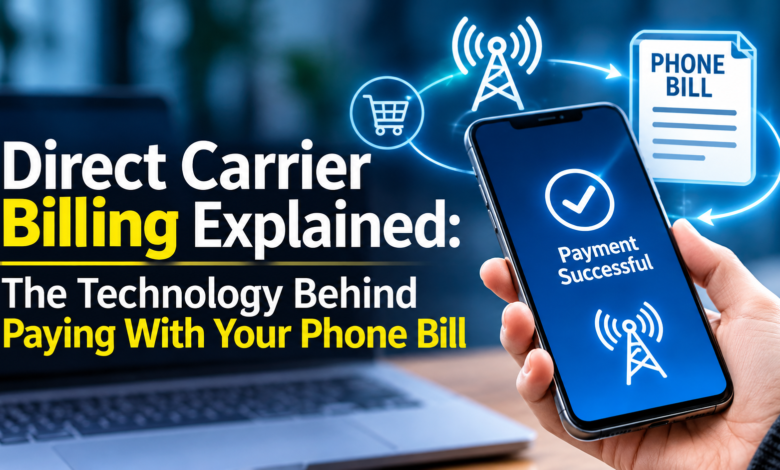
When people talk about mobile payments, they usually mean digital wallets, contactless cards, or QR codes. A quieter technology has been processing billions of transactions for years without attracting much attention: direct carrier billing, often shortened to DCB. Instead of charging a card or bank account, DCB adds the cost of a purchase to the customer’s mobile phone bill.
The model is used around the world, from app stores in Southeast Asia to streaming services in Europe, but few markets have embraced it as thoroughly as South Korea. Looking at how the technology works, and why it took hold there, says a lot about the future of payments in mobile-first economies.
How direct carrier billing works
At its core, DCB connects three parties: the customer, the merchant, and the mobile network operator. A payment aggregator usually sits in the middle, connecting many merchants to many carriers through a single integration.
A typical transaction follows a simple flow:
- The customer chooses carrier billing at checkout and enters their mobile number.
- The aggregator sends a request to the carrier, which checks that the number is active, belongs to the right person, and has enough remaining allowance.
- The carrier sends a one-time code by SMS, or confirms the purchase automatically when the customer is already on the carrier’s network.
- Once the code is entered, the carrier authorizes the payment and the merchant delivers the product.
- The amount appears on the customer’s next monthly bill, and the carrier settles with the merchant later, keeping a share as a fee.
From the customer’s point of view, the whole process takes a few seconds and requires no card details at all.
Why merchants like it
For merchants, the biggest advantage is conversion. Every extra field at checkout causes some customers to abandon a purchase, and entering a card number on a small screen is one of the biggest friction points in mobile commerce. Carrier billing removes that step entirely.
It also opens a market that card-based payments cannot reach. Many young people, students, and people in developing economies have phones but no credit cards. For digital products such as games, music, video, and in-app content, DCB lets these customers pay without a bank account ever entering the picture.
There are trade-offs. Carrier fees are generally higher than card processing fees, and payouts can take longer because carriers settle on their own billing cycles. For low-value digital goods, though, many merchants accept these costs in exchange for higher conversion.
Subscription businesses have found another benefit. Cards expire, get replaced after fraud, or hit spending limits, and each of those events can interrupt a recurring payment. A phone number tends to stay the same for years, so subscriptions billed through the carrier often see fewer involuntary cancellations. For streaming services and mobile games that rely on monthly renewals, that stability can be worth as much as the initial boost in conversion. Some platforms also use carrier billing as a gentle first step, letting new users make a small purchase before they ever save a card.
Why customers trust it
DCB benefits from the trust people already place in their mobile operator. There is no need to share card details with an unfamiliar website, and the confirmation step is tied to a physical SIM card. In markets where phone numbers are registered under real names, the link between the number and the person makes fraud harder to commit at scale.
Spending limits add another layer of protection. Carriers set monthly caps on how much can be charged, and customers can usually lower those caps or block carrier billing completely through their account settings.
The South Korean model
South Korea offers one of the most developed examples of carrier billing anywhere. Smartphone adoption arrived early and almost universally, and mobile commerce grew alongside it. Carrier billing became a default option for digital purchases, gift vouchers, and many online services, and it remains widely used today despite fierce competition from big tech wallets and bank apps.
Several features make the Korean system distinctive. Phone accounts are registered under real names, which makes the phone number a trusted identity. Each account has a monthly allowance that typically ranges up to around 1,000,000 won for long-standing customers, while new accounts start lower and grow over time. Most notably, many Korean carriers track two separate allowances: one for general small payments, such as vouchers and shopping, and another for digital content, such as app stores and games. Each can be adjusted or blocked independently.
For readers curious about the practical side, guides that explain monthly phone payment limits show where each Korean carrier places these settings in its app and how the allowance grows with payment history.
A credit-like product in disguise
Because the charge is billed after the purchase, carrier billing behaves like a small short-term credit line, even though it is not marketed as one. The customer receives the product now and pays when the next phone bill arrives. In Korea, this structure has encouraged an ecosystem of related services, from budgeting apps to informational sites such as Cashday that explain how allowances, fees, and billing cycles work in plain language.
This credit-like nature is also where consumer protection matters most. If a bill is not paid, carriers typically reduce or suspend the allowance, and long-term arrears can affect a person’s broader financial record. Regulators and consumer groups therefore emphasize clear limits, easy blocking options, and transparent statements.
Security considerations
Carrier billing is generally secure, but the one-time code is the critical link. Most fraud attempts target that code, either by persuading a user to share it or by tricking them into installing remote-control software that can read incoming messages. Carriers and security experts give the same advice: never share a payment code, never install apps at a stranger’s request, and review monthly statements for unfamiliar charges.
On the technical side, operators increasingly use network-based authentication, device fingerprinting, and velocity checks that flag unusual patterns, such as many small purchases in a short time, to stop fraud before it reaches the bill.
What comes next
Direct carrier billing is evolving rather than fading. As 5G networks spread and eSIM technology makes switching operators easier, carriers are looking for new ways to stay relevant in the customer’s financial life. Bundling subscriptions, offering flexible spending controls, and partnering with streaming and gaming platforms are all part of that strategy.
The Korean experience suggests that carrier billing can coexist with newer payment methods rather than being replaced by them. When it is fast, trusted, and backed by clear limits, paying through the phone bill remains one of the simplest ways to buy something on a phone. For a technology that rarely makes headlines, that is a remarkable record.