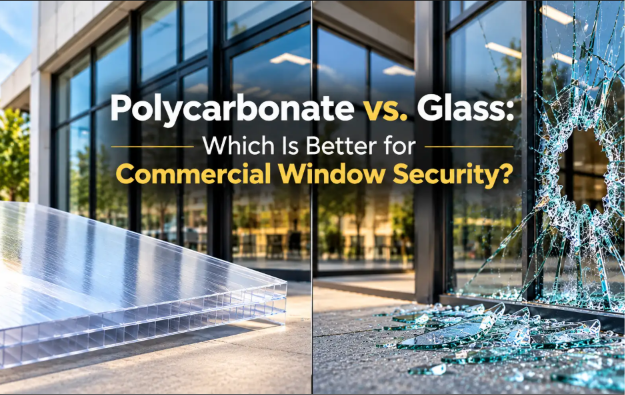

You get to work and find glass all over the doorstep. Before the lights are even on, you’re sweeping up, checking the till and the shelves, and phoning around for a repair. It costs money and wrecks the morning, and a window that’s been hit once usually gets hit again. That makes the polycarbonate vs glass for security decision worth settling before you order anything.
Glass is perfectly good for a lot of shops, so there’s no need to rule it out. Polycarbonate just works differently. What matters is the kind of wear and trouble your windows see daily, and that should guide the decision more than any material’s reputation.
Polycarbonate Vs Glass For Security: What Is The Real Difference?
Look down any high street and it’s mostly glass. Customers can see right in, the stock looks good, and the place feels bright. That’s what glass does well. The trouble starts when something heavy hits it. Ordinary glass cracks or shatters, and then there’s a hole you have to deal with straight away.
Polycarbonate is a light plastic sheet that soaks up a lot of impact before giving way. Glass doesn’t manage that nearly as well. For windows that get knocked about or targeted by vandals, it deserves a proper look.
Glass isn’t a single product either, which people tend to forget. Tempered glass gets its strength from heat treatment, and it shatters into small pieces rather than sharp shards. Laminated glass has plastic sandwiched between two sheets, so the cracked glass stays put. Depending on the build, that layer can also buy you some time against someone trying to get through.
So, there’s no clear winner. Put a thick polycarbonate sheet into a tired old frame and you’ll be disappointed. Same story with glass. The panel, the frame, the fixings and the fitter’s work all decide how the window holds up in the end.
Why Polycarbonate May Be Worth Considering For Vulnerable Windows
Not every window on your property carries the same risk. A display window at street level is easy to reach, while one three floors up barely gets noticed. If a particular pane has been smashed more than once, that’s a hint you shouldn’t ignore.
Polycarbonate makes the most sense where impact is the main worry. It’s usually lighter than glass of the same thickness, and heavy knocks don’t shatter it. Stock sitting right behind the window makes that difference count for more.
Polycarbonate window protection is a sensible thing to look into once plain glazing stops keeping up with what’s going on outside. It also suits some doors, partitions and other commercial jobs, provided the product is actually made for that use.
It does have downsides. Scratches show up faster than on glass, usually from rough cloths or the wrong cleaning spray. Heat and strong sunlight slowly age some grades, although coated and higher-grade sheets hold up well.
The spec sheet is where you find out what you’re really buying with impact-resistant polycarbonate panels for commercial windows. Check the thickness, the coating and the fitting method first. Then check the fire rating and the local building rules. One window’s perfect panel is another window’s wrong choice.
When Glass Remains A Sensible Choice For Business Properties
Writing glass off just because security is on your mind would be a mistake. Plenty of businesses need clean, clear windows where customers can see the products inside. Glass does that well, and some types protect far better than standard panes.
Tempered glass suits spots where the extra strength and that small-piece breakage help. If holding the fragments together is your main goal, laminated glass is the one to pick. Certain tested systems make it tougher to get through a broken window as well, though the result comes down to the full assembly rather than the glass by itself.
Take a boutique where the window display does half the selling. Swap that clear glass for something that scuffs easily and you’ve traded one headache for another, even if it takes a hit better. Decent laminated glazing probably wins there.
Good commercial glass protection starts with matching the glass to the job. Thickness, build, frame and the security level you’re after all go together. A glazier can lay the options side by side for you, so you aren’t treating every pane as identical.
Glass will still break now and then. A cracked, loose or chipped-edge panel needs checking soon. Leaving it only keeps staff and customers close to sharp pieces or an open gap.
What Should You Consider Before Choosing A Material?
Before spending anything, stand in front of the window and work out what you’re trying to stop. A few simple checks make the choice a lot easier.
Start with the likely risk. Accidental knocks, vandalism and a break-in attempt each need a different level of protection, so be honest about which one you’re really facing.
Then check the frame. Loose fittings, rot, rust or damage mean it may not hold a new panel. Strong glazing is pointless if someone can pop it out of the frame.
Cost comes next, and it’s more than the invoice. Add up fitting, cleaning, upkeep, repairs and the day you’ll eventually have to replace it.
Looks count too. Some materials stay clear for years while others haze over, and that changes how the display and the view from inside come across.
Safety rules shouldn’t be skipped. The product has to meet the building, fire and glazing requirements for where it’s going. Then there’s the fitting itself. Panel thickness, support, fixings and frame all need to suit each other.
These points carry the most weight when you plan commercial window security upgrades for retail buildings. A shop with repeated vandalism problems will probably put impact resistance first. An office usually cares more about daylight, clear views and a tidy look.
Plenty of buyers skip the maintenance side. Polycarbonate marks easily if it’s wiped with the wrong cloth, and damaged glass can need specialist help. Check the service life and care needs before you sign. Put complete systems side by side, not just polycarbonate and glass, and the real value becomes obvious.
Can You Improve Existing Glass Without Replacing Every Window?
Replacing every window gets expensive quickly. Often only one or two openings are the real problem. If the glass and frame are in reasonable shape, an upgrade might be possible without ripping everything out.
Security film is one option to raise with a professional. Some films hold broken fragments together, which cuts down on flying shards. Ordinary safety film won’t stop a determined break-in, though, so don’t assume it will. The film, the way it’s attached, the glass underneath and the installation all affect the outcome.
Physical barriers help in certain cases. Security bars make access harder, but they need careful planning, so they don’t block emergency exits.
Swapping a weak panel for a suitable polycarbonate one is another route. Whether it works comes down to the frame and what the opening requires.
The aim of polycarbonate window protection is to solve a real problem, not to stack on another layer just because it sounds secure. A proper inspection will show whether reinforcing, swapping one panel or upgrading the lot is the sensible move.
When Is It Time To Call A Glazing Professional?
If the same window keeps getting hit, a crack appears near the entrance, or the glass just feels wrong for the spot, get a professional opinion. There’s no need to wait for a full break.
A qualified glazier will check the panel, frame, fixings and the structure around it. They’ll also say whether a repair is worth it or whether replacing the panel is the better call. If the glass has already gone, boarding up the opening may be needed until the permanent fix is done.
Sizing up commercial window glass repair and replacement Oakville services comes down to a few things: a clear description of the work, honest material details and an installation process that makes sense. Businesses weighing polycarbonate supply & installation GTA should also confirm the recommended product suits the window and how it will be used.
Ask about the warranty, cleaning instructions, upkeep and safety requirements before agreeing. Find out how the panel will be fixed to the frame as well. A low quote looks tempting, but it saves nothing if the fitting doesn’t suit the property.
Choose the protection your windows actually need
Where heavy impacts are the problem, polycarbonate earns its keep. Where looks, clarity and security all matter, laminated or tempered glass is still a safe bet.
Every window in the building doesn’t need the same material. Begin with the weak spots, check the frames, and compare products made for the job. Good commercial glass protection takes more than a panel. The right material, proper fitting, and an honest look at the property’s real risks give you a far better basis for deciding what to change.