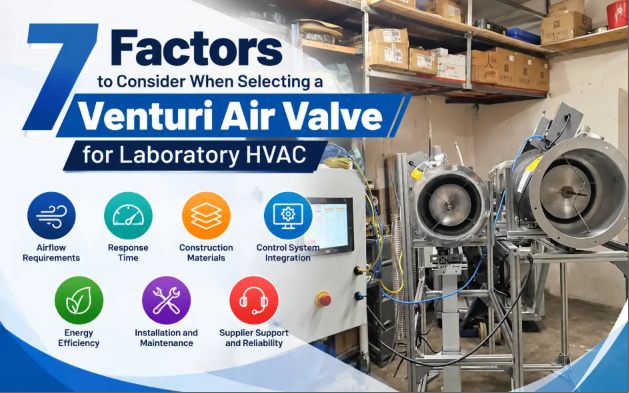

Labs don’t run on one ventilation need. Fume hoods want their exhaust rates changed. Meanwhile, the room has to hold a steady airflow balance, or work stops being safe. Picking a venturi air valve isn’t just duct size and price tags. It has to match your airflow, keep up when conditions shift, and get along with the HVAC controls already there. Materials, maintenance access, tech support: all of it counts. Run through these seven factors before buying. Do that, and you’ll land on equipment that suits how your lab really works; performance, safety, long-term cost, covered.
1. How Should Airflow Requirements Influence Your Selection?
Figure out what your lab actually needs. Fume hoods, general exhaust ducts, supply air systems: each asks for a different flow rate, and whatever you pick must handle them inside its specified operating range.
Good laboratory airflow control means checking minimum and maximum airflow, available duct pressure, and the accuracy you’re after. Pick a valve on duct diameter alone. It might fall short.
Picture a fume hood at different sash openings. Sash moves, exhaust demand moves. Your equipment has to cover that whole range. So before settling on a model, hand your airflow schedule and system design details to your HVAC engineer or supplier. Wrong options drop out early. Well before installation begins.
2. How Quickly Should the Valve Respond to Changing Conditions?
Sometimes ventilation has to react in seconds. Sash moves, and the exhaust may need to change airflow right then, to keep conditions where they belong. Slow response? The system struggles with the change.
That’s why a Venturi valve for laboratory HVAC should be judged on response time, airflow accuracy and pressure-independent performance. Pressure-independent equipment tries to hold its target airflow when duct pressure changes, as long as those changes stay within its specified limits.
Read the manufacturer’s published response time and control accuracy. Skip the general claims. And keep the bigger picture in view: sensors, actuators, controller settings. One valve can’t guarantee how the whole installation behaves. Commissioning and functional testing- that’s what proves the system responds properly in real operating conditions.
3. Which Construction Materials Suit Your Laboratory Environment?
What goes through your lab should steer the material choice. Ordinary indoor air is one story. Corrosive exhaust is another, with different equipment needs.
Aluminium, stainless steel, protective coatings: each behaves differently, and none fits every job. Compatibility comes down to the chemicals involved, their concentration, moisture, temperature, and how long the exposure lasts.
Comparing a laboratory air valve? Check material specs for the complete assembly. Internal components, seals, other exposed parts, all of them. A corrosion-resistant outer body doesn’t mean the insides can take the same punishment.
Handling aggressive chemicals? Ask your supplier to confirm material compatibility for your exact application. Small step. It can spare you early wear, pointless replacements, maintenance trouble down the line.
4. Will the Valve Integrate With Your Existing Control System?
A well-chosen valve still causes problems if it can’t talk to the rest of your HVAC system. Before you buy anything, check compatibility with your building management system, controllers, sensors and actuators.
Installations differ. Some need particular control signals, communication protocols, monitoring points or alarm functions. Confirm those details first, before ordering replacement equipment, before planning a new install.
The right HVAC airflow control valves also have to fit your supply and exhaust strategy. Take exhaust airflow changes: they may call for a matching change in supply air, so the room pressure you want stays put.
Have your controls specialist go over the equipment specs and operating sequences. Talk through a power failure, a sensor fault, any abnormal condition. What the right response looks like depends on your lab’s risk assessment and system design. So don’t assume fail-safe behaviour.
5. How Can Energy Efficiency Affect Long-Term Operating Costs?
Let’s be honest, ventilation eats money. Fans pull electricity all day. The replacement air? Somebody’s got to heat or cool it. In a lab that runs long hours, that bill grows quietly and fast.
Here’s where a variable airflow strategy helps. When conditions allow, it cuts ventilation you simply don’t need. Good laboratory airflow control works off real demand. No need to run higher airflow around the clock.
But hold on. Lower airflow isn’t always a win. Minimum ventilation rates, fume hood requirements, room pressure relationships, they’ve all got approved limits, and you can’t dip below them. Thinking of tweaking an energy-saving setting? Show it to a qualified HVAC professional first.
When you’re comparing equipment, don’t stop at the price. Read the operating requirements and see how they sit with the wider ventilation design. Control accuracy, pressure losses, how the system acts through the day and night. Add those up and you get a far truer idea of what it’ll cost you over the years.
6. What Installation and Maintenance Requirements Should You Check?
Installation details change what a project costs, and how easy daily servicing turns out to be. So measure first. Equipment dimensions, duct connections, mounting needs, clearance around it. Do that before you choose a replacement or specify a new system.
Your Venturi valve for laboratory HVAC should arrive with proper installation and operating documents. No documents, no deal, honestly. Ask how the actuator, sensors and control parts get inspected. And can you actually get replacement parts without a long wait?
Think about maintenance access now, not later. If a component is a pain to reach, every inspection takes longer and troubleshooting turns into a chore. Technicians should be able to get at it safely, without getting in the way of lab work that can’t stop.
Then there’s commissioning. It should confirm real airflow, how the controls respond, and that the alarms work. Where your design calls for it, check the room pressure relationships too. Better to find a setup or configuration problem here than after the system’s already running. And keep those commissioning records somewhere you can find them. Future maintenance and performance reviews will thank you.
7. How Can You Evaluate the Manufacturer’s Technical Support?
Buying isn’t the finish line. You’ll lean on support long after the purchase order’s signed. Say you need a model’s operating range confirmed. Or a control issue shows up out of nowhere. Or you’re hunting for a replacement component. That’s when support either helps or doesn’t.
Sizing up a venturi air valve (VAV) manufacturer and supplier? Ask for detailed product specs. Clear installation instructions. Real, practical application help. And watch how they talk. A good supplier tells you straight where the equipment’s limits are, instead of waving big performance promises at you.
Dig into the warranty terms, the service arrangements, whether replacement parts are easy to get. Find out how you’d actually request technical help, too. Then put the big question to them: can they look over your airflow requirements and confirm the model they’re pitching really fits your job?
Sure, price matters. Nobody’s pretending otherwise. But it can’t be the only thing you weigh. Clear documentation and support you can count on make installation, commissioning and later maintenance so much easier to handle. And a supplier who really knows lab ventilation will help you spot gaps in the specification before those gaps turn into expensive problems.
What Should You Confirm Before Placing Your Order?
Before approving a purchase, sit down with your HVAC designer or supplier and go over these:
- Required minimum, normal and maximum airflow rates
- Available differential pressure and specified operating range
- Material compatibility with your lab’s exhaust conditions
- Response time and airflow accuracy needed
- Compatibility with actuators, sensors and building controls
- Installation dimensions and maintenance clearance
- Commissioning procedures, warranty coverage, technical support
Also make sure the selected HVAC airflow control valves meet the project specifications, and every required document is available. A written checklist keeps technical requirements clear when you’re comparing models or suppliers.
How Can the Right Selection Support Reliable Laboratory Operation?
Here’s the thing. You can’t pick ventilation equipment by staring at one component. The whole system matters. Airflow capacity, response time, material compatibility, control integration, maintenance needs, every one of them changes how well the installation does its job.
Get a laboratory air valve specified properly, install it right, configure it, test it, and it’ll back up your ventilation strategy the way it should. Before you make the final call, line up the technical documents. Walk through your lab’s real operating conditions with qualified professionals.
Last step, and don’t skip it: lay the equipment next to your design requirements and tick them off one at a time. Go the careful way and it pays you back. The performance holds up. Containment does its job. Maintenance doesn’t turn into a headache, and the running costs stay manageable for years.