
Foundational Digital Marketing Strategies for High-Intent Roofing Leads
Building a sustainable roofing business requires a shift from chasing volume to capturing intent. In 2026, the most successful contractors are those who treat their digital presence as a high-performance sales machine rather than a static brochure. By focusing on local search dominance and conversion-optimized assets, you can attract homeowners who are already searching for solutions. When you align your digital marketing strategies with the specific pain points of your local market, you reduce your reliance on expensive, low-intent lead aggregators and build a brand that homeowners trust before you even knock on their door.
1. Local SEO and Google Business Profile Optimization
Your Google Business Profile (GBP) is the digital storefront of your business. For many homeowners, the “Map 3-Pack”—the top three results displayed on Google Maps—is the only list they consult before calling a contractor. To dominate this space, ensure your NAP (Name, Address, Phone number) is consistent across every directory on the web.
Beyond basic setup, you must feed the algorithm with fresh data. Post weekly updates featuring photos of your latest projects, respond to every review within 24 hours, and create geo-targeted landing pages on your website for every city and neighborhood you serve. By using service-area schema markup, you signal to search engines exactly where your crews are active, increasing your chances of appearing for “roof repair near me” searches.
2. High-Converting Websites and Instant Estimator Tools
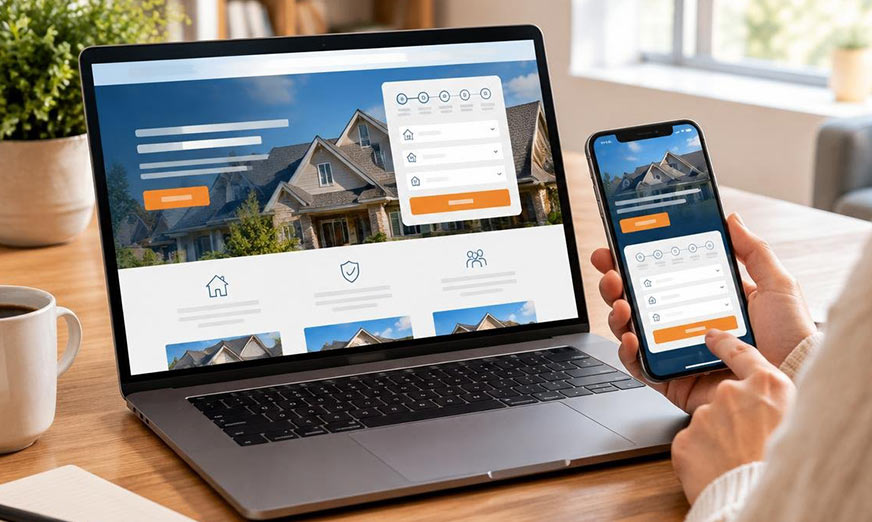
A website that takes more than two seconds to load is a liability. In the roofing industry, where emergencies often drive the search, speed is a critical conversion factor. Your site should be mobile-responsive, featuring prominent click-to-call buttons and, more importantly, an instant roof estimator.
Only a fraction of roofers currently utilize instant estimating tools, yet they are one of the most effective ways to capture leads 24/7. These tools provide immediate value to the homeowner while qualifying them before they even reach your sales team. When integrated with aerial measurement software, these tools allow you to provide accurate, data-backed quotes that set you apart from competitors who still rely on manual, time-consuming site visits.
3. Review Generation and Reputation Management as Core Digital Marketing Strategies
Social proof is the currency of the home services industry. Studies consistently show that over 90% of consumers read online reviews before contacting a business, and a 4-star rating is often the minimum threshold for consideration.
Do not leave your reputation to chance. Implement an automated review workflow that triggers a request via SMS or email immediately following the final walkthrough of a job. By systematizing this, you ensure a steady stream of fresh, five-star reviews. How you respond to feedback is just as important as the rating itself; a professional, empathetic response to a rare negative review can actually build more trust with prospective customers than a perfect five-star streak.
4. Search Engine Advertising: Google Ads and Local Services Ads
While organic SEO is a long-term play, paid search provides the immediate visibility needed to fill your calendar. Google Local Services Ads (LSAs) are particularly powerful for roofers because they feature the “Google Guaranteed” badge, which instantly increases homeowner trust. Because you pay per lead rather than per click, these ads are highly efficient for high-intent searches.
When running traditional Google Search Ads, the key is to be aggressive with negative keyword lists. You want to avoid paying for clicks from people searching for “how to fix my roof for free” or “roofing jobs.” Focus your budget on high-intent keywords like “emergency roof repair” or “roof replacement quote” to ensure your cost per acquisition remains profitable.
Channel Typical Cost per Lead Exclusivity Conversion Rate Organic SEO Low (Long-term) High High Google Search Ads Moderate to High High Moderate Local Services Ads Moderate High High Shared Marketplaces High Low Low 5. Structured Customer Referral and Partner Referral Programs
Referrals remain the number one source of business for the most successful roofing companies. However, “hoping” for referrals isn’t a strategy—it’s a gamble. You must build a structured referral engine.
Consider offering a tangible incentive to past customers who send a neighbor your way. Furthermore, look beyond your customer base. Partner with real estate agents, home inspectors, and insurance adjusters. These professionals are often the first to know when a roof is failing. By creating a reciprocal referral network, you gain access to pre-qualified leads who are already in the market for your services.
6. Neighborhood Canvassing and Door-to-Door Marketing
The “10-around” rule is a classic for a reason: when you finish a roof, you have a captive audience. After completing a job, knock on the ten nearest doors. Don’t go in with a high-pressure sales pitch; instead, be a helpful neighbor. Use a simple talk track: “We just finished the roof at the Jones’s place, and we wanted to let you know we’re in the area if you’ve noticed any leaks or damage.”
Equip your team with high-quality print flyers, door hangers, and yard signs. A yard sign placed at a completed job site serves as a silent salesperson, providing social proof to every neighbor who drives by.
7. Integrating Social Proof and Video into Digital Marketing Strategies
Homeowners want to see what you are capable of. Use your smartphone to capture before-and-after photos and short-form video reels of your crew in action. Drone footage of a finished roof is particularly compelling and can be repurposed across Facebook, Instagram, and YouTube.
When you post these videos to local community groups, you aren’t just advertising; you are providing value and demonstrating your expertise. Authentic, unpolished content often performs better than highly produced commercials because it feels real and builds a personal connection with your local community.
8. Targeted Direct Mail and Hyperlocal Print Media
Direct mail is not dead; it is simply evolving. Instead of “spray and pray” mailers, use data to target homes that are 15 to 25 years old—the prime window for roof replacement. If your area has recently experienced a storm, send postcards to the specific neighborhoods affected. Include a QR code that leads directly to a landing page where they can book a free inspection. This creates a seamless bridge between your offline marketing and your online lead-capture system.
9. Storm Tracking and Rapid Weather-Triggered Outreach
Storm work is a unique opportunity that requires a rapid-response plan. By monitoring NOAA radar and hail-mapping software, you can identify exactly which neighborhoods were hit by a severe weather event.
Have a pre-built emergency landing page ready to go. When a storm hits, launch your ads and social media posts within that 48-to-72-hour window. Homeowners are often overwhelmed after a storm; if you can provide a clear, professional path to an inspection and insurance claim coordination, you become the obvious choice.
Lead Type Sales Cycle Documentation Pricing Sensitivity Retail Roofing Longer Standard Higher Insurance Restoration Shorter Extensive Lower 10. Third-Party Marketplaces and Exclusive Lead Platforms
Platforms like Angi and Thumbtack can be a double-edged sword. While they provide volume, they often lead to price wars because you are sharing the lead with three or four other contractors. Use these platforms sparingly to fill gaps in your schedule during slow months, but never let them become your primary source of business. Always prioritize the leads you generate through your own website and local SEO, as these are exclusive to you and typically carry much higher profit margins.
11. CRM Automation and Speed-to-Lead Response Workflows
The most common mistake roofers make is failing to respond to a lead within the first five minutes. Data shows that your chances of qualifying a lead drop significantly if you wait even thirty minutes to call them back.
Invest in a CRM that automates your follow-up. Use a “missed-call text-back” feature so that if you are on a roof and cannot answer, the prospect receives an immediate, professional text message acknowledging their inquiry. Couple this with a seven-day follow-up sequence that mixes phone calls, emails, and helpful resources. By removing the friction from the initial contact, you ensure that your hard-earned leads don’t slip through the cracks.
Frequently Asked Questions About Roofing Lead Generation
What is the most cost-effective lead generation method for a new roofing business?
For a new business, the most cost-effective method is a combination of Google Business Profile optimization and grassroots neighbor canvassing. These require more time than money and build a foundation of local trust that paid ads cannot replicate.
How do exclusive roofing leads differ in ROI compared to shared marketplace leads?
Exclusive leads—those generated through your own website or referrals—have a significantly higher close rate because you are not competing on price with five other contractors. While they may cost more to acquire initially, the “cost per booked job” is almost always lower than the cost of winning a shared lead.
Why is speed-to-lead critical for converting roofing prospects?
Homeowners in need of roofing services are often stressed and looking for immediate reassurance. If you respond within five minutes, you demonstrate reliability and professionalism. If you wait, they have likely already moved on to the next contractor on the list.
Conclusion
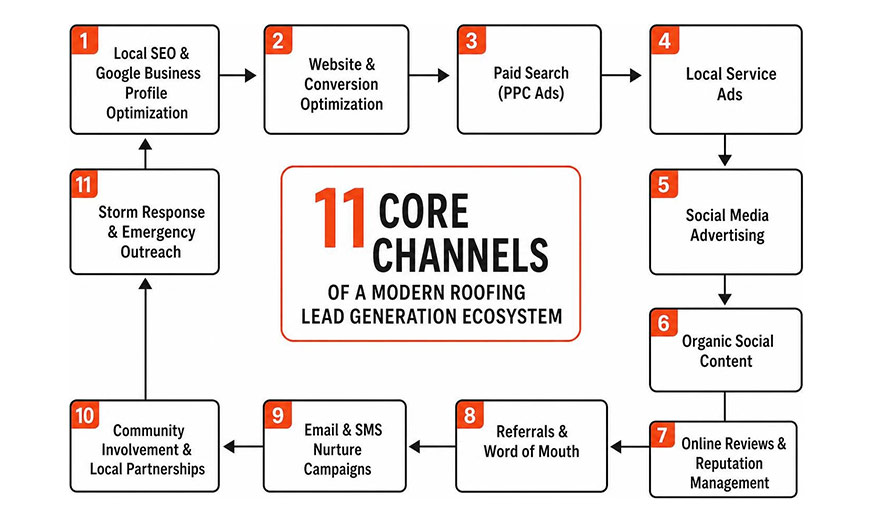
Generating a “never-ending” supply of roofing leads is not about finding one magic bullet; it is about building a balanced ecosystem. By combining fast-acting paid channels with long-term organic strategies and a disciplined CRM follow-up process, you create a pipeline that is resilient against market fluctuations. Own your digital assets, nurture your local relationships, and treat every lead with the urgency it deserves. When you execute these 11 strategies with consistency, you stop chasing work and start building a business that attracts it.