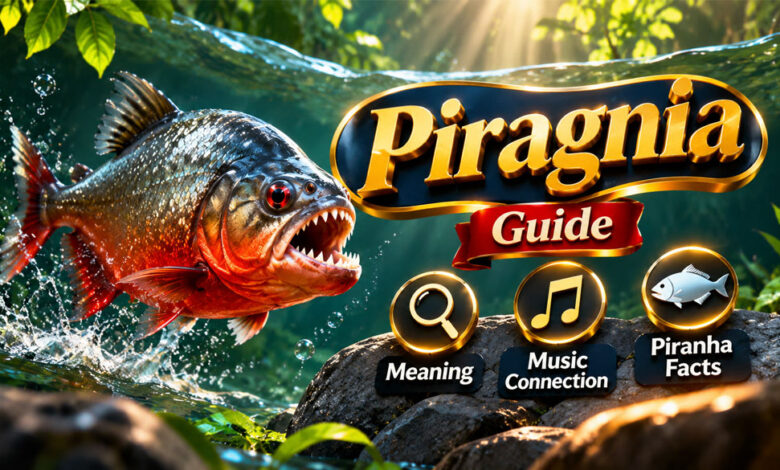

Piragnia is an uncommon term that can be confusing when it appears online. It looks similar to the word piranha, but it has also appeared in music-related contexts. There is no single accepted English definition for Piragnia.
People often search for Piragnia to find out whether it is a fish, another spelling of piranha, or a word with a different meaning. This guide explains what is known about the term, its possible music connection, and how it relates to real piranhas.
What Does Piragnia Mean?
Piragnia does not have one clear meaning in standard English. Its meaning can depend on where and how the word is being used.
One of its strongest connections is with piranha, the well-known South American freshwater fish. The spelling is similar enough that Piragnia may sometimes be used as a spelling variation or an attempt to write the word based on pronunciation.
However, this does not explain every possible use of Piragnia. The term has also appeared in a music and karaoke context. In that case, the unusual spelling could be intentional rather than a simple mistake.
Piragnia may also be used as a creative name online. An uncommon word can be chosen for a username, project, character, or other digital identity simply because it sounds or looks different.
For this reason, Piragnia should not be given one fixed definition without checking the context in which it appears.
Where Did the Word Piragnia Come From?
The exact origin of Piragnia is unclear. There is no reliable information showing who first created the term or when it was first used.
Several explanations are possible.
Piragnia may have developed from a spelling variation of piranha. People sometimes write unfamiliar words based on how they hear or remember them. Differences in pronunciation and language can also change the way a word is written.
Another possibility is that the spelling was created intentionally for music or another creative purpose.
Words used in songs, usernames, and other informal settings do not always follow standard dictionary spelling. A creator may change a word because the new form better matches local pronunciation or simply works better as a name.
These are possible explanations rather than confirmed facts. There is not enough reliable evidence to give Piragnia one proven origin.
Piragnia and Its Music Connection
Music provides an important clue about Piragnia because the term has appeared in a music and karaoke setting.
Songs often use words differently from formal writing. Artists may use local expressions, dialects, shortened words, or spellings based on pronunciation. A word that is easy to understand for local listeners may look unusual to someone from another country.
Creative spelling is also common in song titles. A writer may change the spelling of a familiar word to match the way it is pronounced or used in the song.
Piragnia may be an example of this kind of use. Its spelling could reflect a regional pronunciation or a creative choice.
However, its appearance in music does not prove that Piragnia has the same meaning everywhere. A word used as a song title can have a specific meaning in that song without becoming an accepted English word.
Is Piragnia Another Word for Piranha?
Piragnia and piranha look very similar, which is one of the main reasons the term causes confusion.
In some contexts, Piragnia may be a spelling variation, misspelling, or pronunciation-based form of piranha. However, piranha is the accepted English spelling for the freshwater fish.
Piragnia is not a recognized replacement for that spelling in standard English.
It is also important not to assume that every use of Piragnia refers to the fish. If someone uses the word as a song title, username, character name, or creative name, its meaning may depend entirely on that context.
The safest approach is to check where the word appears before deciding what it means.
Is Piragnia a Real Fish Species?
There is no reliable evidence that Piragnia is the name of a separate fish species.
It is not an established scientific genus or biological classification for a freshwater fish. Scientific information about these animals uses the standard term piranha and recognized scientific names for individual species.
This distinction matters because unusual terms can quickly spread online. If several websites repeat the same spelling, readers may assume that it represents an officially recognized animal. Repetition alone does not make a term scientifically valid.
When Piragnia is used in a wildlife context, it is more useful to check whether the writer is actually referring to piranhas rather than treating Piragnia as a newly identified animal.
Where Does the Word Piranha Come From?
The history of the word piranha is better documented than the history of Piragnia.
The name has roots in Indigenous South American languages, particularly the Tupi-Guarani linguistic tradition. It later became widely used through Portuguese and eventually entered English and other languages.
The name is commonly connected with the fish’s most noticeable feature: its sharp teeth.
This background belongs to the word piranha. It should not automatically be presented as the origin of Piragnia because there is not enough evidence to prove that the two words developed in exactly the same way.
What Are Piranhas?
Piranhas are freshwater fish native to South America. They belong to the family Serrasalmidae and the order Characiformes.
The word piranha does not describe only one species. It is a common name used for several related species. These fish can differ in size, appearance, diet, behavior, and habitat.
Important piranha genera include Pygocentrus and Serrasalmus.
A general classification is:
| Classification | Name |
|---|---|
| Kingdom | Animalia |
| Phylum | Chordata |
| Class | Actinopterygii |
| Order | Characiformes |
| Family | Serrasalmidae |
Piranhas are widely known for their teeth and strong jaws. However, different species can behave and feed differently. They should not all be treated as if they are the same fish.
What Do Piranhas Look Like?
Piranhas generally have strong, compact bodies with relatively deep sides. One of their best-known features is their powerful jaw structure.
Their teeth are sharp and usually triangular. The teeth are arranged closely together and help the fish grip and cut food.
Appearance can vary between species. The red-bellied piranha, for example, commonly has silver or gray sides with red or orange coloring around the lower part of its body. Other species can have different colors and markings.
Size also varies. For this reason, color or size alone should not be used to describe every type of piranha.
Where Do Piranhas Live?
Piranhas are native to freshwater environments in South America.
The Amazon River basin is the region most commonly associated with them, but piranhas are not limited to the Amazon. Different species are also found in other major South American river systems, including the Orinoco, Paraguay-Paraná, and São Francisco systems.
Their habitats can include rivers, streams, lakes, floodplains, and other connected freshwater areas.
Conditions can change throughout the year. During periods of flooding, water spreads into larger areas and creates new feeding and shelter locations. When water levels fall, fish may become concentrated in smaller areas.
Vegetation, underwater branches, water conditions, and available food can also affect where particular piranha species live.
What Do Piranhas Eat?
Piranhas are often shown as fish that eat only meat, but their real diets are more varied.
Some species eat other fish and aquatic animals. Their sharp teeth make it easier to cut and remove pieces of food. They may also feed on injured or dead animals when the opportunity is available.
Other piranhas have a broader diet. Depending on the species and environment, they may eat insects, crustaceans, fruits, seeds, and other plant material.
Diet can also change with age, season, habitat, and food availability.
This means that not every piranha has the same feeding habits. Some are more predatory, while others use a wider range of food sources.
How Do Piranhas Behave?
Piranhas have different behaviors depending on the species, environment, food supply, and situation. Their behavior is more complex than the aggressive image often shown in movies.
Many piranhas swim in groups called schools or shoals. This does not always mean they are preparing to attack prey. Staying in a group can help protect individual fish from larger predators.
Piranhas also interact with each other. Some species use body movements and defensive displays. Research on red-bellied piranhas has also found that they can produce sounds during certain social and aggressive situations.
Their natural predators can include larger fish, caimans, aquatic birds, and river dolphins. Schooling can help reduce the risk to an individual fish when predators are nearby.
Piranha Reproduction
Piranhas reproduce by laying eggs. The exact breeding behavior varies between species.
Some piranhas prepare or use nesting areas around aquatic plants or suitable parts of the riverbed. After eggs are laid, some species show protective behavior around the nest.
Males may guard eggs or young fish in certain species. This can make the fish more defensive when another animal or person gets too close to a nesting area.
Breeding behavior is one reason people should avoid disturbing wild piranhas, especially in areas known to contain nests.
Are Piranhas Dangerous to Humans?
Piranhas have sharp teeth and powerful jaws, so they can bite and cause injuries. However, their danger to humans is often exaggerated.
They do not automatically attack every person or animal that enters the water. Their behavior depends on the species and local conditions.
The chance of a bite may increase when water levels are low and fish become concentrated in smaller areas. Limited food and breeding activity can also affect their behavior.
People should also be careful when fishing for or handling piranhas. A captured fish may bite when it feels threatened.
Anyone swimming or fishing in areas where piranhas live should follow local safety advice. Avoid areas where authorities have issued warnings, stay away from known nesting areas, and never try to handle a wild piranha without proper knowledge and equipment.
Food waste and fish remains should also not be thrown into swimming areas because they may attract aquatic animals.
Common Myths About Piranhas
Movies, television, and dramatic stories have created several myths about piranhas. Their teeth can cause real injuries, but their normal behavior is often different from what entertainment shows.
Piranhas Attack Anything That Enters the Water
Piranhas do not attack everything that enters their habitat.
Their behavior depends on the species, food supply, water conditions, and breeding activity. A person entering water where piranhas live does not automatically cause an attack.
All Piranhas Eat Only Meat
Not every piranha has the same diet.
Some species eat fish and other animals, while others also consume insects, fruits, seeds, and plant material. Their diet can change depending on what food is available.
Piranhas Always Hunt in Groups
Seeing many piranhas together does not mean they are working together to hunt large animals.
Schooling can help protect piranhas from predators. Fish may feed near each other, but this should not automatically be viewed as an organized group attack.
Piranha Attacks on Humans Are Common
Piranha bites can happen, but frequent mass attacks on humans are not an accurate picture of their normal behavior.
Some incidents may happen when fish are defending nests or when environmental conditions bring many fish and people into the same small area.
All Piranhas Are Huge
Piranhas are not all the same size.
There are different species, and their adult size can vary. Habitat, food, age, and individual development can also affect size.
For this reason, one measurement should not be used to describe every piranha.
Piranhas and Their Role in Nature
Piranhas are a natural part of South American freshwater ecosystems.
Predatory species can help influence populations of smaller fish and other aquatic animals. Some piranhas also eat dead organisms, which helps return nutrients to the ecosystem.
Piranhas are also food for other animals. Caimans, aquatic birds, river dolphins, and other predators may feed on them.
This means piranhas are both consumers and prey within freshwater food webs. Their role is not limited to being predators.
Healthy rivers, floodplains, and other freshwater habitats are important for piranhas and the many other species living alongside them.
Why Piragnia Appears in Online Searches
Piragnia shows how an unusual spelling can develop its own presence online.
Someone may first see the word in a song, music catalogue, website, social media post, or search suggestion. Because its meaning is unclear, they search for an explanation.
As more people search for the same term, more websites may begin writing about it. Search engines can also continue showing results for an unusual spelling when enough people use it.
This does not prove that Piragnia has an official definition.
An uncommon spelling can become a searchable keyword even when its original meaning is uncertain. This is why search popularity should not be confused with scientific or linguistic recognition.
Why Online Explanations of Piragnia Differ
Online explanations of Piragnia do not always agree.
Some pages may connect it directly with piranhas. Others may describe it as a creative expression, cultural idea, digital concept, or something completely different.
The problem is that detailed explanations are not always supported by reliable evidence.
One website may publish an unsupported claim. Other websites can then rewrite the same idea. After several versions appear online, the claim can look well established even though all of them may come from the same original statement.
This is especially important with rare words like Piragnia. A confident explanation should not automatically be treated as a confirmed fact.
Readers should look for evidence showing where the term was actually used and what it meant in that specific context.
How to Understand Piragnia When You See It Online
The best way to understand Piragnia is to look at the surrounding content.
If it appears in music, check the song, artist, language, and region. The spelling may have been chosen for pronunciation or another creative reason.
If Piragnia appears in wildlife content, check whether the writer is actually talking about piranhas. Standard scientific sources use recognized common and scientific names rather than Piragnia as a separate fish classification.
The same rule applies if the word appears as a username, character, project, or brand name. A person can use an unusual word as a name without giving it a universal meaning.
Context is therefore more useful than trying to force every appearance of Piragnia into one definition.
It is also reasonable for some questions to remain unanswered. Rare terms do not always have a documented history. When reliable information is missing, it is better to say that the meaning or origin is uncertain.
What We Know About Piragnia
The available information gives us a few useful conclusions.
Piragnia is an uncommon term and is not a standard English word with one accepted definition. It has appeared in music-related contexts and has a strong spelling similarity to piranha.
In some situations, Piragnia may be a misspelling, spelling variation, pronunciation-based form, or creative version of piranha. However, there is not enough evidence to say that every use of Piragnia has the same origin.
There is also no reliable evidence that Piragnia is the scientific name of a fish, a separate species, or an established biological classification.
Its exact first use and original creator remain unclear.
Claims presenting Piragnia as an established scientific, medical, or technical term should therefore be treated carefully unless reliable evidence is provided. The same applies to claims that it is an official company, app, software platform, or technology simply because the name appears online.
Bottom Line
Piragnia is an unusual term with an uncertain origin. It is strongly connected with the spelling piranha, but it has also appeared in a music and karaoke context.
In wildlife discussions, piranha is the accepted English name for the South American freshwater fish. There is no reliable evidence that Piragnia is a separate fish species or scientific classification.
The meaning of Piragnia should therefore be understood from its context. It may be a spelling variation in one place and a creative name in another.
The real piranha is much easier to define. Piranhas are a group of South American freshwater fish with several species, varied diets, different behaviors, and an important place in their natural ecosystems.
Frequently Asked Questions
What does Piragnia mean?
Piragnia has no clear English meaning. It may be a different spelling of piranha or a creative word used in some places.
Is Piragnia another spelling of piranha?
It may be used that way sometimes. However, piranha is the correct English spelling for the fish.
Is Piragnia a real fish?
No separate fish species called Piragnia is officially recognized. The term is often connected with piranhas.
Why is Piragnia connected with music?
Piragnia has appeared in music and karaoke. The spelling may come from pronunciation or creative use, but its exact origin is unclear.
Where does the word Piragnia come from?
Its exact origin is not known. There is no reliable information showing who first used the word.
Where do piranhas live?
Piranhas live in freshwater areas of South America, including the Amazon River basin.
What do piranhas eat?
Piranhas can eat fish, insects, crustaceans, fruits, seeds, and other foods. Their diet depends on the species.
Are piranhas dangerous to humans?
Piranhas can bite and cause injuries, but serious attacks on people are not as common as movies often suggest.
785 Area Code Guide: Where It Is, Cities, and Dialing Rules
Straightforward Talk: Complete Guide to Honest and Respectful Communication