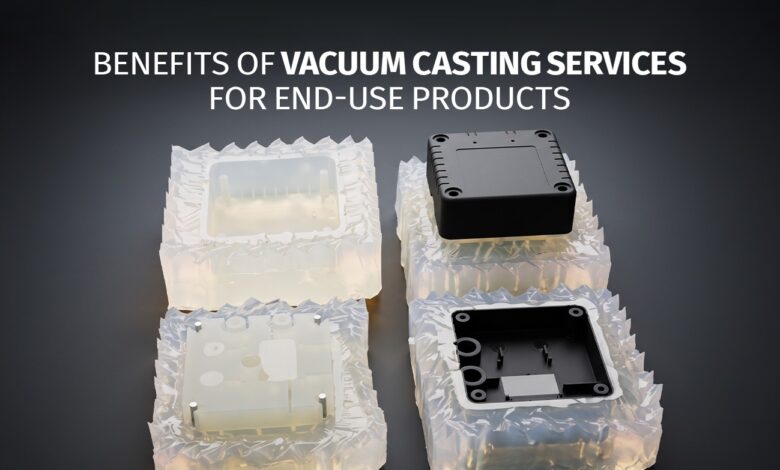

What if you could manufacture functional, production-ready parts without investing in high-cost production tooling? Moving from a prototype to a market-ready product can be challenging for product developers and manufacturers. While a design may be technically validated, producing a small batch of it using traditional manufacturing processes can involve significant tooling costs.
That’s where vacuum casting becomes valuable. The process uses silicone molds and polyurethane-based casting materials to produce accurate,detailed parts in relatively small quantities. This allows manufacturers to evaluate products, validate the market response, and meet the demand for small volumes of production without investing in expensive tools that would be idle for extended periods.
For companies considering casting services in India, understanding the process and its applications can help determine whether it is an appropriate manufacturing approach.
What is Vacuum Casting?
Vacuum casting is a moulding process in which a silicone mold is created from a master model under vacuum conditions. Liquid resin is then introduced into the mold under vacuum conditions to minimise air entrapment and reproduce the fine details of the master model.
The resulting component closely reproduces the dimensions, surface finish, textures, and geometry of the master model.
Vacuum casting does not require the expensive metal production tooling used in conventional injection molding. It is particularly well suited to low-volume production, functional prototypes, pilot production, and selected end-use applications.
Why Use Vacuum Casting for End-Use Products?
A prototype is used to evaluate the functionality of a design, whereas an end-use product must perform reliably in its intended application. When the production volumes are low and the selected casting material provides the required properties, vacuum casting can be a a suitable option.
This demonstrates that vacuum casting can extend beyond visual prototyping to support functional, low-volume product requirements.
7 Key Benefits of Vacuum Casting Services
1. Reduced Tooling Costs
The major benefit of vacuum casting is its lower tooling costs compared with injection molding.
Silicone molds can be produced without developing permanent metal tooling, making vacuum casting an economically appealing solution for small production quantities. This is especially beneficial for limited production runs, market testing, pilot production runs, and parts that could be subject to additional design changes.
2. Accurate Reproduction of Complex Details
Fine features, textures, curves, recesses, and other details of the master model can be accurately reproduced using vacuum casting.
This is particularly useful when both appearance and dimensional accuracy are important. Product properties such as ergonomics, assembly interfaces, surface texture, and component fit can be evaluated by designers before proceeding to larger-scale production.
3. Faster Production for Small Batches
Developing injection molding tooling can add considerable time to a project, especially when design changes are still expected.
For small quantities, vacuum casting can provide a faster production route, because silicone molds can be made within a relatively short period. This enables companies to produce functional parts , evaluate them, receive feedback and improve their design before manufacturing the final tool.
By incorporating vacuum casting into its prototyping and low-volume production services, Cubein supports customers to get their projects from design to production with ease.
4. Greater Material Flexibility
Different products require different material characteristics. Vacuum casting uses polyurethane-based materials available with different levels of rigidity, flexibility, transparency, or mechanical strength, depending on the application.
For example, Cubein offers a range of vacuum casting materials for vacuum casting, including nylon-filled, flame-retardant, rubber-like, transparent, PC-like, ABS-like, and PP-like materials.Selecting an appropriate material allows manufacturers to engineer parts for their intended purpose.
5. Production-Like Surface Finish
In most cases, the end-use components are required to meet both functional and visual criteria.
The surface texture of the original model can be reproduced through vacuum casting method to create a smooth and intricate, and production-like part. This is useful for product demonstrations, customer samples, field tests, photography, and limited commercial releases.
6. Easier Design Iteration
The first successful prototype does not mark the end of product development. Testing can identify issues related to dimensions, wall thickness, ergonomics, interfaces, or other elements that require modification.
As the design evolves , manufacturers can use vacuum casting to produce updated parts without immediately committing to permanent production tooling. A new mold can be made if it is necessary to make changes to the master model.
The flexibility helps to reduce the cost of tooling for permanent parts if the design is not 100% proven.
7. Practical for Market Validation
Assumptions can inform product development , but they cannot replace real-world feedback.
Manufacturers can use the vacuum-cast parts for field trials, customer evaluation, pilot launches, and market testing. By producing a small batch, companies can gather customer feedback before committing to a large production volume or permanent production tooling.
Flexible models are also gaining relevance across the wider manufacturing sector. The Wohlers Report 2025 estimates that the global additive manufacturing industry was valued at approximately $21.9 billion in 2024, with an increase of 9.1% from the previous year. The report lists continued growth in production-oriented manufacturing applications.
Vacuum Casting Services vs. Injection Molding
Neither method is universally superior; the suitability of vacuum casting or injection moulding depends on the specific production requirements. The choice depends largely on the volume of production, the amount of tooling required, the material properties, design developments, and project deadlines.
Generally, injection molding is more appropriate for high-volume production because the initial tooling can be distributed across thousands of parts. It also provides high repeatability and production efficiency when scaled up.
Where production-like parts are required but not a significant investment in tools, or where quantities are limited and designs are still being refined, the advantages of vacuum casting are greater.
For instance, if a few hundred parts are to be required for market testing, vacuum casting might be suitable, but if tens of thousands of identical parts are to be produced, then injection molding may be a better option.
When Should You Consider Vacuum Casting?
Vacuum casting is particularly effective when a product is at the stage of being more than a concept and would not require high-volume production yet.
It can be considered for:
- Low-volume and pilot production
- Functional and production-like components
- Market validation and field testing
- Products with evolving designs
- Customer and presentation samples
- Complex components that need detailed reproduction
It also allows companies to evaluate their products before committing to permanent tooling, as it is a transition step between rapid prototyping and full-scale production.
Conclusion
The benefits of vacuum casting beyond rapid prototyping. Vacuum casting is a viable option for numerous low-volume and end-use applications due to reduced tooling cost, precise detail reproduction, material versatility, quick small-lot production, quality surface finishes, and easy design changes.
The key point is the selection of the process based on the quantity, performance, maturity of design, and commercial goals of the product. With its combination of design, prototyping, and manufacturing capabilities, Cubein supports businesses looking to turn validated concepts into functional, production-ready components.
| Ready to move from prototype to production-ready parts?
|
FAQs
- What are the main benefits of vacuum casting services for end-use products?
The major benefits include lower tooling investment, excellent detail reproduction, material flexibility, fast production, and suitability for small batches.
- How do vacuum casting services vs. injection molding compare?
Vacuum casting is typically used for prototypes or low-volume production, whereas injection molding is economical for high-volume production.
- Are vacuum casting services in India suitable for functional parts?
Yes. By selecting appropriate casting materials and process parameters, vacuum casting can generate functional parts for testing, market validation, and limited production.
- How many parts can vacuum casting produce?
The practical quantity is determined by the part geometry, mold life, material, and application; however, this process is well suited for small-batch production prior to high-volume tooling.