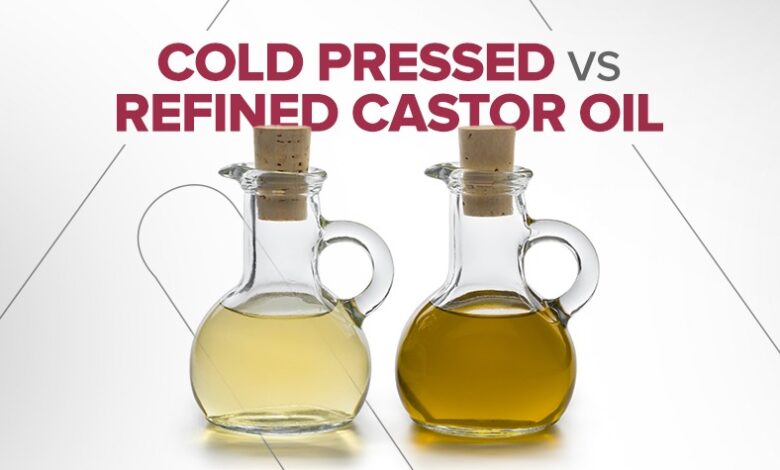

Castor oil seems to be a simple oil, a thick, pale, golden oil derived from castor seeds. However, the processing methods used for these seeds can have a big impact on the appearance, storage properties, and applications of the seed oil.
That’s why cold pressed vs refined castor oil isn’t just about “which oil is better.” The question that is useful to manufacturers, formulators and bulk buyers is which processing route is best suited to a formulation to produce the desired colour, purity and batch-to-batch consistency.
Both types are important for various applications and products, including cosmetics/personal care, pharmaceuticals, paints and inks, lubricants and other industrial formulations. Knowledge of such differences helps in making procurement more precise and helps buyers select an oil that can be expected to behave in the formulation where it is going to be used.
Understanding Cold Pressed Castor Oil: The Extraction Method
Cold pressed castor oil is simply the oil taken from castor seeds using mechanical pressure, without chemical solvents or heating. The resulting oil exhibits many of the natural properties of the seed and thus is especially useful where a more naturally processed raw material is desired.
The procedure is relatively simple: the castor seeds are cleaned, mechanically pressed, and filtered to produce cold-pressed castor oil.
The oil does not undergo extensive refining after pressing, so the oil may have more of its natural colour, odour, and other natural attributes.
This is especially relevant for manufacturers where the natural profile of castor oil is desired. It is used in areas such as:
- Cosmetics and personal care (including skin-care and hair-care formulations)
- Pharmaceutical applications
- Lubricants and selected industrial formulations
But “natural” does not automatically mean “useful in all applications.” Industrial buyers must take into account specifications like moisture, colour, suspended matter, acid value, and other quality parameters based on the intended use.
Understanding Refined Castor Oil: Processing After Extraction
Refined castor oil is castor oil that has undergone additional processing to reduce impurities and improve consistency in its physical and chemical properties. Refining may involve processes such as filtration, bleaching, and other treatments, depending on the required grade and specifications. These processes can reduce certain impurities and improve properties such as colour, clarity, and storage stability.
A simpler path is shown as follows: castor seeds, pressing, crude/commercial castor oil, refining & filtration, and finally refined castor oil
Importantly, cold pressed and refined are not necessarily mutually exclusive terms for the extraction process. Seeds can be cold-pressed and the resulting oil then refined, a combination often used to meet pharmaceutical specifications.
Cold Pressed vs Refined Castor Oil: Key Processing Differences
| Factor | Cold Pressed Castor Oil | Refined Castor Oil |
| Primary processing | Mechanical pressing | Pressing followed by refining |
| Natural characteristics | More pronounced | More controlled |
| Colour | Naturally pale to golden | Generally lighter and more uniform |
| Odour | More characteristic of natural oil | Typically milder |
| Impurities | Reduced by filtration; more natural components retained | Further reduced through refining |
| Batch-to-batch consistency | More variation expected | More repeatable and tighter |
| Best suited for | Natural, cosmetic, personal-care and selected pharmaceutical applications | Pharmaceutical, cosmetic and diverse industrial formulations |
| Buyer priority | Natural profile and processing method | Purity, consistency and application-specific specifications |
These processing differences are particularly relevant in formulations, where castor oil’s colour, odour, purity, and consistency can influence the properties of the finished product.
How Processing Impacts Performance Without Changing the Core
The chemical structure of castor oil makes it an important product, especially when it comes to its naturally high content of ricinoleic acid. This provides a range of properties that make it applicable to a wide variety of formulations.
Refining does not change the fundamental identity of castor oil. It involves additional processing to modify properties such as colour, purity, and consistency according to the required grade and specification.
Depending on the grade and applicable specifications, refined castor oil may be used in applications such as:
- Paints and varnishes
- Inks
- Rubber formulations
- Lubricant formulations
- Petroleum emulsification
- Hydraulic and brake-fluid formulations
- Pharmaceutical formulations
- Cosmetics and personal-care formulations
- Film-forming applications
Cold-pressed grades are specified where the processing method itself is part of the product claim, or where the characteristic colour and odour are acceptable or desirable. This highlights why processing method should be evaluated alongside grade, specifications, and the requirements of the intended application.
Why Grade Matters as Much as Processing
A frequent procurement error is using the words “cold pressed” or “refined” as full quality descriptions. They are not.
The buyer should also consider the grade and specification of the oil. The specifications for pharmaceuticals, for instance, may be vastly different from those for an industrial paint or rubber formulation.
For example. Ambuja Solvex offers refined castor oil (FSG/BSS), as well as pharmaceutical-grade products including virgin castor oil BP, EP, and USP/NF grades and refined castor oil in BP, EP, and JP grades.
This is where the capabilities of suppliers come into play. When sourcing cold-pressed castor oil, the following product and supply details can help buyers assess suitability for the intended application:
- Which processing method was used
- The product grade supplied
- Full quality specifications, including moisture and impurity limits
- The applications the grade is intended for
- Packaging and bulk-supply options
- Available documentation and technical data
When buying in bulk quantities, consistency is as important as the initial specification. If a product shows good performance in one production batch and not so good in another, formulation and production problems may arise.
Which One Should Manufacturers Choose?
The answer totally depends on the formulation.
Choose cold pressed castor oil when:
- A naturally processed oil is preferred.
- The application benefits from its characteristic colour and odour.
- The cosmetic or personal care formulation requires a natural ingredient.
- The appropriate castor oil grade for pharmaceutical applications depends on the required pharmacopoeial standard and product specification.
Choose refined castor oil when:
- A lighter, more uniform appearance and lower impurity levels are required.
- One of the most important factors when purchasing is consistency in every batch.
- The intended industrial application requires a defined grade and consistent specifications.
- A certain pharmacopoeial or technical parameter must be fulfilled.
The correct decision starts with the end application, not the label on the drum.
The Growing Importance of Castor Oil Globally
The significance of trusted suppliers of castor oil can be appreciated by understanding the size of the Indian castor oil trade.
According to World Bank World Integrated Trade Solution (WITS) data, India exported 701.6 million kg of castor oil and its fractions valued at US$1.04 billion in 2024. The scale of these exports highlights the importance of consistent processing, product specifications, and quality requirements in international castor oil supply.
Making the right choice by selecting a manufacturer that has the right processing capabilities, product knowledge, quality systems, and export experience can have a significant impact on long-term procurement.
Conclusion
For manufacturers, the difference between cold pressed and refined castor oil comes down to how it’s processed, its consistency, and why it’s being used for a particular purpose. Cold pressing describes how the oil is extracted, while refining refers to additional processing used to achieve specified quality and performance characteristics.
Ambuja Solvex offers cold-pressed and refined castor oils, along with pharmaceutical-grade, low-moisture, and speciality castor oil derivatives. Product selection can be based on the required grade, specifications, and intended application.
| Looking for the right castor oil grade?
Explore cold-pressed and refined castor oil from Ambuja Solvex. |
FAQs
- Is cold pressed castor oil better than refined castor oil?
Not necessarily. Cold pressing and refining describe different aspects of castor oil processing, and the appropriate option depends on the required grade, specifications, and intended application.
- Can castor oil be both cold pressed and refined?
Yes. The castor seeds can be first cold pressed and then refined and filtered to yield a cleaner and more controlled grade.
- Which castor oil is suitable for cosmetics?
Both may be used, depending on the formulation and required specifications. The choice between cold-pressed and refined castor oil can depend on factors such as processing characteristics, colour, odour, purity, and consistency.