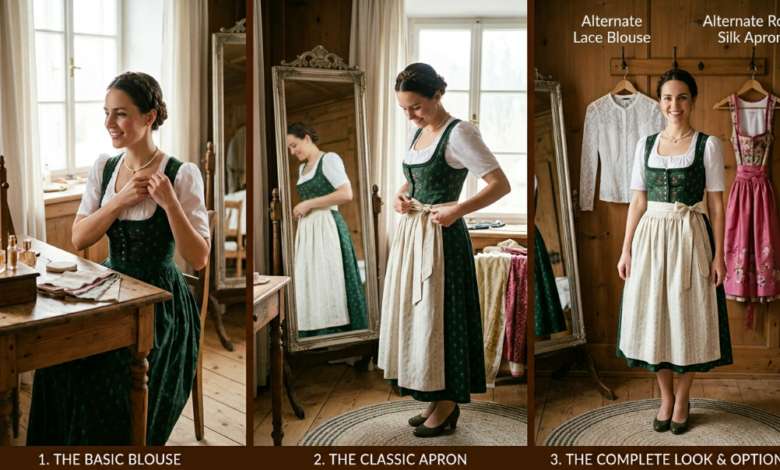

Every dirndl arrives incomplete on purpose. The dirndl blouse and the apron are separate garments by centuries-old design — the two pieces that frame the dress from above and below, carry most of its restyling power, and hold its most famous custom (the apron bow that announces relationship status to the whole festival). Bought and paired well, they make an accessible dress photograph like a premium one; skipped or substituted, they leave the most expensive dress reading unfinished. This guide covers both completing pieces in full: what each garment actually is, the neckline and color pairings that make them sing, the bow code decoded properly, the restyling system that multiplies one dress into several, and the quality screens that keep the costume tier out of the ensemble.
The Blouse: The Frame Above
The Dirndlbluse is a purpose-built garment unlike any ordinary white top: cropped to end just below the bust (secured by a band or drawstring so nothing bunches under the fitted bodice), constructed entirely around what shows — the neckline framing inside the bodice’s edge, the sleeves forming the outfit’s upper silhouette. Substitutes fail structurally: full-length shirts wrinkle through the lacing, camisoles strip the frame and sleeves, and the “built-in blouse panel” of costume dresses announces the shell tier at a glance.
The choosing vocabulary runs on necklines and sleeves. Necklines: the gathered round neck as the universal classic, square for structure, heart for romance, high-neck for heritage, off-shoulder Carmen for the contemporary party register — each echoing the bodice’s own shape and showing as a clean one-to-three-centimeter frame inside its edge. Sleeves: short puffs as the signature, lace and three-quarter versions carrying the elevated registers. Fabric holds the tradition’s line: woven cotton and cotton-lace, matte and breathable, against the scratchy synthetic lace that marks the imitation tier.
The Apron: The Statement Below
The dirndl apron is the dress’s second focal element and its restyling engine: a genuinely separate garment — waist ties long enough for a proper bow, hem sitting just above the skirt’s — whose color and fabric set the whole outfit’s mood against the dress beneath. The classic pairings are a working palette: cream over everything (the universal), rose over green (the romantic signature the photographers chase), black formalizing any dress for evening, gold and mustard warming the autumn registers, and florals grounding the vintage look over solids.
Fabric follows register: cotton for festival days, silk-touch and taffeta finishes for elevated occasions — always as real yardage with real ties, because the printed-on or tack-stitched apron is the costume tier’s single most reliable tell.
The Bow Code, Decoded Properly
The apron’s tie position is the tradition’s most famous signal, read actively at every festival: bow on the wearer’s left — single; on the right — taken; center-front — traditionally undecided (and by convention, the position of young girls); center-back — widowed, or working as a server. The code’s practical notes: it’s the wearer’s left and right, not the observer’s; the reading is genuinely live in the tents (tie deliberately, because people check); and the bow itself deserves execution — a full, even, horizontal-looped bow at the natural waist, retied when the day loosens it, since a collapsed bow undermines the signal and the silhouette together.
For first-timers, the code is the cheapest fluency in the whole outfit: one correctly tied bow reads as belonging before a word is spoken.
The Restyling System: One Dress, Many Outfits
Together, blouse and apron are why the tradition never needed a closet of dresses. The system: the dress endures while the completing pieces rotate — a second blouse changes the register (cotton round-neck for daytime, lace heart-neck for the wedding), an alternate apron changes the entire look (cream day one, rose or black day two), and both machine-wash overnight while the dress airs on its hanger. The arithmetic is the tradition’s own economy: two blouses and two aprons, at a fraction of a second dress’s cost, turn one quality dirndl into four visibly distinct outfits and carry a full multi-day festival without repetition.
The pairing discipline that keeps the system styled rather than shuffled: register matching (festival cotton with festival cotton, lace with the elevated dress) and the one-word test — name each piece’s register, and make the words agree.
The Quality Screens, Side by Side
Both pieces screen fast. The blouse: cropped purpose-cut named, woven cotton or cotton-lace fabric, finished seams, functional closures, real gathering at neckline and sleeves — roughly the modest price band the category honestly occupies, against polyester-lace shells beneath it. The apron: separate garment confirmed (the non-negotiable), fabric named and substantial, ties long enough to bow properly at the natural waist, hem depth finished — with the printed-apron and stitched-on tiers disqualified on sight.
The shared timing rule: both pieces sell through in popular sizes and colorways alongside everything else as festival season opens — the one-cart early order (dress, blouse, apron together) is how the ensemble arrives paired, fitted and photograph-ready before the first tent.
Frequently Asked Questions
Is a special dirndl blouse really necessary?
Structurally yes — the cropped Dirndlbluse frames the neckline and sleeves without bunching; ordinary tops and built-in panels read unfinished instantly.
Which blouse neckline should I choose first?
The gathered round neck — universally correct, broadly flattering, and matched to every bodice shape; add lace or heart necklines as registers call.
What does the apron bow position mean?
Wearer’s left single, right taken, center-front undecided, center-back widowed or serving — read actively at every festival, so tie deliberately.
What are the classic apron color pairings?
Cream over everything, rose over green for the romantic signature, black to formalize, gold for autumn, florals for vintage over solids.
How do blouse and apron multiply one dress?
Rotation: second blouse shifts register, alternate apron shifts the whole look — two of each turn one dirndl into four outfits.
How do I spot costume-tier versions?
Built-in blouse panels, printed or tack-stitched aprons, synthetic lace and short ties — against separate, woven, properly tied real garments.