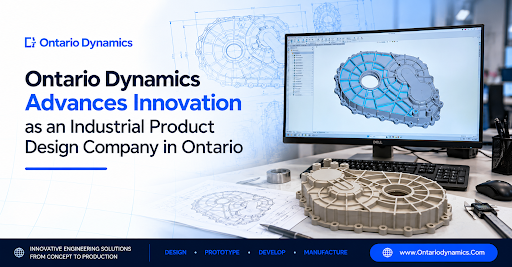
Ontario Dynamics Advances Innovation as an Industrial Product Design Company in Ontario

Toronto-based engineering company highlights integrated product development, mechanical design, prototyping, and specialized equipment engineering capabilities supporting modern manufacturing requirements.
TORONTO, Ontario, Canada — October 30, 2026 — Ontario Dynamics, a Toronto-based engineering and product development company, highlights its capabilities as an Industrial Product Design Company in Ontario, supporting manufacturers, original equipment manufacturers (OEMs), and industrial businesses in transforming technical concepts into functional, production-ready products. Through integrated engineering, mechanical design, prototyping, and product validation, the company addresses the growing demand for practical and reliable industrial product development solutions.
Modern manufacturers face increasing challenges involving product complexity, performance expectations, production efficiency, and manufacturing costs. Developing successful industrial products requires more than creating a functional design. Engineering teams must consider material properties, structural integrity, assembly requirements, operational safety, and long-term reliability throughout development.
By combining technical analysis with practical engineering expertise, industrial product development helps businesses identify design limitations early, refine product functionality, and prepare components for manufacturing.
Engineering Expertise of an Industrial Product Design Company in Ontario
Industrial product design involves transforming initial concepts into engineered solutions capable of meeting specific operational and manufacturing requirements. This process integrates mechanical engineering, technical evaluation, design optimization, and production planning.
Unlike conventional design approaches focused primarily on appearance or basic functionality, industrial engineering considers how a product operates under actual working conditions.
Engineering teams evaluate mechanical loads, movement, environmental exposure, component interaction, material selection, and maintenance requirements before finalizing product designs.
Effective Product Design and Development also requires coordination between design engineers, manufacturers, component suppliers, and testing specialists. This collaboration helps establish realistic engineering specifications and reduces uncertainty during fabrication and assembly.
A structured approach allows manufacturers to evaluate potential design challenges before committing substantial resources to production tooling or large-scale manufacturing.
Comprehensive Product Development From Concept to Production
Successful industrial product development begins with clearly defined objectives, functional requirements, and technical constraints.
Manufacturers must establish what a product needs to accomplish, how the product will operate, and which engineering considerations influence performance and production feasibility.
Professional Product Development Services support this process through concept evaluation, feasibility studies, detailed engineering, prototyping, and manufacturing preparation.
Concept Development and Engineering Analysis
During the initial development stage, engineers analyze product objectives, mechanical requirements, available technologies, and anticipated manufacturing conditions.
Conceptual sketches, preliminary calculations, and design evaluations help determine whether proposed solutions are technically practical.
Working with an experienced Industrial Product Design Company in Ontario allows manufacturers to connect concept creation with structured engineering development and prototype evaluation.
Early analysis also helps identify potential challenges involving component integration, dimensional constraints, mechanical performance, and production costs.
Prototyping and Design Refinement
Prototyping provides an opportunity to evaluate product concepts before final manufacturing decisions.
Physical prototypes allow engineers to examine component fit, assembly procedures, mechanical movement, ergonomics, and functional performance.
Prototype evaluation may reveal unexpected interference, structural limitations, or manufacturing complications requiring design adjustments.
Through controlled design revisions, engineering teams can improve functionality, refine component configurations, and reduce potential problems during subsequent production stages.
CAD Modeling and Mechanical Design Optimization
Computer-aided design (CAD) plays an important role in modern industrial engineering by enabling accurate development and evaluation of mechanical components.
Three-dimensional models provide detailed representations of product geometry, assemblies, dimensions, and mechanical interfaces.
CAD modeling supports engineering collaboration by allowing design changes to be reviewed before physical components are manufactured.
Material Selection and Structural Engineering
Choosing appropriate materials is essential for achieving reliable product performance.
Engineers evaluate material strength, weight, corrosion resistance, wear characteristics, manufacturing compatibility, and expected operating conditions.
Material decisions also influence fabrication processes, production expenses, and long-term maintenance requirements.
Specialized Mechanical Engineering Services support structural analysis, component optimization, tolerance evaluation, and engineering documentation.
Where appropriate, simulation methods such as finite element analysis can help assess stress distribution, deformation, and potential structural weaknesses.
These evaluations support better-informed design decisions before manufacturing begins.
Designing for Manufacturability
Design for Manufacturing (DFM) helps ensure that engineered products can be manufactured using practical production methods.
Engineers consider machining accessibility, material availability, achievable tolerances, component complexity, and assembly requirements.
Design for Assembly (DFA) further examines how components fit together during manufacturing.
Integrating these considerations into Product Design and Development can reduce unnecessary complexity, improve assembly consistency, and support more efficient production planning.
Product Testing and Validation for Reliable Performance
Testing and validation are essential for determining whether industrial products meet established engineering and functional requirements.
A product may perform successfully during initial operation but encounter unexpected challenges when exposed to repeated loads, vibration, temperature variations, or prolonged use.
Engineering validation helps identify such limitations before broader manufacturing or deployment.
Functional and Durability Testing
Functional testing evaluates whether a product operates according to defined technical specifications.
Durability testing examines how mechanical components respond to repeated operation, loading conditions, and anticipated service environments.
Depending on the application, validation procedures may involve force measurement, vibration assessment, fatigue testing, displacement monitoring, and operational cycle testing.
Collected performance data allows engineers to compare results against established acceptance criteria.
These findings support modifications involving material selection, component geometry, mechanical connections, or overall design architecture.
Improving Safety and Product Consistency
Industrial products must satisfy applicable safety expectations and operate consistently under intended conditions.
Testing procedures help engineers evaluate mechanical stability, component reliability, and potential operational hazards.
Identifying weaknesses during development can reduce the likelihood of unexpected failures and costly manufacturing revisions.
Documented validation procedures also establish measurable evidence supporting engineering decisions and product improvement activities.
Customized Engineering Solutions for Industrial Applications
Different manufacturing industries require products designed around distinct operating conditions, technical specifications, and production environments.
Standardized designs may not adequately address specialized equipment requirements, mechanical constraints, or unique production challenges.
Customized engineering provides greater flexibility by adapting product configurations to specific applications.
Automotive and Mechanical Engineering
Automotive applications frequently require precision-engineered components capable of handling mechanical loads, vibration, movement, and extended operating cycles.
Engineering development may involve powertrain components, mechanical assemblies, testing fixtures, and specialized automotive equipment.
Industrial machinery applications often focus on structural frames, mechanical mechanisms, rotating equipment, automated assemblies, and machine integration.
Professional Mechanical Engineering Services help address these requirements through detailed component design, technical analysis, manufacturing drawings, and mechanical system development.
Specialized Equipment and Manufacturing Systems
Manufacturing facilities may require purpose-built equipment to support assembly, inspection, product testing, or automated production processes.
Custom machinery development involves mechanical architecture, fixture design, operating sequences, equipment accessibility, and integration with existing production systems.
These solutions can help manufacturers address operational limitations and improve process consistency.
Integrating Design, Prototyping, and Manufacturing Readiness
Industrial product development becomes more effective when engineering design, prototyping, validation, and manufacturing preparation operate within a coordinated process.
Separating these activities can create communication gaps, inconsistent specifications, and avoidable design revisions.
Integrated Product Development Services allow engineering teams to review manufacturability and testing requirements alongside ongoing design decisions.
This approach supports better coordination between conceptual planning and practical manufacturing execution.
Engineering documentation, including technical drawings, material specifications, bills of materials, and assembly instructions, provides essential information for component sourcing and fabrication.
Clearly defined tolerances and mechanical interfaces also help suppliers understand critical production requirements.
A coordinated development process can improve technical communication, support efficient prototype revisions, and establish a more reliable transition into manufacturing.
About Ontario Dynamics
Ontario Dynamics is a Toronto-based engineering company specializing in product development, mechanical design, industrial equipment engineering, automation, and testing solutions.
The company provides engineering support for manufacturers, OEMs, and businesses developing mechanical products, specialized machinery, and industrial systems.
Its capabilities include concept development, CAD modeling, prototyping, design optimization, technical documentation, equipment development, and engineering validation.
Supporting the Future of Industrial Product Innovation
As manufacturing requirements continue to evolve, innovative engineering approaches remain important for developing durable, efficient, and production-ready industrial products.
Integrating mechanical engineering, product validation, manufacturability analysis, and specialized equipment design helps manufacturers address technical challenges while supporting long-term product performance.
Working with an experienced Industrial Product Design Company in Ontario can support the development of practical manufacturing solutions through coordinated mechanical engineering, equipment design, and product development expertise.
The continued emphasis on engineering quality, reliable performance, and manufacturing readiness reinforces the importance of structured industrial product design in modern manufacturing.