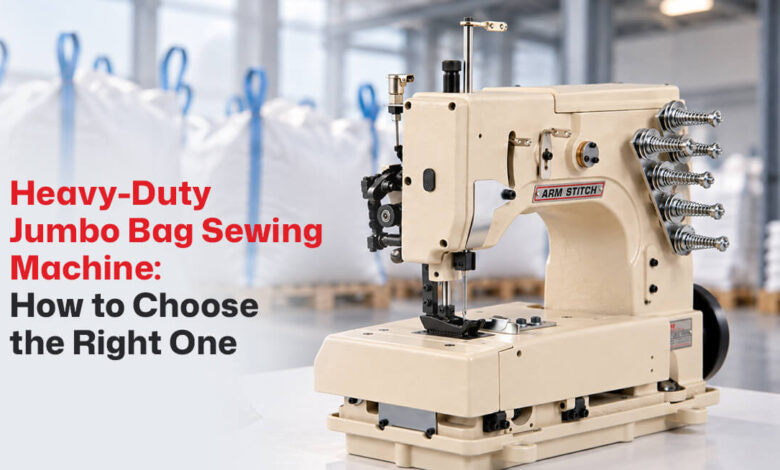

Choosing the right heavy-duty jumbo bag sewing machine comes down to five things: the fabric you use, the seam you need to produce, the machine’s sewing capacity, its practical working speed and the type of feeding system it uses. The right combination will depend on your FIBC design and production requirements.
It is tempting to compare machines by RPM or price alone. In practice, a machine that handles your material consistently and produces the required seam can be far more valuable than one with a higher headline speed.
Why jumbo bag sewing needs specialised equipment
FIBCs, commonly called jumbo bags or big bags, are used to transport bulk quantities of materials across industries such as chemicals, agriculture, food, minerals and construction.
Their construction can involve several sewing operations. Depending on the bag design, these may include body seams, top and bottom panels, filling and discharge spouts, baffles and reinforced sections.
The fabric itself can also be demanding. Woven polypropylene is widely used, while different fabric weights, coatings and multiple layers can change how the material behaves during sewing.
This is why a machine needs to be selected around the actual bag construction.
The current ISO 21898:2024 standard covers materials, construction, design, type testing and marking for FIBCs intended for non-dangerous solid materials. It also includes guidance on their selection and safe use.
What to consider when choosing a heavy-duty jumbo bag sewing machine
1. Start with your fabric and seam
Before looking at machine speed, establish what the machine needs to sew.
Consider the fabric’s weight and construction, the number of layers at the seam and whether the material is coated. A machine designed for one operation may not be suitable for another, even when both are marketed for FIBC production.
For instance, Arm Stitch’s AS 602 UHR is specified for overlock stitching on container bags in the 180–350 GSM range, while its AS 603 DR is intended for safety stitching and attaching filling and discharge panels on 150–200 GSM container-bag material.
The lesson is simple: choose against the actual sewing operation, not the product category alone.
2. Look at sewing capacity
Sewing capacity tells you how much material the machine is designed to handle at the seam.
Arm Stitch lists the AS 602 UHR with a sewing capacity of up to 15 mm, while its AS 602 HR is specified at up to 12 mm.
These figures are model-specific specifications, not universal FIBC requirements.
Your own seam construction should therefore determine the capacity you need. If the machine will regularly sew several layers or heavier sections, leave enough headroom rather than selecting a machine that only just meets the requirement.
3. Treat speed as a working specification
Maximum RPM is useful when comparing machines, but it does not tell the whole story.
Arm Stitch’s AS 602 UHR is specified at approximately 1,600 RPM, while the AS 602 HR is listed at approximately 1,800 RPM.
This difference between maximum and working speed is worth paying attention to.
For production planning, ask what speed the machine can maintain with your material and seam, rather than using the highest RPM in the brochure as your expected output.
4. Check the feeding system
Thick or layered fabric needs controlled movement through the sewing area. Poor feeding can lead to slipping, bunching or inconsistent seams.
Some FIBC machines use feeding arrangements on both the upper and lower sides. Arm Stitch’s AS 602 UHR, for example, uses feed dogs on both upper and lower sides, while its AS 602 HR uses a bottom single-feed arrangement.
If your production involves several fabric weights or difficult multi-layer seams, feeding should be part of the machine evaluation, not an afterthought.
5. Make sure the stitch configuration fits the bag
There is no single stitch arrangement for every part of an FIBC.
Depending on the construction, you may require chain stitching, overlock stitching, safety stitching or specialised configurations for spouts and other components.
For example, Arm Stitch’s AS 802 VMC uses two needles and four threads for double-row chain stitching and is designed for attaching spouts and skirts, with or without filler cord. The machine is specified for material up to 8 mm thick.
Before choosing a machine, identify:
- Stitch type
- Stitch length
- Number of needles and threads
- Seam width
- Number of fabric layers
- Filler-cord requirements
- Components to be sewn
This helps you select a machine for the actual job rather than trying to make one machine cover operations it was never designed for.
Heavy-duty jumbo bag sewing machine: key features compared
| Factor | Why it matters | What to check |
| Fabric | Determines feeding and needle penetration | Material, GSM, coating and layers |
| Sewing capacity | Indicates the thickness the machine is designed to handle | Compare with your thickest seam |
| Working speed | Gives a more realistic production picture than maximum RPM | Ask for speed on your material |
| Feeding system | Affects control and seam consistency | Upper/lower or single feed |
| Stitch configuration | Determines which bag components can be sewn | Stitch type, needles and threads |
| Filler cord | Required for certain reinforced constructions | Top, bottom or both |
| Service support | Affects uptime after installation | Spare parts, maintenance and technical support |
Don’t skip the machine trial
A specification sheet is a useful starting point. It should not be the final test.
Take your actual fabric, thread and seam construction to the supplier whenever a trial is possible. Run the machine on the part of the bag that is most difficult to sew and examine the result.
Look for consistent stitches, smooth feeding, suitable thread tension and clean seam formation. Ask about the recommended working speed for that material too.
It is also worth watching how easily the operator can thread, adjust and control the machine. Small practical issues can become significant when equipment is used throughout a production shift.
A practical buying checklist
Before finalising the machine, confirm:
- Fabric type and GSM
- Number of layers
- Seam construction
- Stitch type and length
- Sewing capacity
- Working speed
- Feeding arrangement
- Filler-cord compatibility
- Motor and power requirements
- Lubrication system
- Needle and spare-part availability
- Operator training
- Local service and technical support
Choose the machine around the bag
The best heavy-duty jumbo bag sewing machine is the one that fits your production process.
Speed matters, but it sits alongside fabric compatibility, sewing capacity, feeding performance, stitch configuration and service support. Arm Stitch’s own machine specifications show how these parameters can vary across different FIBC sewing applications.
For that reason, the buying decision should begin with your bag construction and work backwards to the machine specification.
That approach makes comparisons more meaningful and reduces the risk of choosing equipment that looks suitable on paper but struggles with the actual job.
FAQs
1. What is a heavy-duty jumbo bag sewing machine?
It is an industrial sewing machine designed for the woven fabrics and reinforced seams used in FIBC or jumbo bag production. Different configurations are available for operations such as body seams, spouts, panels and other components.
2. What materials can these machines sew?
Many FIBC machines are designed for woven polypropylene and can handle different fabric weights depending on their configuration. Always check the manufacturer’s stated material range and sewing capacity before purchase.
3. Is maximum RPM a good measure of productivity?
It is one factor, but it should not be used alone. Maximum speed and working speed can differ, and actual output also depends on the material, seam construction, stitch quality, feeding and machine downtime.
4. What should I test before buying an FIBC sewing machine?
Use your actual fabric, thread and seam construction wherever possible. Check stitch consistency, feeding, seam quality and working speed. It is also important to discuss maintenance, spare parts, operator training and after-sales technical support.