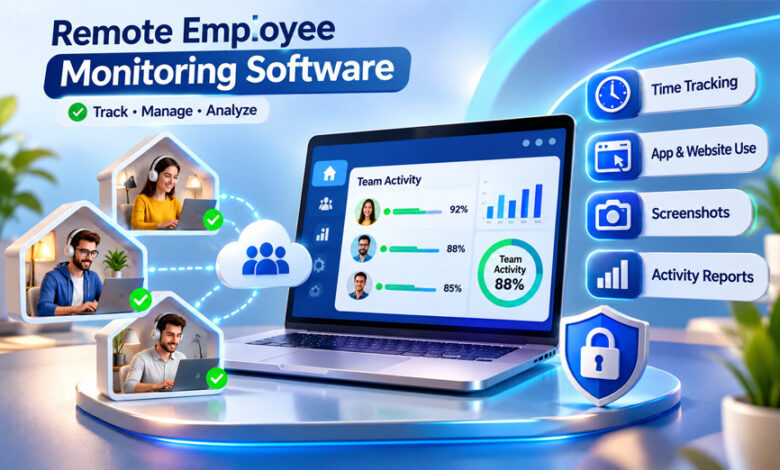

Remote employee monitoring software helps companies see how remote workers spend their work time. It can track work hours, apps, websites, tasks, activity, and other work details.
Companies use these tools to manage remote and hybrid teams, check project progress, and keep work records. This guide explains how remote employee monitoring software works, its main features, benefits, costs, privacy concerns, and legal issues.
What Is Remote Employee Monitoring Software?
Remote employee monitoring software is a tool that helps companies track work-related activity. It is mainly used for employees who work from home or other locations.
The software can show how long an employee works and how much time they spend on projects or tasks. Some tools can also track apps, websites, breaks, screenshots, and computer activity.
Remote employee monitoring software is not one single product. Many companies offer these tools with different features and prices.
Basic tools may only track working hours and projects. More advanced tools may include screenshots, live screen viewing, GPS tracking, security alerts, and detailed reports.
Employee monitoring is also different from basic time tracking. Time tracking mainly records working hours. Monitoring software can provide more details about what happens during those hours.
How Does Remote Employee Monitoring Software Work?
Remote employee monitoring software usually runs on an employee’s computer or another supported device.
Some tools require employees to start and stop a timer. Other tools can automatically track activity during working hours.
The software collects information based on the settings chosen by the company. This may include work hours, apps, websites, tasks, screenshots, and active or idle time.
The information is then shown on a dashboard. Managers can use this dashboard to check working hours, attendance, projects, and activity reports.
Some tools also provide live information. For example, managers may be able to see who is active, idle, or offline.
Companies can choose how much information they want to track. One company may only track working hours, while another may also use screenshots and app tracking.
What Can Remote Employee Monitoring Software Track?
The information collected depends on the software and its settings.
Most tools can track when employees start and finish work. They may also show how much time is spent on different projects or tasks.
Some tools can track the apps and websites used during working hours. This can help managers understand how work time is being used.
Employee monitoring software may also measure keyboard and mouse activity. This is often used to show active and idle periods.
However, measuring keyboard activity is not the same as recording what someone types. Some advanced monitoring tools can record actual keystrokes, but many do not.
Other possible features include screenshots, live screen viewing, attendance tracking, breaks, GPS location, and screen recording.
Companies should check exactly what information a tool collects before using it.
Main Features of Remote Employee Monitoring Software
Remote monitoring tools can offer many different features. A company does not need to use every feature. It should choose the ones that match its needs.
Time Tracking
Time tracking shows how long an employee works.
It can also show how much time is spent on different projects, tasks, or clients.
These records can help with timesheets, payroll, project planning, and client billing.
App and Website Tracking
This feature shows which apps and websites employees use during work hours.
For example, managers may see time spent on a project management tool, browser, design software, or communication app.
Some tools label apps and websites as productive or unproductive. These labels should be used carefully because the same website may be useful for one job but not another.
Activity and Idle Time Monitoring
Activity monitoring can measure keyboard and mouse activity.
It may show when an employee is active and when the computer has been idle for some time.
However, low activity does not always mean someone is not working. An employee could be reading, planning, researching, or attending a meeting.
Activity scores should not be the only way to judge someone’s work.
Screenshots and Screen Monitoring
Some monitoring tools take screenshots during working hours.
Screenshots may be taken at set times or randomly. Managers can use them to understand what was happening during tracked work time.
More advanced software may also offer live screen viewing or screen recording.
These features can collect sensitive information. A screenshot could capture a password, private message, customer information, or personal details.
Attendance and Break Tracking
Attendance tracking records when employees start and finish work.
It can also record breaks and periods when employees are away from their computers.
This can help companies manage remote teams working in different places or time zones.
However, working for more hours does not always mean someone is doing better work.
Productivity Reports and Analytics
Monitoring software can turn collected information into simple reports.
Reports may show working hours, activity, project time, app use, and attendance.
Companies can use these reports to understand work patterns and find possible problems.
For example, a report may show that one task takes much longer than expected.
Managers should still review the situation before making decisions. Software data does not always explain why something happened.
Alerts and Notifications
Some tools can send alerts when certain events happen.
These alerts may cover attendance, unusual activity, security problems, or other work events.
Alerts can help managers notice important problems quickly. However, too many alerts can become difficult to manage.
GPS and Location Tracking
Some employee monitoring tools can track location through GPS.
This can be useful for employees who travel, visit customers, make deliveries, or work at different job sites.
Some platforms also offer geofencing. This can connect work time or attendance with a certain location.
GPS tracking may not be useful for employees who only work from home. Location information is also sensitive, so companies should use this feature carefully.
Project, Payroll, and Billing Tools
Some monitoring platforms also include project and payment tools.
Employees may choose a project or task before starting their timer. Managers can then see how much time was spent on each project.
Some platforms also offer payroll and invoicing features. These can help companies calculate payments or prepare client bills.
Not every monitoring tool includes these features.
Integrations
Some remote employee monitoring tools can connect with other business software.
This may include project management, communication, payroll, accounting, and task management tools.
Integrations can make it easier to use work data across different systems.
The available integrations depend on the monitoring platform.
Who Uses Remote Employee Monitoring Software?
Many types of companies use remote employee monitoring software.
Technology and software companies may use it to track project time and tasks. Marketing agencies and consulting companies may use it to record billable hours.
BPO companies, call centers, and customer support teams may use monitoring software to manage remote workers and attendance.
Finance, accounting, and some healthcare organizations may also use monitoring tools. These companies need to be especially careful when dealing with private or sensitive information.
Businesses with field workers may use mobile and GPS features to manage employees working at different locations.
The right level of monitoring depends on the company. A small remote team may only need time tracking, while another company may need stronger security tools.
Why Do Companies Monitor Remote Employees?
One reason is to understand how work time is being used.
Managers may not be able to see remote employees working in person. Time and project tracking can provide useful work records.
Companies can also use the information for project planning. Knowing how long tasks normally take can help managers plan future projects.
Some companies use tracked hours for client billing or payroll.
Security is another reason. Advanced tools may help companies notice unusual activity involving company systems or information.
Monitoring reports can also help find workflow problems. For example, they may show that a certain task takes too much time.
However, companies should have a clear reason for monitoring. Collecting unnecessary employee information can create privacy and trust problems.
Benefits of Remote Employee Monitoring Software
One benefit is better work visibility. Managers can see work hours, project time, and other useful information.
Time records can also help with payroll, client billing, project planning, and workload management.
Reports may help companies find slow processes or other workflow problems.
Monitoring can also improve accountability by keeping clear records of working time and project activity.
Security-focused tools may help identify unusual activity involving company systems or data.
However, these benefits are not guaranteed. Simply installing monitoring software does not automatically improve productivity or work quality.
Drawbacks and Limitations
Employee privacy is one of the biggest concerns.
Screenshots, browsing records, GPS information, and screen recordings can collect sensitive information.
Monitoring may also hurt employee trust if workers do not understand what is being tracked or why.
Activity information can sometimes be misleading. Low keyboard or mouse activity does not always mean an employee is not working.
Monitoring software also costs money. Managers need time to check reports, manage settings, and solve problems.
Technical problems may also happen. The software could record time incorrectly or have problems working on certain devices.
Monitoring data should help managers make decisions. It should not replace normal communication and human judgment.
Remote Employee Monitoring Software Pricing
There is no fixed price for remote employee monitoring software.
Many platforms charge a monthly fee for each user. Annual plans may cost less per month. Large companies may also receive custom enterprise pricing.
The sources we reviewed gave starting prices from around $4 to $15 per user per month for several products. These are only examples, and prices can change.
The final cost depends on the number of users, features, reports, integrations, security tools, and billing period.
Businesses should compare what each plan includes instead of choosing only the cheapest option.
Free vs. Paid Monitoring Software
Some monitoring platforms offer free plans. Others only offer a free trial.
Free tools can be useful for small teams that mainly need basic time and project tracking.
Paid plans may include screenshots, detailed reports, advanced analytics, payroll, invoicing, security tools, and other features.
Free plans may also limit users or features.
Companies should first decide what they actually need. A small team may be fine with a free plan, while a larger company may need paid features.
Supported Devices and Platforms
Device support is different for each monitoring platform.
Many tools work on Windows and macOS computers. Linux support may be available on some platforms.
Some monitoring companies also offer Android and iOS apps. These can be useful for field workers or employees who travel.
Features can also be different between desktop and mobile versions. For example, a mobile app may provide GPS tracking, while detailed activity monitoring may only work on a computer.
Companies should check supported devices and system requirements before choosing a platform.
Privacy and Employee Trust
Privacy is an important part of employee monitoring.
Employees should know what information is being collected and why the company needs it.
For example, a company that only needs work hours may not need to collect screenshots or location information.
Personal devices need extra care. Monitoring software could accidentally collect information that has nothing to do with work.
Companies should clearly explain what is tracked before monitoring begins. Employees should also be able to ask questions or raise concerns.
Clear and limited monitoring can help protect trust between employees and managers.
Is Remote Employee Monitoring Software Safe?
Remote employee monitoring software can be safe when it is used properly.
However, these tools can collect sensitive information. Screenshots may contain passwords, customer details, private messages, or financial information.
Companies should protect monitoring records and limit who can access them.
Management accounts should also use strong passwords and secure login methods.
Before choosing a provider, businesses should check how monitoring information is stored, protected, and deleted.
Monitoring software may help identify security problems, but it should not replace other cybersecurity tools.
Is Remote Employee Monitoring Legal?
Employee monitoring laws are different around the world.
The rules can depend on the country, state, industry, type of monitoring, and device being used.
Some places may require companies to tell employees before monitoring starts. Consent or other privacy rules may also apply.
Companies should be especially careful with keystroke logging, screen recording, GPS tracking, audio or video recording, and hidden monitoring.
Monitoring personal devices can create additional privacy and legal concerns.
Companies with workers in different countries may need to follow different rules for different employees.
Businesses should check the laws that apply to them. Legal advice may also be useful before using more detailed monitoring methods.
How to Choose Remote Employee Monitoring Software
First, decide what the company needs to track.
A business that only needs timesheets may not need screenshots or screen recording. A company with field workers may need GPS and mobile support.
Check whether the software works with the devices employees use.
Also look at reports, integrations, security, privacy controls, customer support, and pricing.
Companies should check whether sensitive monitoring features can be turned off.
The cheapest tool is not always the best choice. A company should choose software that provides the features it needs without collecting unnecessary information.
Popular Types of Remote Monitoring Tools
Remote monitoring tools have different purposes.
Some mainly track time. Others focus on productivity, workforce analytics, GPS tracking, or security.
Apploye offers time tracking, screenshots, activity monitoring, project management, and billing tools.
Hubstaff combines time tracking with activity and location features. Its GPS tools can be useful for field workers.
Time Doctor offers time tracking, screenshots, app and website tracking, and productivity reports.
ActivTrak focuses more on workforce analytics and work patterns.
Teramind provides advanced security features such as screen recording, behavior alerts, and keystroke monitoring. These features may be more useful for companies with strict security needs.
Insightful focuses on workforce analytics and helps businesses understand work patterns and possible workflow problems.
Clockify mainly focuses on time and project tracking. It also offers paid monitoring features.
PeopleGoal is different from traditional monitoring software. It focuses more on goals, employee reviews, feedback, and development rather than screenshots or computer activity tracking.
There is no single best option for every company. The right choice depends on team size, budget, work type, and monitoring needs.
How to Introduce Employee Monitoring to a Remote Team
Companies should first decide why monitoring is needed.
They should then create a clear monitoring policy. Employees should know what is tracked, when tracking happens, why the information is collected, and who can see it.
It can also help to explain what is not being monitored.
Employees may need training on timers, projects, mobile apps, or other software features.
Companies should also allow workers to ask questions and give feedback.
It is usually better to use only the monitoring features the company actually needs.
Monitoring settings should also be reviewed over time. A feature that was useful before may no longer be necessary.
Best Practices for Remote Employee Monitoring
Use monitoring software for a clear business reason.
Where possible, only monitor employees during working hours. Avoid collecting personal information that the company does not need.
Do not judge employees only by keyboard or mouse activity. These numbers do not show the full quality of someone’s work.
Limit access to monitoring information. Only approved people should be able to see sensitive records.
Keep the collected data secure and do not store it longer than necessary.
Take extra care when using screenshots, GPS tracking, screen recording, or keystroke logging.
Companies should also review their monitoring rules when laws or working arrangements change.
Most importantly, use monitoring software together with normal communication. Software reports should help managers understand work, not replace conversations with employees.
Bottom Line
Remote employee monitoring software helps businesses understand how remote work time is being used. It can track hours, projects, apps, websites, attendance, activity, screenshots, and other work information.
These tools can help with project management, billing, work visibility, reporting, and some security needs. However, they can also create privacy, trust, security, and legal concerns.
Companies should only collect the information they really need. Employees should understand what is being monitored and why.
Frequently Asked Questions
What is remote employee monitoring software?
It is software that helps companies track work hours and other work-related activity of remote employees.
How does remote employee monitoring software work?
It collects selected work information from an employee’s device and shows it in a dashboard for approved managers.
What can employers track on remote workers?
Depending on the software, employers may track work hours, apps, websites, activity, screenshots, projects, attendance, and location.
Can employee monitoring software record keystrokes?
Some advanced tools can record keystrokes. Other tools only measure keyboard activity without recording what employees type.
Is remote employee monitoring software legal?
It can be legal, but the rules depend on the country, state, industry, and type of monitoring being used.
Can remote monitoring software see an employee’s screen?
Yes, some tools can take screenshots. Certain advanced platforms can also provide live viewing or screen recording.
Does employee monitoring software improve productivity?
It can provide useful work information, but it does not guarantee better productivity.
Should employees be told they are being monitored?
Employees should clearly understand what is being tracked and why. Local laws may also require notice or consent in some cases.
Startup Booted: What It Is, Services, Pricing, and Funding Strategy